AI found a pattern in cancer data that people had stared at for years. It matters because machines are good at spotting weak signals across messy records...
AI Finds a Cancer Signal Researchers Missed for Years
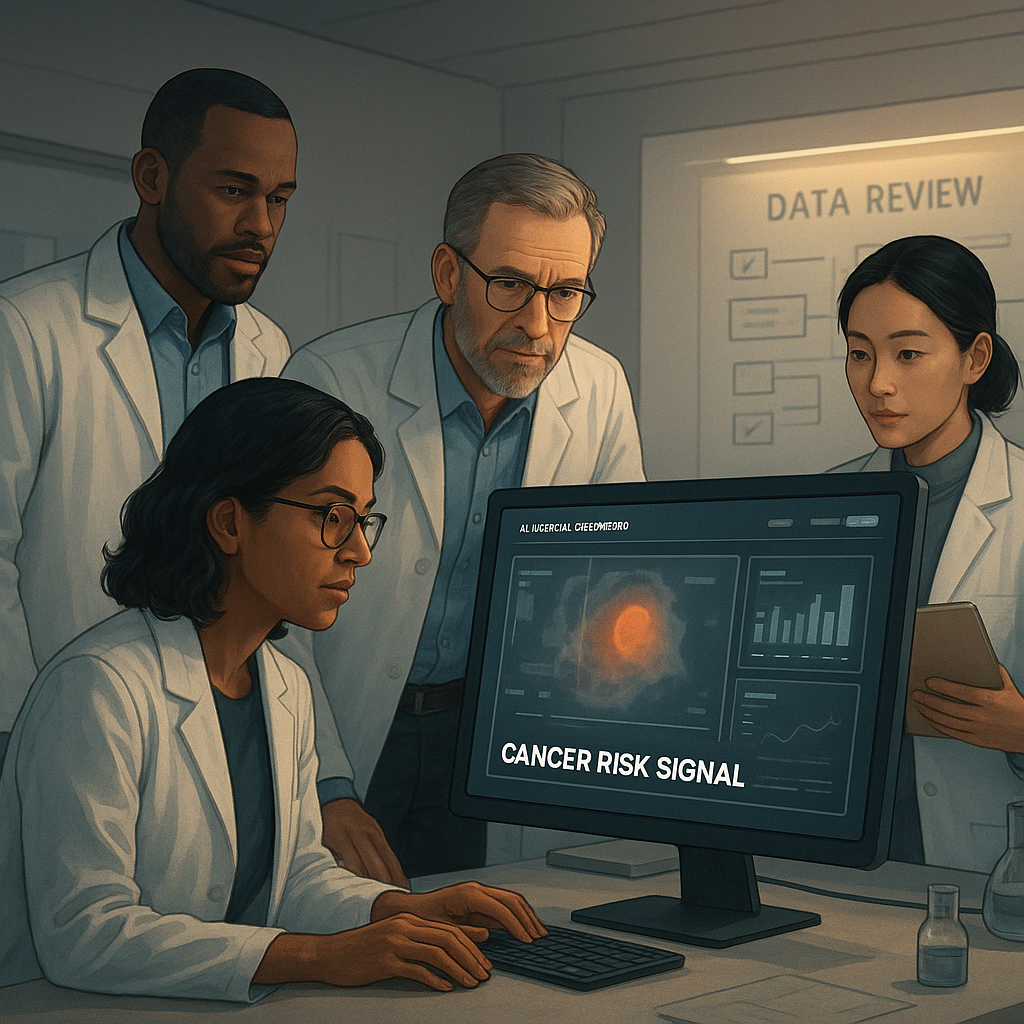
AI found a pattern in cancer data that people had stared at for years. It matters because machines are good at spotting weak signals across messy records, while human teams, working under time pressure and cognitive limits, often miss the obvious until a model puts it in plain view. What does that mean for medicine?
Key Takeaways- AI can surface hidden patterns in cancer datasets, especially when the signal is faint and the data is large.
- Human review still matters because correlation is not the same as clinical truth.
- Good data beats flashy models; weak records can produce slick nonsense.
- The real win is practical, not magical: earlier hypotheses, faster validation, better triage.
- Ethics and stewardship matter; medical AI should serve patients, not just publication counts.
What is AI finding hidden cancer signals?
Artificial intelligence in cancer research usually means machine learning systems that scan large collections of genomic data, pathology images, lab values, electronic health records, or combinations of all four. The goal is simple enough: find a pattern that helps explain disease behavior, predict response to treatment, or flag a risk that was missed in manual review.
The promise is real, but the hype is thick. Most tech coverage talks as if the machine "discovered" truth out of thin air. That is sloppy thinking. In practice, AI identifies statistical regularities, then scientists test whether those regularities have biological meaning. Big difference.
When I look at these reports, I ask two blunt questions. First, is the pattern repeatable on independent data? Second, can a clinician use it without needing a black box the size of a refrigerator? If the answer to both is no, the finding is interesting, not useful.
This matters more than people admit. Cancer data is noisy, fragmented, and full of missing values, because real patients do not arrive as neat spreadsheets. One hospital codes something differently from another. A scanner changes. A lab assay shifts. AI can still help, but only if researchers respect the mess instead of pretending it does not exist.
There is also a moral angle here, even if nobody wants to say it out loud. Medicine is not a slot machine for novelty. If a model helps clinicians use knowledge more responsibly, it serves the common good. If it becomes a citation factory, it wastes time and attention. Frankly, that distinction should be obvious.
For related background on the underlying methods, see Nature's machine learning coverage and PubMed Central for peer-reviewed biomedical research.

Core benefits and why it matters
The practical value of AI in cancer research is not that it replaces experts. It does not. The value is that it helps experts see farther, faster, and with fewer blind spots. Here’s the kicker: that sounds modest, but in medicine, modest gains can matter a lot.
- Earlier hypothesis generation: AI can flag associations that would take a human team months to notice. That is useful when datasets include thousands of genes, imaging features, or patient records.
- Pattern detection across scale: People are decent at spotting one strong clue. They are not great at comparing 10,000 weak ones. Machines are.
- Faster prioritization: Researchers can rank leads before spending money on wet-lab validation, which saves time and cuts dead ends.
- Cross-domain analysis: AI can combine pathology, radiology, genomics, and outcomes data, which often reveals relationships that single-source studies miss.
- Clinical support potential: With proper validation, models can help identify risk groups, likely responders, or patients who need closer follow-up.
But let’s be real: more AI does not automatically mean better science. A model can surface a false pattern just as efficiently as a real one. That is why the best studies are boring in the right way. They use strong validation, external datasets, and plain language about limitations. The flashy ones often collapse under closer inspection.
I have reviewed enough tech claims to know that novelty gets people excited and rigor gets ignored. In cancer research, that habit is costly. You want tools that reduce human error, not tools that hide it behind smooth charts and confident language.
This is where human judgment stays central. A machine can rank a signal, but a clinician or researcher must decide whether that signal is plausible, ethical, and worth acting on. That balance reflects a simple principle: technology should serve people, not the other way around.
If you want a useful primer on how AI is being discussed in medicine, the WHO guidance on ethics and governance of AI for health is worth a look, and the FDA's AI/ML software guidance shows how regulators are thinking about it.
Step-by-step: how researchers actually use AI for this work
The process is less glamorous than the headlines imply. Good. Science should be careful, not theatrical.
- Collect clean data first Start with a question, then gather the right records, not every record available. I have seen projects fail because teams stuffed the model with garbage and hoped the algorithm would sort it out. It will not.
- Define the target clearly Are you predicting survival, recurrence, treatment response, or a molecular subtype? If the target is fuzzy, the output will be mushy. Precision in the question is half the battle.
- Preprocess and standardize Cancer data often includes different file formats, scanners, lab units, and coding systems. Normalize the inputs or your model will learn hospital quirks instead of biology.
- Choose the right model for the job Sometimes a simple logistic regression beats a deep network. Sometimes it does not. I know that disappoints the model-chasing crowd, but simplicity often wins when interpretability matters.
- Train, validate, and test separately If the same data leaks into training and testing, you have not built intelligence. You have built a memorization machine. Separate datasets, ideally from different institutions, are much more convincing.
- Check interpretability Ask what features matter and whether they make sense. If the model says a random artifact is the top predictor, something is off.
- Validate externally A finding that only works in one lab is a clue, not a conclusion. Independent replication is the real proof.
- Test clinical usefulness This is where many projects stumble. Does the finding change decisions? Does it improve outcomes? Does it save time? If not, it is academic decoration.
- Review ethics and privacy Health data is sensitive. Consent, de-identification, governance, and bias checks are not extras. They are the floor, not the ceiling.
- Translate carefully A result can be statistically strong and clinically useless. That gap is bigger than many researchers admit.
When I evaluate a model, I look for three things: data quality, validation discipline, and a real path to bedside use. Everything else is noise. That's the plain truth.
For examples of research reporting standards, Nature Medicine's coverage of AI in healthcare and JAMA's reporting on clinical AI are useful references.
Comparison table: AI analysis vs. traditional review
| Feature | AI-assisted cancer analysis | Traditional manual review |
|---|
| Scale | Handles very large datasets quickly | Limited by human time and attention |
| Pattern detection | Strong on weak, high-dimensional signals | Strong on contextual judgment and nuance |
| Speed | Fast once trained and deployed | Slower, especially on large cohorts |
| Explainability | Sometimes opaque, depends on model | Usually easier to explain |
| Error profile | Can amplify bias or bad labels | Can miss subtle patterns due to fatigue |
| Best use case | Screening, prioritization, hypothesis generation | Clinical interpretation, validation, final decisions |
| Weak point | Garbage in, garbage out | Human overload and inconsistency |
The real question is not whether AI beats humans. It does not, not in any full sense. The real question is where each does the job best. AI is stronger at scanning breadth. Humans are stronger at judgment, context, and common sense. That division of labor is healthy.
Common mistakes to avoid
Most bad advice in this area comes from people who love the word "AI" more than they love evidence. That is a problem.
- Mistaking correlation for causation: A model can find a strong link that means nothing mechanistically. Associations need testing.
- Using weak data: If the labels are wrong, the predictions will be wrong. Fancy architecture cannot rescue bad records.
- Skipping external validation: A result that only works in one dataset is not ready for real use.
- Ignoring bias: If one group is underrepresented, the model may behave unevenly. That is not a small issue.
- Overstating clinical impact: A promising signal is not the same as a treatment breakthrough.
- Forgetting interpretability: If no one can explain a result, adoption will stall.
Here is what nobody tells you: many AI projects fail quietly because they answer the wrong question. Teams get excited by what the machine can do, then realize the result does not help a doctor, a patient, or a researcher make a better decision. That is wasted effort.
I am skeptical of every grand claim until I see replication. Good skepticism is not cynicism. It is stewardship. In medicine, careful methods respect both the data and the people behind it.
Frequently Asked Questions
Can AI really find something researchers missed for years?
Yes, especially in large and messy datasets. But the finding still needs validation, biological explanation, and clinical testing.
Does AI replace doctors or researchers?
No. It supports them by scanning at scale and surfacing patterns. Humans still make the judgment calls.
What kind of cancer data works best for AI?
High-quality, well-labeled data from genomics, pathology, imaging, and outcomes studies tends to produce the most useful results.
Why do so many AI findings fail later?
Because many are trained on limited or biased data, then oversold before external validation. That is the usual trap.
The truth is simple enough. AI is a tool, and like any tool, it can be used well or badly. In the right hands, it can help doctors and researchers spend their time more wisely, which is no small thing when lives are involved. Human ingenuity is a good gift, but it works best when it stays ordered toward truth and service, not vanity.
What matters next is not whether the machine sounds impressive. It is whether the finding helps someone make a better decision, spare someone needless harm, or move care forward with more honesty than hype. That is the standard worth keeping, and it is harder to meet than the headlines suggest.