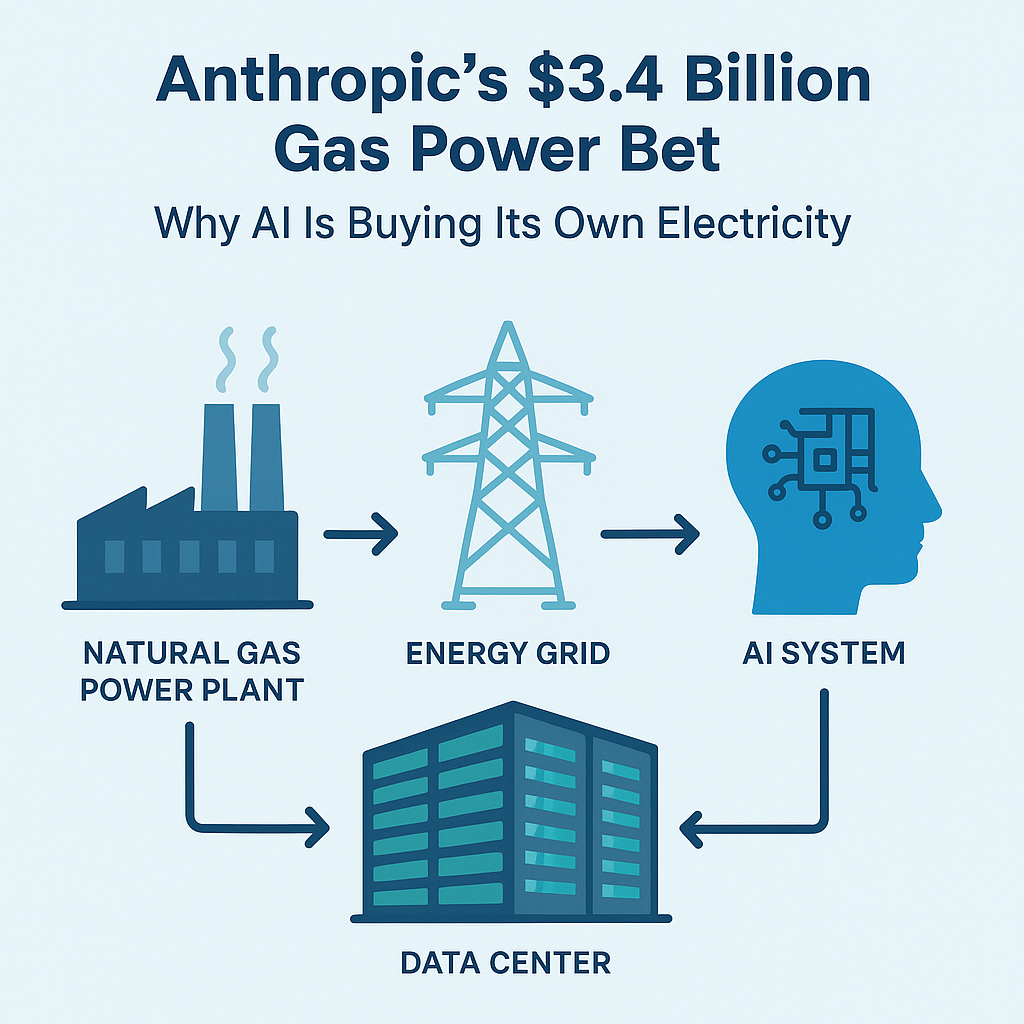
Anthropic’s $3.4 Billion Gas Power Bet: Why AI Is Buying Its Own Electricity
Anthropic’s reported $3.4 billion purchase of natural-gas generating equipment shows how the AI boom is running into a basic constraint: electricity. The company has usually rented computing capacity rather than owned infrastructure, but it is now pursuing equipment capable of producing up to 1.7 gigawatts. That is a large change in strategy—and a costly hedge against power delays.
Key Takeaways- The Financial Times reports that Anthropic is buying Caterpillar generating equipment originally ordered by OnePWR.
- The equipment is reported to have up to 1.7 gigawatts of generating capacity; that is a power rating, not a measure of electricity produced over time.
- Anthropic’s move follows a rental-heavy approach to computing, including a reported agreement with SpaceX subsidiary xAI.
- On-site natural gas can give data centers more control over electricity supply, but it brings fuel-price, emissions, permitting, and financing risks.
- The precise equipment configuration, project schedule, fuel contract, and reason OnePWR could not secure financing have not been reported.
The deal matters because electricity has become part of the AI infrastructure race, not just a utility bill. Training and operating large AI systems requires data centers packed with processors, cooling equipment, networking gear, and backup systems; all of them need steady power. The International Energy Agency expects electricity demand from data centers to grow sharply, though forecasts depend on how fast facilities are built and how efficiently they run. Its Energy and AI report is a useful account of the demand drivers and uncertainties.
The purchase is not proof that gas generation is cheap, clean, or the only workable answer. It is evidence that a company expecting heavy compute demand may value access to equipment enough to accept risks it once avoided. Frankly, that is less a victory lap than a warning about the bottlenecks behind the glossy AI demos.
What Is Anthropic’s Natural-Gas Power Purchase?
The reported transaction is a plan to buy large-scale generating equipment for power-hungry AI operations. The Financial Times says Anthropic is spending $3.4 billion on Caterpillar generators that OnePWR had ordered earlier, with the equipment capable of producing up to 1.7 gigawatts. The report says Anthropic first planned to buy the equipment from OnePWR, then went directly to Caterpillar when OnePWR could not secure financing. The reason for that financing problem has not been reported.
There is an important technical distinction here. A generator is a machine that converts mechanical energy into electricity; the mechanical energy can come from a gas turbine, a reciprocating gas engine, or another prime mover. The report describes the equipment as natural-gas turbines and Caterpillar generators, but the exact configuration and model mix are not specified in the information available. Those labels should not be treated as interchangeable without a published equipment list. Caterpillar’s electric power equipment information describes its broad generator-set business, but it does not establish which products are in this reported purchase.
Capacity also needs a little translation. 1.7 gigawatts describes the maximum rate at which the equipment could produce power under stated operating conditions; it does not mean Anthropic will generate that amount continuously, nor does it reveal the facility’s annual electricity use. Actual output depends on how many units are installed, maintenance, ambient conditions, fuel availability, operating rules, and whether the project runs around the clock. A plant’s nameplate rating is a starting point, not a utility bill.
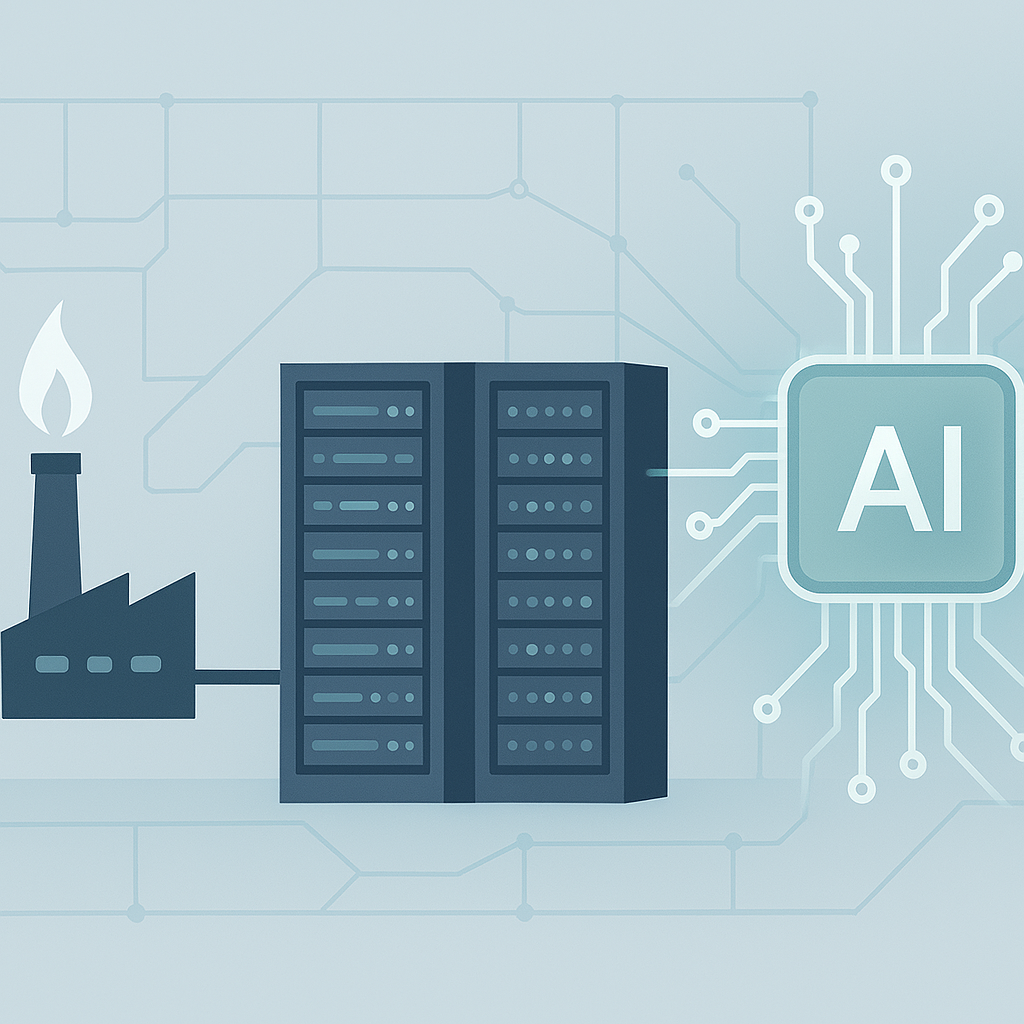
The purchase stands out because Anthropic has historically leaned on rented compute. The company reportedly disclosed in a May S-1 filing that it expects to pay SpaceX subsidiary xAI $1.25 billion per month through May 2029 to use computing capacity, and said it expected to enter similar services contracts. Those reported commitments show that renting remains part of its plan. Owning or controlling generation would address a different constraint: not the processors themselves, but the electricity needed to run them.
That distinction matters. A data center can have a building, servers, and a power contract yet still wait for a grid connection or adequate supply. The U.S. Department of Energy has documented the growing attention paid to data-center electricity demand in its report on projected demand growth. A power-equipment purchase can be a response to that pressure, but it does not by itself prove that the equipment is installed, permitted, connected, or operating.
Why Buy Power Equipment? The Benefits—and the Limits
The strongest argument for buying generation is control. If a data center can produce some of its own electricity, it may have more say over when and where it gets power, rather than relying entirely on a utility connection that could be delayed. That can matter when a company has committed to building compute capacity on a schedule and cannot simply wait for a new transmission line or substation.
A second benefit is capacity certainty. A major equipment order can reserve hardware at a time when suppliers are dealing with long lead times. The Financial Times report says turbine backlogs stretch into the early 2030s and grid-connection queues can also be lengthy. A reservation or purchase may therefore be valuable even before the plant is ready to run. It gives the buyer a claim on physical equipment rather than just a forecast of when equipment might become available.
Third, on-site generation may help with resilience and operating flexibility. A properly designed facility can coordinate generation, grid supply, battery storage, and backup power. That does not make it immune to failures: generators need fuel, maintenance, trained operators, and safe electrical systems. But a mix of supply sources can reduce exposure to a single point of failure. Here’s the kicker: resilience comes from a system that has been engineered and tested, not from the mere presence of a generator on a site plan.
There is also a strategic benefit. If Anthropic controls a scarce block of generating equipment, a competitor cannot buy those same units from the same seller. That may be one reason to secure the order, although the reported facts do not establish Anthropic’s motive. The company may also be trying to protect its own development schedule. Neither interpretation proves the investment will pay off.
The trade-offs are substantial. Gas prices can swing, and the cost of the fuel is separate from the purchase price of the generating equipment. A price forecast cited in the reporting warns that gas prices could more than triple by the end of the decade in some markets; the specific market assumptions and forecast details are not reported here. If fuel costs rise, frequent operation can become much more expensive than the headline equipment cost suggests. The U.S. Energy Information Administration explains the range of natural-gas uses and market factors, but a national overview cannot predict the price Anthropic would pay under a particular contract.
There are environmental costs, too. Burning natural gas releases carbon dioxide, while methane leakage can add climate impact before the fuel reaches a generator. Local air pollution, water use, noise, and permitting also matter. A plant could be used only during certain periods, or it could run for long stretches; the emissions profile depends heavily on that operating pattern and the equipment’s efficiency. Energy infrastructure is a stewardship question as well as an engineering one: reliable systems should serve people without making avoidable costs someone else’s problem.
How to Assess an AI Power Purchase: A Step-by-Step Guide
A large purchase is easy to turn into a headline. Assessing whether it makes practical sense takes more work. When I analyze infrastructure claims, I start by separating confirmed details from estimates, marketing language, and unanswered questions. This deal deserves the same treatment.
- Confirm what is actually being bought. Start with the equipment type, model numbers, quantity, and rated output. The report identifies Caterpillar generators and a maximum capacity of 1.7 gigawatts, but does not provide a full equipment schedule. Ask whether the system uses gas turbines, reciprocating engines, or a mix; the answer affects efficiency, maintenance, footprint, and operating flexibility. Without that detail, calling the purchase a specific kind of plant goes beyond what has been reported.
- Separate equipment cost from total project cost. The reported figure is $3.4 billion, but the information available does not break down what that figure includes. It may not tell us whether the price covers only equipment or also related work, delivery, installation, electrical infrastructure, fuel connections, or other project costs. Do not divide the headline amount by the capacity and treat the result as a complete cost-per-kilowatt figure. That calculation can be a rough prompt for questions, not a verified comparison.
- Check the project’s route to operation. A generator order is not the same as a functioning power plant. The buyer still needs a suitable site, permits, construction, fuel delivery, electrical connections, safety systems, and an operating plan. It also needs to know whether the facility can export electricity, operate only for the data center, or interact with the public grid. Those details have not been reported for this purchase, so any claim about the project’s completion date would be guesswork.
- Ask how the fuel will be priced and supplied. A generator can be ready while its fuel arrangement remains uncertain. A sound analysis looks for the supplier, contract term, pricing formula, transport capacity, and any hedging strategy. It also checks whether fuel is available during the hours when the data center needs it most. A low initial gas price does not settle the question if the contract later resets to volatile market rates.
- Compare generation with other options. The real alternatives might include grid upgrades, long-term electricity contracts, renewable generation, storage, efficiency improvements, or a combination of these. None is free of trade-offs. Solar and wind output varies; batteries are limited by duration and cost; transmission lines take time; gas has fuel and emissions costs. The IEA’s analysis of AI-related energy demand discusses why efficiency and supply choices both matter as computing grows.
- Use realistic operating assumptions. A plant designed to cover brief shortages has a different fuel bill and emissions profile from one intended to run most hours. Ask what capacity factor the company expects, how often equipment will be offline, and whether it will be used as primary supply, backup, or a mix. Those answers determine how much electricity the equipment produces annually. The reported 1.7-gigawatt rating alone cannot answer any of those questions.
- Test the plan against demand that might not arrive. AI demand is large, but it is not perfectly predictable. Models can become more efficient, workloads can move, customers can change their plans, and construction schedules can slip. The buyer should compare several demand scenarios rather than assume every planned data center reaches full use. A costly plant can become an expensive monument to a forecast if compute demand or project timing changes.
- Check who carries the risks. Look for financing terms, fuel-price exposure, construction commitments, and the consequences of a delayed or canceled project. The reported OnePWR financing problem is a reminder that an interested customer does not automatically make a deal bankable. In this case, why OnePWR could not finance its order has not been disclosed. A careful review does not fill that gap with speculation.
Comparison: Anthropic’s Purchase vs. Its Hyperscaler Rivals
The most useful comparison is not one company’s generator count against another’s. The reported information gives Anthropic’s price and capacity, but does not provide comparable figures for Google, Amazon, Microsoft, or Meta. It does say those companies have announced plans for large natural-gas power plants to support data centers. Marking missing figures as “not reported” is better than inventing precision.
| Measure | Anthropic | Google, Amazon, Microsoft, and Meta |
|---|
| Reported approach | Buying Caterpillar generating equipment originally ordered by OnePWR | Announced plans for large natural-gas plants for data centers |
| Reported scale | Up to 1.7 GW of capacity | Comparable combined capacity not reported here |
| Reported spending | $3.4 billion | Comparable cost figures not reported here |
| Relationship to power | Equipment purchase intended to secure generating capacity | Plans described as on-site natural-gas generation |
| Compute strategy noted in the report | Also rents compute; a reported xAI contract runs through May 2029 | Comparable contract details are outside the reported facts here |
| Main visible risk | Equipment cost, fuel exposure, permitting, and project delivery | Similar fuel, emissions, permitting, and delivery risks; project details differ |
Anthropic’s visible distinction is the reported equipment transaction and its scale, not proof that it is the only AI company pursuing gas. The peer group appears to be moving toward on-site power as well, but its projects may differ in ownership, fuel contracts, construction status, and intended use. A press release announcing a plant is not the same as a plant producing electricity. Let’s be real: without comparable disclosures, claims that one company has “won” the power race are mostly noise.
The broader industry context is measurable, though forecasts are uncertain. A Lawrence Berkeley National Laboratory report estimates U.S. data centers used about 4.4% of the country’s electricity in 2023, with the share potentially rising to between 6.7% and 12% by 2028 under its modeled scenarios. The range is wide because future demand depends on facility growth, server efficiency, and how heavily systems are used. The lab’s U.S. data-center energy report offers context; it does not forecast Anthropic’s individual power needs.
This comparison also shows why “buy versus rent” is too simple. Anthropic can rent computing capacity while investing in power equipment; a company can own servers but buy electricity from a utility; another can finance a plant through a third party. The commercial arrangements are different, and the useful question is whether the supply plan can deliver reliable electricity at a tolerable cost with acceptable environmental and community impacts.
Common Mistakes to Avoid
Mistake one: treating gigawatts as annual electricity. A gigawatt is a rate of power, while a gigawatt-hour measures energy delivered over an hour. The reported 1.7-gigawatt capacity does not reveal how many hours the equipment will run or how much power it will actually produce. A facility could operate below its maximum rating, shut down for maintenance, or run only when another supply is unavailable. Confusing capacity with output makes the project sound more certain than it is.
Mistake two: assuming a purchase means immediate power. Equipment still has to be delivered, installed, permitted, connected, fueled, and commissioned. The report does not give a complete schedule or confirm that the generating units are operating. Even a signed equipment order can face delays in construction, electrical work, staffing, and fuel connections. A delivery announcement is a milestone, not the finish line.
Mistake three: treating gas as a guaranteed bargain. Natural gas can provide dispatchable electricity, but the fuel market is not fixed. Contract structure, location, transport capacity, and demand all affect the final bill. The reported forecast of possible price increases in some markets should be read as a scenario, not a certainty. Conversely, a low current price would not prove that a long-term project will stay cheap. The honest answer is that the price exposure depends on contracts and market conditions that have not been reported.
Mistake four: comparing the $3.4 billion headline with a utility bill. The number is striking, but the details matter: what the spending includes, how the equipment is financed, how long it lasts, and how often it runs. A buyer could spend heavily on equipment and use it sparingly, or operate it frequently and face a large fuel bill. Without the cost breakdown and operating plan, the headline is not enough to calculate the project’s value.
Mistake five: assuming on-site generation is automatically more reliable. A generator can reduce dependence on a grid connection, but it introduces its own failure points: mechanical faults, fuel interruptions, maintenance needs, and weather or site constraints. Reliability comes from engineering redundancy, fuel security, grid coordination, and careful operations. A collection of machines with no credible maintenance plan is not a resilient power system.
Mistake six: ignoring neighbors and emissions. Data centers are often discussed as abstract compute capacity, but power plants occupy real places. They bring permitting questions, local air emissions, noise, traffic, and possible effects on fuel infrastructure. Natural gas emits less carbon dioxide per unit of electricity than some coal-fired generation, but it is not emissions-free, and methane leakage matters. The U.S. Environmental Protection Agency’s information on stationary combustion turbines describes regulatory requirements; compliance is a baseline, not a complete measure of community impact.
Mistake seven: assuming competitors will copy the exact deal. Other companies may use different sites, equipment, contracts, or mixes of grid power and generation. Google, Amazon, Microsoft, and Meta have announced natural-gas plans, according to the report, but comparable project details are not provided here. The fact that firms face similar pressure does not mean they face identical economics. A sensible comparison separates shared market pressure from individual project choices.
Frequently Asked Questions
Why is Anthropic buying natural-gas generating equipment?
The reported reason is access to a large amount of power amid rising demand for AI computing and long waits for generating equipment or grid connections. The purchase may help Anthropic secure capacity and reduce reliance on outside supply for at least some operations. The company’s exact operating plan and motive have not been reported, so it would be premature to claim the equipment will power a specific data center or run continuously.
How much power can the equipment produce?
The Financial Times report gives a maximum capacity of up to 1.7 gigawatts. That is the rate of power the equipment can produce under specified conditions, not the total amount of electricity generated over a year. Actual output will depend on the equipment configuration, operating hours, maintenance, fuel supply, and project design. Those details are not reported.
Is natural gas cheaper than grid electricity for AI data centers?
There is no universal answer. Costs depend on local electricity prices, gas prices, plant efficiency, equipment financing, construction, maintenance, transmission charges, and how often the generator runs. On-site generation can offer control or avoid some grid constraints, but it does not remove fuel-price risk or the cost of connecting the plant to the data center. Anthropic’s expected total cost per unit of electricity has not been reported.
Does Anthropic’s purchase mean it is abandoning rented computing?
No. The reported S-1 filing describes a large xAI computing-services commitment through May 2029 and says Anthropic expected to enter additional similar contracts. Renting compute and securing power equipment address different parts of the infrastructure chain. The deal suggests Anthropic may combine leased compute with greater control over electricity supply, rather than replacing one model with the other.
Final Thought
Anthropic’s reported $3.4 billion equipment purchase is notable because it puts a physical price tag on a problem often discussed in abstract terms. AI needs processors, memory, networks, cooling, buildings, and—before any of that works—electricity. When power supply becomes uncertain, a company accustomed to renting compute can decide that owning or reserving generating equipment is worth the financial and operational burden.
That does not make the decision obviously wise or obviously reckless. The case for it depends on what the $3.4 billion includes, how much of the 1.7 gigawatts is built and usable, how often the equipment runs, and what Anthropic pays for fuel. It also depends on the alternatives available at the sites where the company needs capacity. Those important details are not reported, and pretending otherwise would be guesswork dressed up as analysis.
The wider lesson is more durable than the deal itself. AI companies are now competing for energy infrastructure as well as chips and computing time. A capacity shortage can push firms toward on-site generation, but the costs do not stop at the fence line: communities, utilities, fuel markets, and the climate all enter the calculation. Innovation is most useful when it serves people responsibly, rather than treating energy as an invisible input with no consequences.
For now, Anthropic’s purchase looks like a hedge against scarce power and slow connections. It may prove valuable if demand grows and the equipment arrives on time. It may look expensive if fuel costs rise, projects slip, or AI workloads need less power than expected. The sensible verdict is not that gas has solved AI’s power crunch. It is that one of the industry’s biggest buyers is willing to spend billions to avoid waiting—and the bill for that choice will depend on what happens after the headline.