Authors are pushing back. The fight is over who gets a slice of the Anthropic settlement, and that matters because copyright money is not a fog bank of...
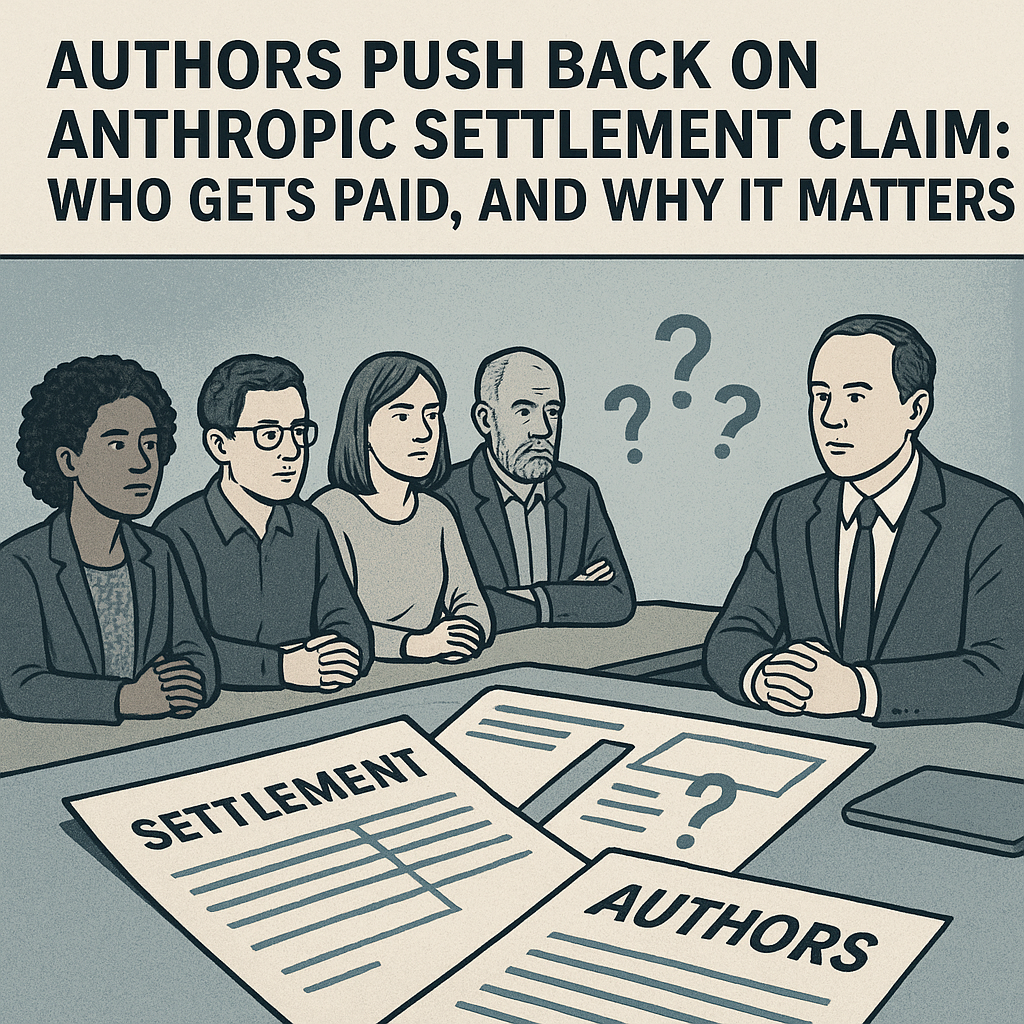
Authors are pushing back. The fight is over who gets a slice of the Anthropic settlement, and that matters because copyright money is not a fog bank of abstract claims, it is a concrete payment tied to books, contracts, and who actually held the rights when the copying happened.
Key Takeaways:
- The Anthropic settlement dispute is not just about money; it is about who owned what rights, when, and under which contract.
- Authors, publishers, and agents may all have claims, but those claims are not equal.
- The core issue is allocation: settlement proceeds must track the real rights holder, not the loudest voice in the room.
- Writers need to review contracts, royalty statements, and rights reversions carefully.
- A fair result should respect authorship, stewardship, and the common good, not just legal convenience.
What is the Anthropic settlement claims dispute?
This is a rights fight. It is about the Anthropic settlement, which stems from allegations that copyrighted books were used in training-related contexts without proper permission, and now different parties are arguing over who should receive compensation.
That sounds simple. It is not.
Authors say, fairly enough, that they wrote the books, created the expression, and often held the underlying copyright or a meaningful share of it. Publishers and agents, meanwhile, may argue that contracts gave them rights to exploit, license, or collect on certain uses, or that the settlement funds should pass through established business arrangements. Frankly, this is where legal paperwork stops being boring and starts being expensive.
I’ve reviewed enough product and policy disputes to know the same pattern shows up everywhere: people speak confidently about “entitlements” until someone opens the contract. Then the air leaks out of the room.
The Anthropic matter is especially thorny because it sits at the junction of copyright law, publishing contracts, and AI training practices. Courts and settlements do not exist to hand out moral gold stars. They exist to sort claims by law, proof, and chain of title. That means the real questions are practical:
- Who owned the copyright at the time of the alleged use?
- Did the publisher acquire broad digital rights, text-and-data rights, or only limited print rights?
- Did the agent have authority to negotiate settlement participation on behalf of the author?
- Were rights reverted, terminated, or assigned back later?
Here’s the kicker. In many publishing deals, the answer is not clean. Some books were sold under older contracts drafted before modern AI disputes existed. Some rights were split. Some authors kept foreign rights, audio rights, or secondary licensing rights. Others signed away broad control and now need to see whether that sweep includes settlement proceeds. The law likes categories. Publishing contracts often don’t.
You can see why authors are objecting. They do not want a middle layer to claim money that follows the creation of the work itself. That objection is not greed; it is often a defense of authorship as a real property interest, not a decorative label.
For background on how AI copyright disputes are shaping the tech sector, see the U.S. Copyright Office’s AI resources, and for the underlying model-company debate, Reuters technology coverage has been tracking the broader litigation wave closely.
Core Benefits/Importance
This dispute matters because it sets the tone for future AI settlements. If settlement money gets distributed without careful rights analysis, the next case will be messier, and the one after that uglier still.
- Protects authors’ property rights. The person who created the work should not be treated like a bystander. If a contract did not transfer a particular right, then that right should remain with the author.
- Forces contract accuracy. Publishers and agents will need to show exactly what they control, rather than relying on habit or industry assumptions. That is healthy. Sloppy claims breed bad precedent.
- Improves settlement fairness. Settlement funds should track actual injury and actual rights ownership. Otherwise the process becomes a distribution lottery, and nobody serious should want that.
- Clarifies AI licensing norms. The publishing world has spent years pretending that old boilerplate can handle new machine-learning disputes. It cannot, not without strain. A hard case like this may force better drafting and cleaner licensing language.
- Discourages overclaiming. Some parties always show up with broad rhetoric and thin proof. Those claims should be resisted. I have little patience for “we’re all stakeholders” talk when the paperwork says otherwise.
- Supports human labor and dignity. Creative work is not raw material floating in a tank. It is the fruit of mind, labor, and formed judgment. A just settlement should respect that, because the common good depends on honoring real human creativity, not just the machinery built around it.
- Creates better industry habits. Publishers, agents, and authors will be pushed to track rights more carefully from the start. That saves time, money, and a lot of future nonsense.
Most tech and media disputes are sold as abstract policy fights. They are not. They are usually paperwork fights with moral consequences. The numbers matter, but so does the order of justice. If the settlement process is honest, it can encourage stewardship rather than extraction.
For more context on creator compensation and AI disputes, see The Verge’s AI coverage and Financial Times technology reporting.

Step-by-Step Implementation/Guide
If you are an author, agent, or rights manager, here is what actually works. I’ve seen too many people rely on memory, which is a bad habit in contract disputes.
- Pull the original publishing contract. Do not trust summaries. Get the signed version, all amendments, all side letters, and any rights reversion notices. The language is the whole game.
- Identify the exact rights granted. Look for clauses covering print, digital, audio, foreign, derivative works, sublicensing, and any broad language that might be stretched to cover settlement participation. If the clause is vague, that is not a victory; it is a fight waiting to happen.
- Check ownership at the relevant time. Settlement claims usually depend on who held the right when the alleged use occurred. If rights reverted later, that may not change the original claim, though it can affect who receives proceeds.
- Review agency authority. Agents negotiate deals, yes. But did they have authority to claim settlement money for the publisher, for the author, or for both? Assumption is not evidence.
- Match claims to books, not reputations. Some parties will argue in broad portfolio terms. Ignore the theater. Each title needs its own rights map, especially for works with co-authors, anthologies, or complicated backlist deals.
- Document moral rights and attribution issues where relevant. In some jurisdictions, authors have rights that survive broader assignments. Even where the law is narrower, attribution and control questions can affect settlement posture.
- Consult counsel before signing anything. This is not a DIY weekend project. A few pages of legal release language can waive more than a person realizes. That is not paranoia; it is prudence.
- Track tax and payment handling. Settlement proceeds may be treated differently depending on whether they flow to an individual author, a company, or a rights administrator. The tax tail is rarely small.
- Push for transparent allocation rules. If there is a common fund, the method for dividing it should be public, legible, and tied to verifiable rights. Hidden formulas are how trust dies.
- Keep stewardship in view. The point is not to squeeze every last dime from the process. It is to give each party what is due and to avoid treating creative work like a spreadsheet orphan. That principle is older than the publishing industry, and a lot wiser.
One more practical note. If you are an author reading this and thinking, “My agent handles this,” fine. But verify anyway. Delegation is sensible; blindness is not. The same goes for publishers. If the claim is real, prove it. If it is not, stop acting entitled.
For guidance on copyright basics, the U.S. Copyright Office FAQ is still better than a dozen hot takes.
Comparison Table
| Issue | Authors’ Position | Publishers/Agents’ Position | What Usually Decides It |
|---|
| Copyright ownership | The creator owns the core expression and should receive settlement money unless rights were clearly transferred | The contract may have granted broad rights, including some settlement-related claims | Contract language and rights chain |
| Settlement proceeds | Should flow to the party injured by the unauthorized use | Should be allocated under existing publishing and agency arrangements | Court-approved settlement terms |
| Authority to claim | Only the true rights holder can claim compensation | Agents or publishers may claim as representatives | Agency authority and written authorization |
| Backlist and reversion rights | Reverted rights should return value to authors | Older agreements may still control certain exploitations | Reversion clauses and timing |
| Fairness standard | Creators should not be cut out by intermediaries | Administrative efficiency may justify centralized claims handling | Settlement administrator rules |
The comparison is ugly, but it is honest. Efficiency is not the same thing as justice. That distinction gets blurred all the time in tech and media deals, and then everyone acts shocked when creators complain.
If you want a deeper read on how publishers handle rights in practice, Publishers Weekly has ongoing coverage of the industry mechanics, while Author’s Guild resources are useful for creator-side perspective.
Common Mistakes to Avoid.
The first mistake is assuming the loudest claimant wins. It does not work that way, at least not in serious legal analysis. Volume is not ownership.
The second mistake is treating all publishing contracts as interchangeable. They are not. Old print-only deals, later digital addenda, and international rights agreements can produce radically different outcomes. Anyone pretending otherwise is selling comfort, not accuracy.
The third mistake is ignoring the difference between licensing rights and settlement rights. A publisher may have rights to exploit a book in certain ways, but that does not automatically mean it owns every future claim tied to unauthorized machine use. That distinction is where many arguments will either stand or collapse.
The fourth mistake is believing that an agent’s involvement guarantees authority. Agents are useful. They are not magic wands. If the paper trail is weak, the claim is weak.
The fifth mistake is overgeneralizing from one title to the whole catalog. I see this constantly. One decent contract in the stack does not rescue the rest. Every work stands on its own feet.
The sixth mistake is assuming settlement money can be divided by vibes. It cannot. If a claim administrator uses rough heuristics without disclosing them, expect resentment and, eventually, objections.
The seventh mistake is forgetting the ethical layer. Not in a preachy way. In a plain way. Human creativity is worth more than a bargaining chip. A settlement should reflect that reality by honoring the author’s work, the publisher’s lawful role, and the reader’s trust in a fair market.
The truth is, bad advice often comes draped in pragmatic language. “Just let the publisher handle it.” “Don’t make trouble.” “The process will sort itself out.” That is how people lose leverage and then act surprised when the check is tiny or the release is broader than expected.
If you are watching this from the tech side, note the larger pattern: AI companies want clarity; content owners want compensation; intermediaries want control; and the settlement administrator wants clean claims. Those goals overlap only part of the time. That is why careful rights mapping matters.
For more on AI policy and copyright, see Techdirt’s AI coverage and WIRED’s AI reporting.
Frequently Asked Questions
Who is likely to receive money from the Anthropic settlement?
Likely claimants include authors, publishers, estates, and in some cases agents or rights administrators, but actual payment depends on the specific rights chain and settlement rules.
Can a publisher claim settlement money if the author wrote the book?
Yes, sometimes. If the contract transferred the relevant rights or gave the publisher authority over the disputed use, the publisher may have a claim. But that is contract-specific, not automatic.
Why are authors objecting to publisher or agent claims?
Because many authors believe the settlement follows the creative work itself, and they worry intermediaries are claiming money without a clear legal basis. That concern is often valid.
What should an author check first?
The original contract, any amendments, reversion notices, and the exact language about sublicensing, digital rights, and settlement authority. Start there. Everything else is noise.
Final Thought
This dispute is bigger than one payout. It is about whether the industry can still tell the difference between creators and the machinery built around them.
I think that matters more than most people admit. The easy story is that a settlement will smooth things over and everyone will move on. Maybe. The better story is that a proper settlement forces the publishing world to respect the person who actually made the thing, while still honoring legitimate contracts and business roles. That balance is not sentimental; it is the only way markets remain trustworthy.
There is also a plain moral point here. Creative labor should be treated as real labor. Not as a halo, not as a slogan, and certainly not as something to be skimmed by whoever has the best lobbyist or the slickest filing. A just order gives each party what is owed, no more and no less. That is old wisdom, and we keep needing it because people keep forgetting it.
If this case pushes publishers to draft cleaner contracts, authors to track rights more carefully, and AI companies to pay more attention to the humans whose work trained their systems, then something useful may come of the mess. Not perfect. Useful. That will do.