Big Tech is trying to repair its relationships with Democrats after years of closer ties to President Donald Trump and his administration. OpenAI’s hiring of...
Big Tech’s AI Pivot After the Midterms: Can It Win Back Democrats?
Big Tech is trying to repair its relationships with Democrats after years of closer ties to President Donald Trump and his administration. OpenAI’s hiring of Jessica Schumer and its new “compute campus” label sharpen the optics debate, but the harder test will be whether companies answer concerns about AI rules, electricity, jobs, and community consent.
Key Takeaways- The reported outreach looks like political risk management, not proof that companies have changed course.
- Data center siting, energy costs, and state AI laws may matter more than Washington’s next speech.
- Workforce partnerships can help, but only when benefits are concrete, measurable, and shared.
- The midterms could produce gridlock in Congress while state and local governments keep acting.
The timing is hard to miss. TechCrunch reported that OpenAI hired Jessica Schumer, daughter of Democratic Sen. Chuck Schumer, shortly before the midterms, and also began referring to its data centers as “compute campuses.” Neither move proves improper influence or a shift in policy; both make it easier for critics to ask whether Silicon Valley is polishing its image as the political weather changes. Frankly, that is a reasonable question.
For two years, prominent technology companies cultivated closer ties with the Trump administration, while the administration pursued policies that could benefit the industry, including tax changes, reduced federal scrutiny in some areas, and a lighter touch on AI regulation. Now Democrats are promising stronger oversight, and companies are emphasizing bipartisan relationships, training programs, and local investment. The practical question is not whether a company can sound friendly in Washington. It is whether it can show who benefits, who bears the cost, and who gets a meaningful say.
What Is Big Tech’s Post-Midterm Political Pivot?
It is a change in emphasis by major technology companies seeking to preserve access and reduce political risk as control of government shifts. The pivot includes relationship-building with Democrats, public-private workforce programs, messaging about community benefits, and more careful language around facilities and artificial intelligence. That is political strategy, not necessarily a change in a company’s underlying product choices or lobbying priorities.
OpenAI’s reported hiring of Jessica Schumer is a visible example, but it needs careful handling. A family connection can attract attention without establishing that a hire was improper, that Sen. Schumer intervened, or that a policy decision followed. The facts reported are the hire and its timing; claims about motive or influence would require evidence beyond those facts. A serious analysis keeps that distinction intact.
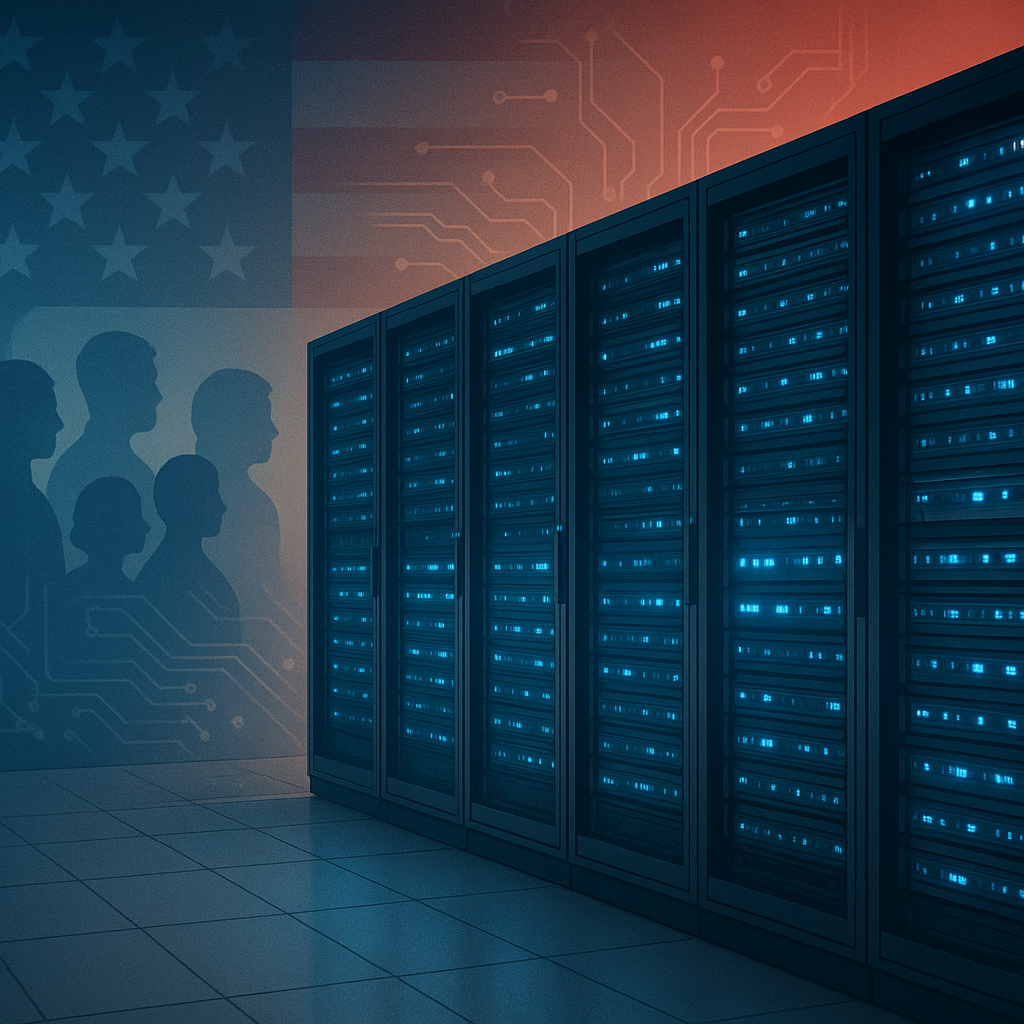
The “compute campus” label is another example of image management. A data center is still a data center when it gets a friendlier name: it needs land, electrical capacity, cooling, construction workers, and a route to the grid. Yet “campus” can suggest jobs, innovation, and a shared local project rather than a large industrial facility. Here’s the kicker: language matters, but a new sign does not lower a resident’s utility bill.
The broader pivot follows a rough political bargain. Companies want room to build, access to public officials, and rules that do not change unpredictably; elected leaders want investment, jobs, and assurances that AI systems will not harm consumers or weaken worker protections. The White House has described U.S. leadership in advanced AI as a national and economic priority, while also saying consumer protection matters. The administration’s January 2025 AI executive order illustrates how quickly federal policy can change when a new administration takes office.
J.B. Branch of Public Citizen called the industry’s recent efforts an “optics problem” and described some of them as “PR washing,” according to TechCrunch’s reporting. Alice Marwick of Data & Society was more doubtful, arguing that it may be too late for a simple return to the political middle. I read both reactions as a useful warning: access is not trust, and trust is not earned by a press release.
Why the Pivot Matters
The political relationship matters because federal rules are only one part of the operating environment. AI companies need power, buildings, customers, skilled workers, and permission to deploy systems in schools, workplaces, and public services. Each of those needs brings a different audience—and a different way for a company’s promises to be tested.
- Bipartisan relationships can make policy less fragile. If companies speak only to one party, a change in congressional control can put key agreements at risk. Dialogue across parties can help lawmakers understand technical trade-offs, provided it includes critics and affected communities rather than only executives and lobbyists.
- Workforce programs can turn investment into useful skills. OpenAI’s partnership with the American Federation of Teachers, as well as programs associated with Anthropic and Meta, points to a strategy of connecting AI with education and employment. That can be worthwhile when training leads to real teaching resources, recognized skills, and jobs. A logo-sharing event is not the same thing.
- Local engagement can reveal costs before construction starts. Data centers can bring construction activity and tax revenue, but residents may also worry about power demand, water use, noise, land, and future bills. The International Energy Agency’s Energy and AI report examines the relationship between AI growth and electricity demand. That makes energy planning a practical public question, not a side issue for engineers.
- State laws offer a test bed for policy. States have advanced measures involving chatbots, deepfakes, and other uses of AI. The National Conference of State Legislatures’ AI legislation tracker helps show how varied those efforts are. The variety can frustrate companies, but it can also expose weak rules before they become national policy.
- A public framework can improve internal discipline. The voluntary NIST AI Risk Management Framework offers organizations a way to identify and manage AI risks. It does not replace law, and it cannot certify that a product is harmless. It can, however, give companies and their customers a shared vocabulary for testing claims.
Let’s be real: not every partnership is cynical, and not every criticism is fair. But the industry’s strongest case is evidence of public benefit, not a polished vocabulary list. That means reporting what a program actually delivered, disclosing who paid for it, and showing whether workers or communities had any influence over its design. A responsible use of human ingenuity should serve people beyond the boardroom; that standard is not anti-technology, it is what good stewardship looks like.
There is also a market reason to take the politics seriously. The reported trillion-dollar sell-off rattled investors, while some reportedly reconsidered expectations around Anthropic’s possible public offering. Those reports do not establish that an AI bubble will burst, or that any one company caused a market move. They do underline a basic point: political enthusiasm and investor enthusiasm can turn quickly when expected returns, infrastructure costs, or public confidence disappoint.
How to Judge a Company’s Political Reset
The useful question is not whether a company says it is bipartisan. It is whether the promises can be checked. When I analyze a technology initiative, I look for a chain of evidence from the announcement to the people affected, rather than treating a partnership headline as a result. This six-step checklist works for residents, journalists, investors, and public officials.
- Separate the event from the interpretation. Start with what is known: a hire, a partnership, a new name for a facility, a policy statement, or a donation. Then label what is not established, such as a motive, a private agreement, or a direct effect on legislation. In the Schumer case, the reported family relationship and timing are relevant context; they are not proof of an exchange of favors.
- Find the decision-maker and the decision. Identify which office or agency can approve a project, write a rule, provide an incentive, or enforce a law. A meeting with a national politician may attract attention, while a local utility board or planning commission holds the immediate power over a data center’s connection or siting. Ask who can actually say yes or no.
- Ask for measurable commitments. “Community benefit” should be translated into specifics: expected jobs, job types, construction timelines, training access, tax arrangements, energy sources, and plans for handling water and noise. If the company does not publish figures, mark them as unreported rather than filling the gap with a guess. I trust a modest, verifiable promise more than a grand one with no dates attached.
- Check who carries the costs. A project can create tax revenue and still put pressure on local infrastructure. Examine who pays for grid upgrades, whether costs could reach household bills, how water use will be managed, and whether public subsidies have conditions. The right comparison is not “investment or nothing”; it is the actual deal against the realistic alternatives.
- Track the policy path at multiple levels. Read federal statements, then check state legislation and local permits. The White House announced an AI Litigation Task Force in December, according to the reported account, with the stated purpose of challenging state AI laws; states have continued to advance their own measures. A company operating in several states may face different requirements even if Congress does nothing.
- Return after the cameras leave. Set a review date and compare results with the original promise. Did training happen? Were local jobs filled? Did the data center meet its energy commitments? Did the company publish safety information or respond to complaints? Frankly, follow-up is where a partnership stops being theater and starts being accountable—or fails the test.
This process is not a demand for every company to publish confidential business details. It is a demand for enough public information to evaluate public claims, especially where public money, public infrastructure, or public safety is involved. Companies can protect trade secrets while still reporting broad outcomes and measurable commitments. If a claim cannot survive a basic follow-up question, it was never much of a promise.
Comparison: Big Tech’s Political Reset vs. State and Local Pressure
The main competition for attention is not another technology company. It is the gap between Washington’s political messaging and the state and local decisions that determine where systems are built, how they are used, and who pays for infrastructure. One side can shape the national argument; the other can affect a permit, a power connection, or a state law. Both matter, but they work on different clocks.
| Issue | Big Tech’s political reset | State and local pressure |
|---|
| Main activity | Build bipartisan relationships, promote partnerships, and explain planned investment. | Debate AI bills, data center siting, utility impacts, and consumer protections. |
| Visible examples in the reporting | OpenAI hired Jessica Schumer and adopted “compute campuses”; companies highlighted workforce and community programs. | States have passed or considered rules on chatbots and deepfakes; local communities can debate or oppose projects. |
| Main public promise | AI leadership, jobs, training, investment, and community benefit. | Rules and project decisions should address local costs, safety concerns, and public consent. |
| What can be checked | Program outcomes, public commitments, and whether company positions change with political control. | Bill text, agency actions, permits, electricity planning, and community benefits. |
| Biggest weakness | Good optics can conceal thin results; a hiring decision or rebrand alone proves little. | Different rules can create uneven protections and compliance burdens across state lines. |
| Likely time horizon | Federal action may be slowed by political gridlock. | State legislation and local approvals can keep moving even when Congress stalls. |
Here’s the kicker: neither column is automatically the public-interest column. Companies can deliver valuable jobs and training; local opponents can raise legitimate concerns, or make claims that deserve scrutiny. The question is whether decisions are made with credible information and fair participation, rather than whether the company or the protest has the better slogan.
The federal-state tension is real. The administration has argued that U.S. AI companies should be able to innovate without burdensome regulation, while the reported creation of the AI Litigation Task Force signals a willingness to challenge some state approaches. State lawmakers, meanwhile, have acted on issues such as chatbot safety and manipulated media. The result may be a patchwork: requirements change by state, by product, and by the way a system is used.
That patchwork is hard for companies to manage, but it may also reflect differences in local needs. A national rule can provide consistency, yet a badly designed national rule can freeze a weak standard in place. State rules can expose problems, yet conflicting definitions can leave both businesses and residents confused. That is why the quality of the law matters more than the number of bills passed. There is no simple scoreboard here; the reported account does not provide a common measure of the economic cost or public benefit of each policy.
Common Mistakes to Avoid
The first mistake is treating political outreach as proof of a secret bargain. A relationship can create a conflict worth examining, but suspicion is not evidence. Report who was hired, what role they hold, what policies are being discussed, and what records support a claim of influence. Do not turn proximity into a verdict.
The second is assuming a new phrase changes the underlying project. “Compute campus” may be an attempt to describe a large, connected development, but residents still need answers about electricity, cooling, water, traffic, and noise. The truth is plain: a softer label is not a new environmental plan. Ask for engineering details and public commitments, not better branding.
The third is accepting “jobs” as a complete answer. A facility may require many construction workers and far fewer permanent employees; the specific mix depends on the project, and the reported account gives no comparable job totals. Ask for local hiring estimates, job duration, wage ranges, training pathways, and whether promised positions require credentials available in the area. Count outcomes, not just ribbon-cutting attendance.
The fourth is assuming every AI rule is either a ban or a blank check. A law can address a specific use—such as disclosure, consent, or a harmful deployment—without outlawing the whole technology. Conversely, a rule can sound protective while leaving enforcement too weak to matter. Read the actual text, the enforcement mechanism, and the exceptions before repeating either side’s talking points.
The fifth is confusing voluntary frameworks with enforceable protections. NIST’s risk framework can help organizations set internal practices, but it is guidance, not a statute and not a guarantee that a product works safely. Companies should say what they tested, what remains uncertain, and how they handle failures. “We follow a framework” is a beginning, not a clean bill of health.
The sixth is treating state-by-state action as either obviously good or obviously disastrous. State rules can respond to local problems and provide useful experiments; they can also create contradictory obligations or leave residents with different protections. A better test asks whether the rule addresses a documented harm, whether affected people can seek a remedy, and whether the requirements are workable. Most tech commentary skips those questions because slogans are quicker.
Finally, do not assume bipartisan means neutral. It may mean a company wants durable support across administrations, which is sensible business planning. It may also mean minimizing the policy demands that could inconvenience the company. Judge the positions, not the label. If public officials are being asked to act for the common good, they should hear from workers, researchers, local residents, and consumer advocates—not just the people selling the system.
Frequently Asked Questions
Did OpenAI hire the daughter of Sen. Chuck Schumer?
TechCrunch reported that OpenAI hired Jessica Schumer, daughter of Democratic Sen. Chuck Schumer, shortly before the midterms. That reported relationship and timing are relevant to the discussion of political access, but they do not by themselves establish that the senator influenced a decision or that the hire was improper. Those are separate claims and require separate evidence. A responsible account should distinguish the public fact of a hire from speculation about its purpose.
Does calling a data center a “compute campus” change anything?
Not by itself. The name does not change a facility’s electricity demand, water needs, location, construction schedule, or effect on nearby infrastructure. It could describe a broader site that includes several buildings or related operations, but that description should be backed by plans residents can inspect. Ask the company and local authorities for concrete figures, project maps, and details about who pays for needed upgrades.
Can states regulate AI if the federal government challenges state laws?
States can pass laws, and the reported account says the Trump administration created an AI Litigation Task Force to challenge some state AI measures. A federal challenge does not automatically erase every state law; courts and the specific legal claims determine what happens next. Companies should track enacted laws, court decisions, and rules in each place they operate. The NCSL tracker is one useful starting point, but legal advice should come from qualified counsel.
What are Democrats likely to focus on in AI policy?
The reporting anticipates attention to consumer protection and tighter AI oversight, while political campaign strategist Aryan Ranjan expects state-level activity to remain important. He also suggested that some federal debate may center on electricity bills, data center siting, and jobs rather than abstract safety arguments. Those priorities may vary by lawmaker and district. Watch bill text and committee actions, not only campaign statements.
Final Thought
Big Tech does not have to choose between innovation and public accountability. It does have to stop treating political access as a substitute for public confidence. A company can hire experienced policy staff, meet elected officials from both parties, and support workforce programs while still facing hard questions about its products and facilities. Those questions are not an attack on technology; they are ordinary scrutiny of powerful institutions making decisions with consequences for other people.
The next two years may bring gridlock in Washington. That does not mean the rules stop mattering. State lawmakers can act, local officials can approve or reject projects, utilities can assess new demand, and consumers can decide whether a product deserves their trust. The practical center of AI policy may therefore be a hearing room, a planning meeting, or a household bill—not a White House photo opportunity.
I would watch three things: whether companies publish verifiable community commitments, whether state laws survive legal challenges, and whether AI investment produces durable value beyond investor excitement. If the answer is measurable jobs, useful tools, reliable safeguards, and fair treatment of local communities, the political reset may amount to more than public relations. If the answer is only fresh slogans and familiar lobbying, voters will notice. Technology is a human craft; its worth is measured not only by what it can build, but by whether it serves people with honesty and care.
