BrainChild Bio just raised <strong>$116 million</strong> to push <strong>CAR T therapy</strong> for childhood brain cancer. That’s the core fact. The money...
BrainChild Bio just raised $116 million to push CAR T therapy for childhood brain cancer. That’s the core fact. The money matters because pediatric brain tumors are brutal, current treatments are limited, and cell therapy is still trying to prove it can work in the brain without causing chaos.
Key Takeaways- BrainChild Bio has raised $116 million to advance CAR T therapy for childhood brain cancer.
- The big target is not hype; it is a hard medical problem: treating tumors in the brain while protecting developing tissue.
- CAR T has transformed some blood cancers, but solid tumors and brain tumors are a different beast.
- The real challenge is delivery, safety, and tumor escape, not headline numbers.
- Investors are betting that better engineering, smarter targets, and careful trial design can move the field forward.
- This is medical innovation at its best when it serves children and families with prudence, not bravado.
What is BrainChild Bio’s CAR T push?
BrainChild Bio is a Seattle biotech focused on using CAR T cell therapy against pediatric brain cancer. The company’s new financing round, reported at $116 million, gives it more fuel to continue clinical development, manufacturing work, and trial expansion. On paper, that sounds simple. It is not.
CAR T stands for chimeric antigen receptor T-cell therapy. Doctors collect a patient’s T cells, reprogram them to recognize a cancer target, expand them, and put them back into the body. In blood cancers like certain leukemias and lymphomas, this approach has produced real, ugly-pretty miracles. I say ugly-pretty because the science is elegant, but the treatment can be harsh and complicated.
Brain tumors are harder. A lot harder. The blood-brain barrier blocks many drugs. Tumors in the central nervous system can hide, mutate, and spread in ways that make one-shot treatments look naive. Children's brains are also still developing, which means any therapy has to be measured against long-term neurocognitive harm, not just whether it shrinks a lesion on a scan.
That is why this funding round matters. It does not prove success. It buys time, data, and room for iteration. And in biotech, iteration is the difference between a serious program and a PowerPoint fantasy. For a useful primer on the broader cell therapy field, the overview from the National Cancer Institute is worth a read: NCI on CAR T cells. For basic pediatric brain tumor context, see NCI childhood brain tumor treatment.
The important thing here is not investor buzz. It is the clinical question: can engineered T cells find and kill a tumor inside the brain, enough to matter, while avoiding inflammation that could harm a child? That is the whole ballgame.
If you want the sober version, here it is. CAR T for childhood brain cancer is promising, but the biology is stubborn. The funding helps BrainChild Bio keep pushing on targets, delivery routes, and manufacturing. It does not guarantee a cure. It does, however, keep one more serious shot alive for a disease where families often run out of options too soon.
Core benefits and why this matters
The value of this funding round is not abstract. It affects real development work, and some of the benefits are obvious if you strip away the hype.
- More clinical runway. Drug development burns cash like dry timber. This financing gives BrainChild Bio more time to gather safety and early efficacy data without scrambling for the next check.
- Better trial design. Pediatric brain cancer trials are small, messy, and ethically delicate. More money means better monitoring, better patient support, and more careful dose escalation.
- Manufacturing stability. Cell therapy depends on reliable production. If the product varies batch to batch, the whole promise starts wobbling.
- Target refinement. Most CAR T failures in solid tumors come down to the target not being specific enough, or not being present enough. Funding supports better target selection and validation.
- Hope with boundaries. Hope is not a metric, but for families facing pediatric brain cancer, it matters. Serious research gives hope a shape that is not just emotional vapor.
Frankly, many biotech announcements are just investor theater. This one is more grounded because the problem is clear and the bar is brutally high. Pediatric brain cancer remains one of the most difficult areas in oncology. Current treatment often includes surgery, radiation, chemotherapy, and close surveillance. Those tools help some children, but they also carry serious burdens, especially for the developing brain.
CAR T could matter because it is programmable. That sounds fancy, but the real point is simple: scientists can teach immune cells to seek a tumor antigen. If they pick the right target and get the cells where they need to go, the treatment may hit harder and more selectively than older therapies.
Of course, there is a catch. There always is. In solid tumors and brain tumors, cancer cells may not express one clean target across the whole tumor. Some cells may downregulate the antigen. Others may hide behind microenvironment tricks. Tumors are rude that way. They do not cooperate.
Still, this is why scientists keep trying. Incremental gains in cell trafficking, antigen recognition, and toxicity control can add up. That kind of stewardship—careful use of talent, capital, and technology for the common good—matters more than shiny rhetoric.
For broader context on the state of CAR T research, the FDA’s cellular and gene therapy resources explain the regulatory side. For a serious review of how CAR T works in cancer medicine, Nature Reviews on CAR T therapy is a solid technical reference.
Step-by-step: how a CAR T program like this actually moves forward
This is where the marketing fog usually starts. So let’s cut through it.
- Identify the target.
The first job is finding a tumor antigen that appears on cancer cells and not, or at least not much, on healthy brain tissue. I’ve seen plenty of promising targets fall apart when tested against normal cells. That is the graveyard of clever ideas. - Engineer the T cells.
Scientists insert a receptor into the patient’s T cells so they recognize the target. That receptor has to bind tightly enough to work, but not so aggressively that it creates collateral damage. Balance matters. Biology punishes overconfidence. - Test trafficking and persistence.
It is not enough for the cells to work in a dish. They must survive, move into the brain or cerebrospinal fluid, and persist long enough to do real damage to the tumor. If they disappear too fast, the treatment fizzles. - Run safety-first trials.
Pediatric oncology is not a place for cowboy medicine. Trials begin with tiny cohorts, strict escalation rules, and constant monitoring for inflammation, neurologic symptoms, and cytokine release syndrome. Any serious program treats safety as a first principle, not a box to check. - Measure meaningful outcomes.
Tumor shrinkage matters, but so do survival, quality of life, steroid use, neurologic function, and how long remission lasts. A child can technically survive a treatment and still be harmed by it. That is why endpoint selection matters. - Scale manufacturing carefully.
Cell therapies are living products. They are not widgets. Each batch has to be consistent, sterile, and clinically usable. Scale is a technical and logistical headache, not a press-release bullet. - Refine the platform.
If early trials show signals, researchers may tweak the CAR design, add safety switches, or test regional delivery methods such as intraventricular or intracerebral administration. That is where real progress usually happens: not in one giant leap, but in many tight corrections.
I’ve reviewed enough tech and biotech stories to say this plainly: most people overrate the announcement and underrate the grind. The grind is the story. The science only becomes medicine after years of calibration, failures, and boring but vital operational discipline.
For readers who want a broader sense of oncology trial structure, the NCI clinical trials basics page is useful. And if you want a cleaner explanation of pediatric cancer research priorities, St. Jude clinical research offers a good high-level view.
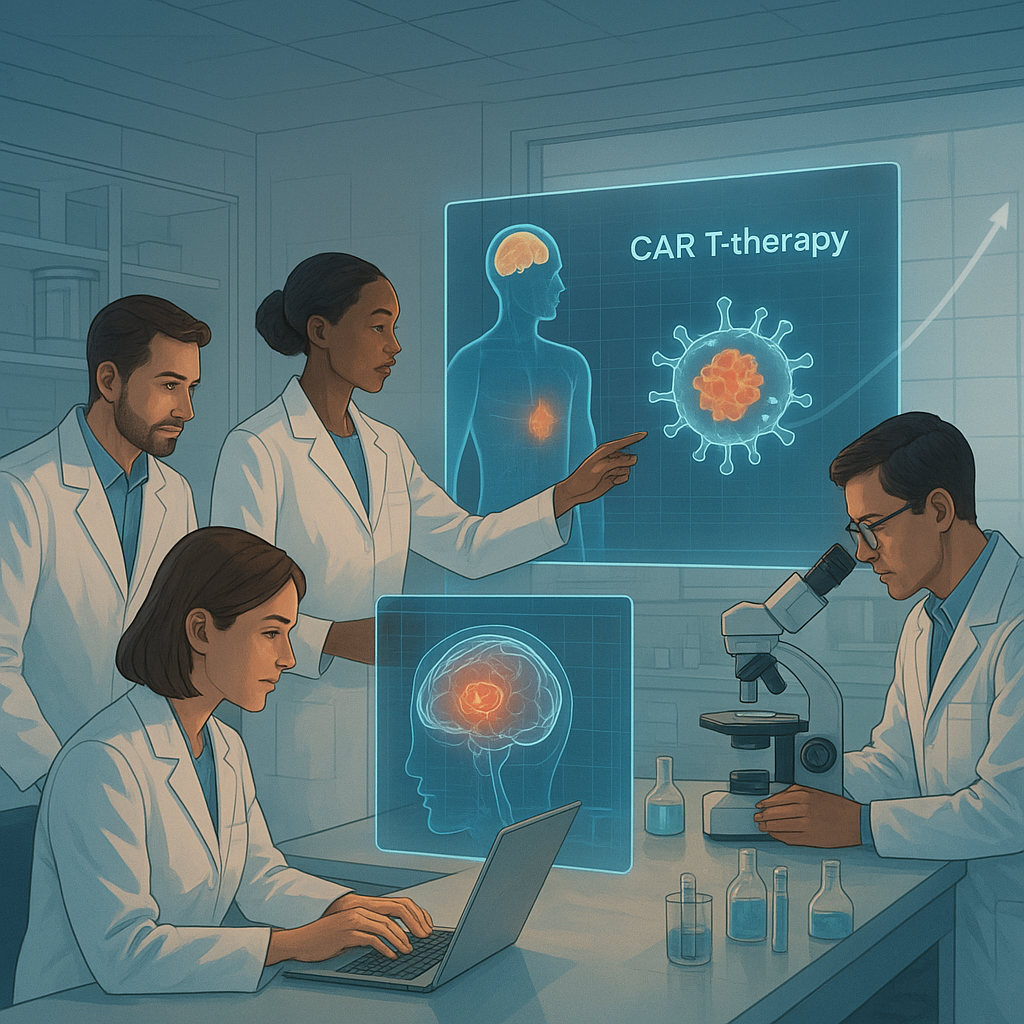
Comparison table: CAR T for childhood brain cancer vs. standard treatment
| Approach | Main Strength | Main Weakness | Typical Use | What It Means for Families |
|---|
| CAR T therapy | Potentially precise immune targeting | Early stage, hard delivery, uncertain safety | Experimental / clinical trials | Could offer a new option when standard care is not enough |
| Surgery | Immediate tumor removal when feasible | Often incomplete in risky locations | Standard care | Can reduce tumor burden but may not remove all disease |
| Radiation therapy | Effective in controlling local disease | Can affect developing brain tissue | Standard care or adjuvant | Helpful, but long-term side effects are a real concern |
| Chemotherapy | Broad anti-cancer effect | Less selective, systemic toxicity | Standard care | Often part of treatment, but exhausting and imperfect |
| Targeted therapy | Can be more specific than chemo | Works only if the target is present | Some tumor subtypes | Useful in select cases, not a universal fix |
The table tells the story better than any press release. CAR T is not a replacement for standard care today. It is an experimental move aimed at a disease where current options are often blunt. The comparison is not “new versus old.” It is “possible future versus difficult present.”
That distinction matters. Anyone claiming otherwise is selling something.
Common mistakes to avoid when reading this news
Most coverage of biotech funding makes the same mistakes, and they get old fast.
- Mistake 1: Treating fundraising as proof of clinical success.
Money is not data. It is fuel. Sometimes fuel reaches the engine; sometimes it sits in the tank while the car stalls. - Mistake 2: Assuming CAR T works the same in every cancer.
It doesn’t. Blood cancers are not solid tumors. Brain tumors are even trickier because of location, heterogeneity, and safety constraints. - Mistake 3: Ignoring toxicity.
The news cycle loves response rates and hates side effects. That is backward. For children, safety is not a footnote. - Mistake 4: Confusing one early trial with a cure.
Early signals can be encouraging without being definitive. Plenty of programs look good at first and then stall. - Mistake 5: Forgetting the patient experience.
Families do not live inside abstract efficacy curves. They live through hospital stays, fear, uncertainty, and hope that has to be handled carefully.
Here’s the kicker: a lot of tech and biotech journalism borrows the same lazy language. “Breakthrough.” “Revolutionary.” “Transformative.” Those words get cheap when used every other week. Serious readers should ask sharper questions. What target? What delivery method? What toxicity profile? What are the actual inclusion criteria? What happens if the tumor escapes antigen detection?
That skeptical habit is healthy. It keeps excitement from turning into nonsense. It also respects the people involved. Children with cancer are not a market segment. They are kids. Their families deserve sober analysis, not cheerleading.
That view lines up with a basic moral rule most people understand, whether they phrase it religiously or not: human ingenuity should serve human dignity, not crush it. Good science is disciplined service.
Frequently asked questions
What is CAR T therapy?
CAR T therapy is a form of cell therapy where a patient’s T cells are modified to recognize and attack cancer cells. It has worked well in several blood cancers and is now being studied for harder targets, including solid tumors and brain tumors.
Why is childhood brain cancer so hard to treat?
Because the tumors are in a sensitive organ, often near critical structures, and many treatments can damage healthy brain tissue. Add the blood-brain barrier, tumor diversity, and the need to protect development, and you get a very tough problem.
Is BrainChild Bio’s treatment available to patients now?
Not as a standard treatment, no. This kind of program is generally in clinical development, meaning it is being tested in trials before broader use.
Does this funding mean the therapy works?
No. It means the company has more resources to keep testing and refining the approach. In biotech, funding is a start, not a finish line.
Final thought
This is the kind of news that deserves cautious optimism. Not the sloppy kind, where every large check gets treated like a medical miracle, but the sober kind that recognizes a hard problem and backs the people trying to solve it with discipline.
BrainChild Bio’s $116 million raise signals real confidence in a difficult idea: that engineered immune cells might one day help children with brain cancer in ways current treatments cannot. That possibility is worth pursuing. Children deserve better than a shrug, and families deserve science that takes their suffering seriously.
But the measure of the work will not be the size of the round or the shine of the headlines. It will be whether the therapy can reach the tumor, control the disease, and do so without stealing too much from the child’s future. That is the standard. Anything less is just expensive noise.