Did Chinese AI Labs Train on Restricted Nvidia Blackwell GPUs? What Model Weights Can—and Can’t—Prove
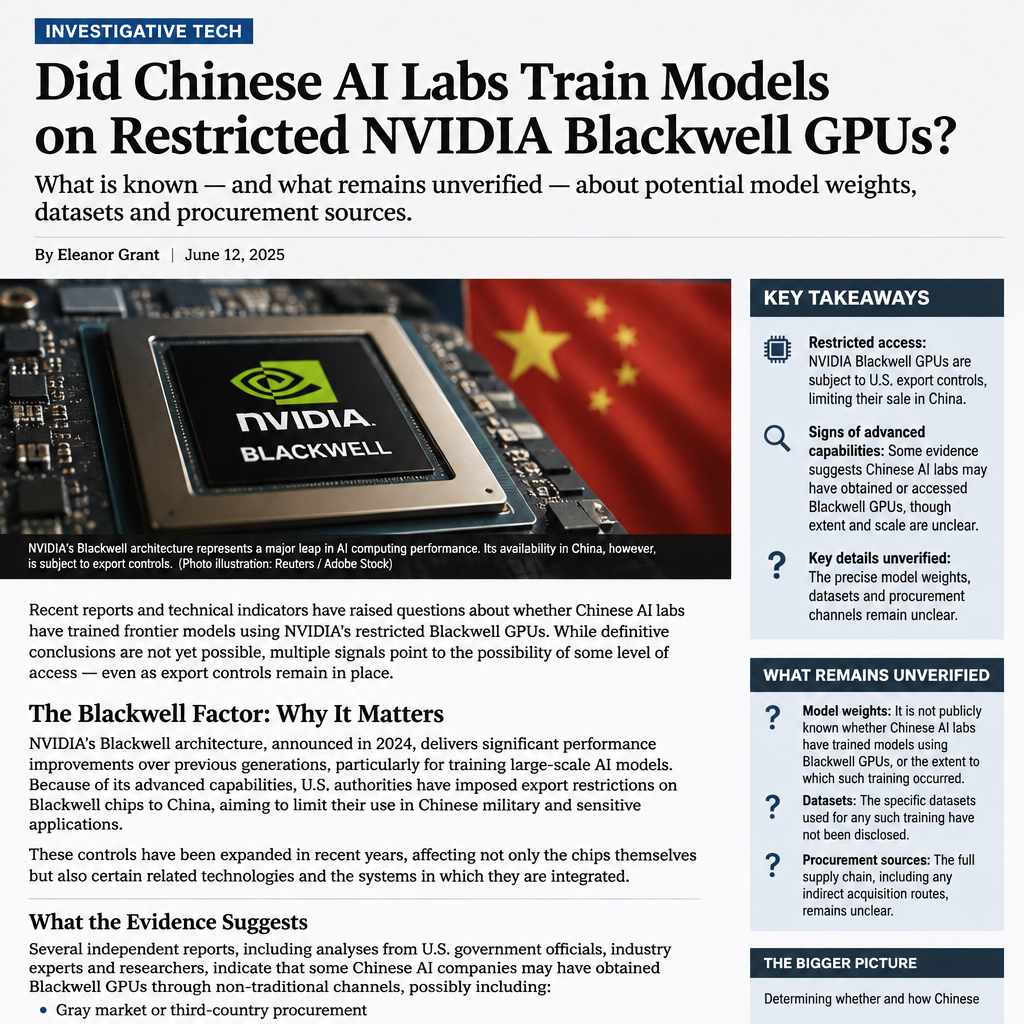
Model-weight analysis may reveal clues about the chips used to train an AI model, but it cannot, by itself, prove where a training run happened or who owned the hardware. Claims about DeepSeek, Moonshot AI, MiniMax, and Ant Group therefore deserve serious scrutiny—not a verdict based on suggestive technical patterns alone.
The distinction matters. If the reported analysis is sound, it could help officials and researchers spot possible access to restricted chips that ordinary shipment records miss. But an inference about hardware is not the same thing as evidence that a named company broke a law. Training may involve multiple chip types, cloud providers, contractors, or facilities in different countries, and the legal details depend on the controls in force at the time.
There is another problem with the broader account: it also includes personal allegations about Nvidia CEO Jensen Huang and an executive at another company. Those allegations are not evidence for a claim about model training, and the technical discussion does not establish them. A careful report should verify personnel claims separately against reliable records and official statements—or leave them out. Frankly, mixing sensational personal claims with a chip-provenance question makes both harder to assess.
What Is AI Model-Weight Fingerprinting?
A model’s weights are numerical values adjusted during training. They shape how a neural network responds to input, but they are not a record of every event that produced the model. A released set of weights is closer to a finished recipe than a kitchen security camera: it may retain traces of the process, but it does not show every ingredient, tool, cook, or location.
The research described in reporting is attributed to Will DePue, a former OpenAI researcher who leads the nonprofit Unemployment Labs. The account says DePue examined openly released models from DeepSeek, Moonshot AI, MiniMax, and Ant Group, and identified patterns he connects with Nvidia Blackwell hardware. It names DeepSeek V4 and Moonshot’s Kimi K3 releases among the models of interest. That is a potentially important claim. The public account, however, does not itself provide enough detail to independently assess the method, error rate, or strength of the evidence.
Why might hardware leave a trace? Training calculations use numerical formats, software libraries, processor instructions, and choices about precision. Different hardware and software combinations can produce small numerical differences, even when the underlying model and training data are similar. Researchers may look for recurring patterns in those differences and compare them with known runs. Nvidia’s description of the Blackwell platform outlines its hardware and computing capabilities, but a product specification does not validate a fingerprinting method.
A pattern can also have several possible causes. The software framework, compiler, optimization settings, quantization, model architecture, and training schedule can all affect numerical results. A large training run may use more than one kind of accelerator, and a model can be fine-tuned or modified after its main training stage. The final weights may blend those stages together.
That is why the phrase Blackwell fingerprint should be treated as a hypothesis that needs testing, not as a label stamped into every model file. A strong study would explain which measurable features it used, how it established reference examples, how often it misclassified other chips, and whether independent teams could reproduce the result. Without that information, readers can understand the claim, but they cannot audit it fully.
Why the Claim Matters
The issue is bigger than one model release. Export controls aim to limit access to certain advanced computing capabilities, so a reliable way to identify likely use of restricted hardware could help investigators check whether those controls work. But the tool is only useful if it separates a real signal from coincidence, and if it helps answer a precise question rather than merely generating suspicion.
- It could flag leads that shipping records miss. A company might use cloud capacity or a third-party data center rather than import hardware directly. Model analysis could give investigators a reason to examine contracts, compute logs, and facility records. A flag is not a conviction.
- It could improve transparency. Labs that publish models could be asked to disclose where training occurred, what hardware was used, and which providers supplied compute. Clear disclosures would help customers, researchers, and officials compare claims with records.
- It could sharpen policy debates. If restricted chips can be accessed through overseas data centers, rules aimed only at hardware sales or final destinations may leave gaps. The policy question then becomes who can use the compute, under what terms, and how access is monitored.
- It could help vendors manage risk. Chipmakers, cloud providers, and data-center operators have reasons to check customers and end uses. Strong evidence may support better controls; weak evidence can expose ordinary customers to unfair suspicion.
- It could improve public understanding of AI capability. Training compute matters, but it is not the only ingredient. Data quality, engineering, model design, training methods, and inference-time resources also shape performance. A chip name alone does not explain why a model is capable.
The figures in the reporting also need careful reading. Epoch AI estimates cited in the account put about two million advanced chips into China during 2024 and 2025 through schemes intended to hide their final destination, and around 275,000 Nvidia AI accelerators imported into Malaysia during those years. Those are estimates, not a public itemized inventory proving that every chip was smuggled or used by a Chinese AI lab. The numbers may describe a serious enforcement challenge, but they do not identify the hardware behind a particular training run.
Here’s the kicker: access to a chip and a violation of export law are different questions. A Chinese company might rent compute in another country, while the hardware is legally owned and installed there. Whether a particular arrangement is allowed depends on the applicable rules, parties, end use, licensing, and dates. A model-weight signal might help point an inquiry in the right direction, but it cannot settle those legal questions alone.
There is a human concern here, too. Advanced chips are products of extraordinary engineering, and their value depends partly on whether they serve useful work without undermining public safety or basic rights. Responsible stewardship means enforcing rules fairly, making evidence inspectable, and not treating technical suspicion as permission to accuse first and check later.
How to Assess a Chip-Fingerprint Claim
A careful review should move from the technical signal to corroborating records. I would not start with the most dramatic headline. I would start with the method, its controls, and the chain of evidence.
- Identify the exact claim. Record which model version, checkpoint, and release date are under discussion. Distinguish a claim that a model used Blackwell at some point from a claim that it was trained entirely on Blackwell, or that a named company operated the machines. Those are not interchangeable statements.
- Ask what the fingerprint measures. The researchers should describe the features extracted from the weights and explain why those features are expected to differ across hardware. Ask whether the method identifies a particular GPU generation, a software stack, or simply a family of training conditions. Vague labels make weak evidence look stronger than it is.
- Demand reference tests. A useful method needs examples trained on known hardware, with comparable model architectures, software, precision settings, and training procedures. The investigators should test both positive and negative examples, report false positives and false negatives, and show results on models not used to build the detector.
- Check for mixed compute. Large labs may divide work across devices, locations, or providers. Some stages may use one accelerator and later stages another. Fine-tuning, distillation, and quantization can also change a model after its initial training. Ask whether the analysis can identify a stage or only a broad resemblance.
- Look for independent replication. A second group should attempt the analysis without relying on private guidance from the original team. Ideally, researchers would publish code, describe limitations, and let qualified reviewers test the method against blinded model samples. Reproducibility is not a decorative extra; it is the difference between an intriguing observation and a dependable tool.
- Match technical clues with operational evidence. Investigators can compare model-release timelines with cloud contracts, data-center capacity, GPU shipment records, access logs, invoices, and credible statements from the organizations involved. Each record has limits, but several independent lines that point to the same conclusion are more persuasive than one pattern in a weight file.
- Check the applicable rule and date. Export-control rules change. The relevant question is not just whether a chip was restricted in general, but which hardware, destination, end user, end use, and transaction were covered at the time. The Federal Register’s advanced-computing export-control rule and the current Export Administration Regulations are starting points; a specific legal conclusion requires the full facts.
- Write the conclusion at the level the evidence supports. If the analysis points to a possible hardware family, say that. Do not turn it into a claim about a company’s intent, the exact data-center location, or a law violation unless separate evidence supports those statements. I have reviewed enough technical claims to know that precision in wording is not pedantry; it prevents a clue from being sold as a verdict.
This process takes longer than reposting a striking chart. It is also how a claim earns the attention of people who understand both machine learning and export law. If the reported fingerprint holds up under blind testing and independent review, it could become a valuable investigative signal. If it does not, that result is useful too: it keeps policy from leaning on a measurement that cannot bear the weight placed on it.

Model-Weight Fingerprints vs. Compute Audits
The strongest comparison is not between Blackwell and another chip. It is between model-weight analysis and audited compute records, the more direct method for establishing which machines a training job used. They answer related questions, but they do not produce the same kind of proof.
| Evidence method | What it can show | Strength | Main limitation |
|---|
| Model-weight fingerprint analysis | A released model may contain patterns associated with particular hardware or training conditions. | Can flag models for further review, including when internal logs are unavailable. | Inference can be confounded by software, precision, mixed hardware, later training, and unknown reference data. |
| Compute and data-center audit | Logs, contracts, hardware inventories, access records, and job histories may show which compute was available and used. | More direct evidence when records are complete, authentic, and independently checked. | Records may be incomplete, split across providers, withheld, or difficult to connect to the exact model version. |
A fingerprint can be useful precisely because investigators may not have access to a company’s private logs. It may help narrow a large field of models to a smaller set worth examining. Yet its strength depends on validation: a detector that confuses one software stack with a chip generation could send an inquiry in the wrong direction.
An audit offers a more concrete trail. It can connect a training job to a cluster, a contract, and a customer account, but only if the records are preserved and the identity links are sound. A cloud provider’s hardware inventory does not prove which customer used each machine. A shipment record does not prove where a chip ended up. Even direct records need context.
The best answer is usually triangulation. Weight analysis can generate a lead; server logs and contracts can test it; shipping, ownership, and licensing records can clarify the chain. If those sources agree, confidence rises. If they conflict, investigators need to explain why rather than quietly choosing the most dramatic interpretation.
The available account describes its model analysis as compelling, but it does not establish that every named model was trained wholly on Blackwell, that the chips were in mainland China, or that a specific company violated a rule. Those are separate propositions. The same caution applies to claims about offshore facilities: Malaysia’s reported accelerator imports may merit scrutiny, but location alone does not demonstrate illegal access or use by a particular lab.
Common Mistakes to Avoid
The first mistake is treating technical resemblance as a serial number. Model parameters do not carry a neat manufacturer stamp. A researcher may find a pattern that appears more often in runs using one hardware family, but that remains an inference until the method is tested against alternative explanations and independent samples.
The second is saying the models were trained entirely on a restricted chip. A training pipeline can combine devices, providers, and locations. A model can be pretrained on one cluster, fine-tuned on another, and distilled into a smaller model elsewhere. Unless the analysis can isolate those stages, a sweeping statement outruns the evidence.
The third is confusing access with ownership. A lab can use computing capacity without owning the physical accelerators. Conversely, a shipment into a country does not prove that a specific lab used the hardware. Ownership, location, access, end user, and end use are distinct facts; export rules may treat them differently.
The fourth is collapsing offshore compute into a legal conclusion. Renting servers in Malaysia or another country may raise questions about access, control, and licensing, but geography alone does not answer them. Rules can reach some foreign transactions or end uses, and the details matter. The Nvidia Blackwell overview explains the product family, not whether a particular customer’s use was lawful.
The fifth is using aggregate estimates as case-specific proof. A national or regional estimate can help describe the scale of a problem, but it cannot identify a buyer, a server rack, or a training job without additional records. Numbers with many zeroes are impressive. They are not a substitute for tracing a particular transaction.
The sixth is letting sensational side claims do the work of evidence. Allegations about executives, personal relationships, or intelligence ties must be checked independently and should not be presented as fact merely because they appear beside a technical story. Nvidia’s official leadership page is one place to verify company leadership; it does not establish allegations about private conduct or export violations. Frankly, those are different reporting lanes.
Finally, avoid assuming that a rule’s intent proves its effectiveness. A policy can be designed to restrict access and still have gaps; a possible gap does not automatically prove evasion. Better enforcement requires useful records, workable standards, and careful treatment of legitimate cloud services and research. That balance protects national security without punishing people or organizations on the basis of a guess.
Frequently Asked Questions
Can a model’s weights prove which GPU trained it?
Not on their own. Weights may contain numerical patterns that researchers associate with hardware or training conditions, but those patterns can also reflect software, precision choices, optimization, or later training. The strength of a claim depends on reference tests, disclosed error rates, and independent replication. Even a well-validated detector would normally identify a likely signal, not establish who owned the machines or where they were located.
Does a Blackwell fingerprint prove that export controls were violated?
No. It could justify a closer look, but a legal violation depends on facts beyond the model’s final weights. Investigators would need to establish the relevant hardware, parties, destination, access, end use, licenses, and rules in force at the time. A chip may also be in an offshore data center, which raises different questions from a direct shipment into China. Technical evidence and legal analysis have to meet in the middle.
Could a Chinese AI lab use Nvidia chips outside China?
A company may obtain computing services through a data center or cloud provider outside its home country, but whether a particular arrangement is permitted depends on the applicable controls and transaction details. The existence of overseas capacity does not itself prove evasion, just as a lawful-looking contract does not settle every end-use question. Investigators need records connecting the customer, hardware, location, and training activity.
What evidence would make the reported claim stronger?
A public methodology, known-hardware reference runs, blind tests, independent replication, and clearly reported error rates would strengthen the technical case. Compute logs, cloud contracts, access records, shipment documents, and licensing information could then corroborate the inference. The strongest account would state what remains unknown, including whether training used a mix of chips or took place across multiple facilities.
Final Thought
A technical fingerprint is most valuable when it starts a careful investigation, not when it ends one. If the analysis attributed to Will DePue can be independently reproduced, it may give researchers and officials a new way to notice possible access to restricted compute. That would be consequential. It would also require discipline: publish the method, show where it fails, and resist turning a probability into a headline that names a culprit.
Export controls are difficult to enforce across global supply chains, cloud services, and data centers. That difficulty is not a license to lower evidentiary standards. Nor is uncertainty a reason to ignore a credible lead. The sensible response is to compare independent records, identify what each can actually establish, and revise the conclusion when new evidence arrives.
Most importantly, public debate should keep the technology question separate from unverified personal allegations. A model’s weights cannot validate a story about an executive’s private life, and a disputed personnel claim cannot prove where a training run took place. Let evidence do its own work.
Advanced computing is a human achievement with real consequences. The point of responsible oversight is not to stop useful invention, but to keep powerful tools accountable and direct their benefits toward people rather than avoidable harm. That calls for strong technical work, fair enforcement, and modest claims. Anything less is noise wearing a lab coat.