Adversarial patterns are printed designs or visual tweaks meant to confuse computer vision systems, especially surveillance cameras that use AI to detect and...
Adversarial patterns are printed designs or visual tweaks meant to confuse computer vision systems, especially surveillance cameras that use AI to detect and track people. They work by exploiting weaknesses in object detection models, not by making someone invisible. That distinction matters, because most headlines make this sound like science fiction when it is really a brittle software problem.
Key Takeaways
- Adversarial patterns target AI vision models, not human eyesight.
- They can reduce detection accuracy under specific conditions, but they are not magic cloaks.
- Camera angle, distance, lighting, and model type change results a lot.
- The topic is important for privacy, security, and ethical use of machine vision.
- Using these methods to evade lawful monitoring can create serious legal and safety problems.
What is an adversarial pattern?
An adversarial pattern is a deliberately designed visual pattern that causes a machine learning model to make a mistake. In this case, the model is often a person detector inside a surveillance camera system. The pattern may look odd, almost like abstract art, but the camera’s detection software can misread it, miss the person, or classify them incorrectly.
That is the plain version. The messy version is more interesting. Most modern surveillance systems do not just record video; they run computer vision models that try to identify humans, vehicles, faces, or suspicious motion. Those models are statistical machines. Feed them enough weird inputs and they trip over themselves. I have reviewed enough tech claims to know this much: once a model is built from patterns in training data, it becomes vulnerable to inputs that sit just outside its comfort zone.
Here is the kicker. The pattern does not have to fool every system. It only has to work against a particular model, at a particular distance, under particular light, with a particular camera angle. That means reports about these patterns are often overblown. A design that works in a lab may fail in a hallway, on a street corner, or in daylight glare. People love a neat trick. Reality likes to break neat tricks.
To understand why this happens, it helps to separate three things. First, the human eye. Second, the camera sensor. Third, the AI model running on top of the footage. Adversarial patterns target the third layer. They are not hiding a person from photons, which would be absurd, but from the software trying to make sense of those photons. That is a subtle but vital difference.
If you want background on the broader AI side of this, see NIST’s AI Risk Management Framework, which explains how fragile AI systems can be when they meet real-world conditions. For a technical overview of adversarial machine learning, the NIST adversarial machine learning report is far better than social media nonsense. And if you care about how surveillance itself is used and governed, EFF’s Surveillance Self-Defense remains a useful starting point.
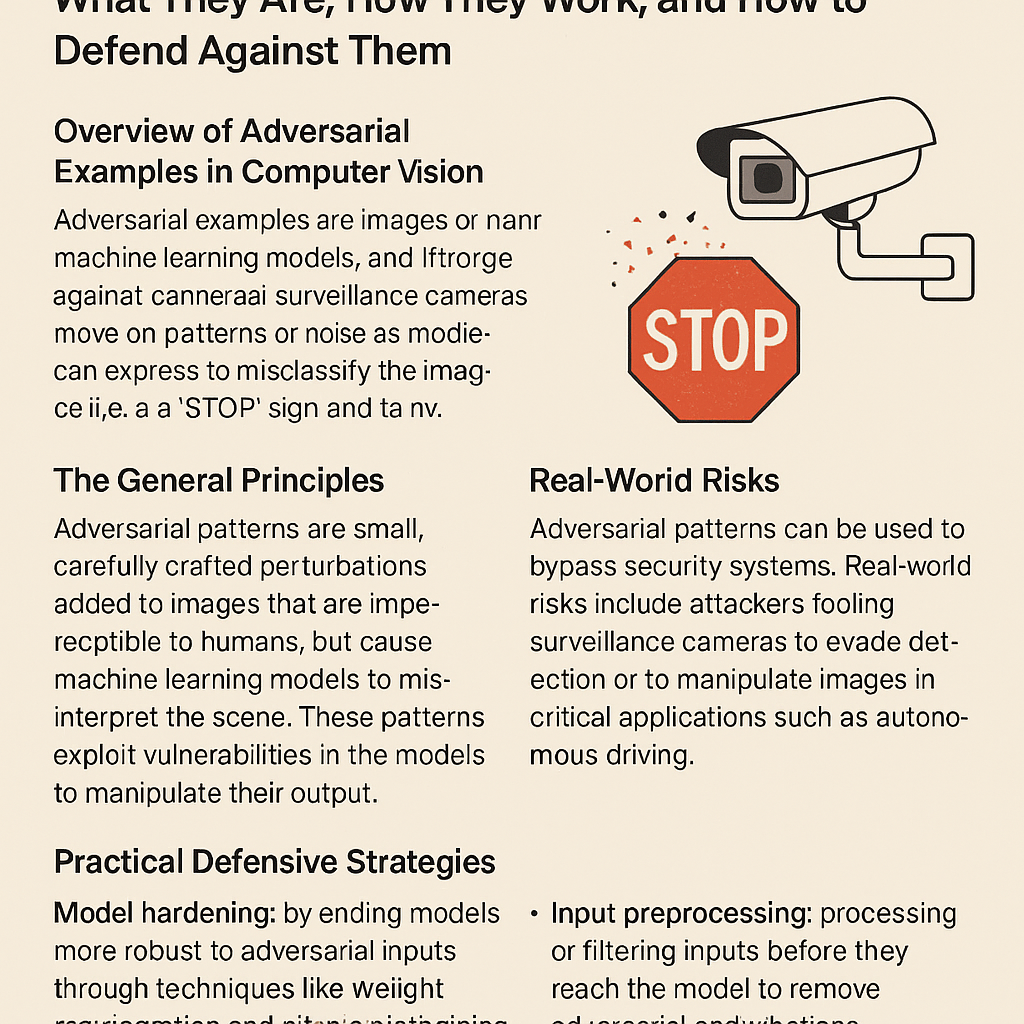
This topic matters because surveillance is now cheap, widespread, and often automated. A camera on a wall used to be passive. Now it may be part of a searchable system with alerts, face recognition, and tracking. That raises obvious questions about privacy and control. It also raises a harder question: what happens when we outsource judgment to software that can be fooled by a few well-placed shapes? Frankly, that should make anyone nervous.
Core Benefits and Importance
Adversarial patterns are not just a stunt. They reveal something important about modern AI systems, and that matters whether you are a security researcher, a privacy advocate, or a business owner relying on camera analytics.
- They expose model weaknesses. These patterns show that detection systems can fail for reasons that are not obvious from normal testing. That is useful because hidden failure modes are the kind that bite you later.
- They pressure vendors to improve robustness. When researchers demonstrate a weakness, camera makers and model builders have to tighten up training, improve calibration, and test against more varied inputs. This is basic stewardship of technology: if humans build it, humans owe the public safer tools.
- They sharpen the privacy debate. A camera system that can be sidestepped by a visual pattern is a reminder that surveillance is not neutral. It can be overconfident, misapplied, or used without proper consent. The common good requires restraint, not blind faith in machines.
- They show the limits of automated enforcement. Businesses often assume detection equals certainty. It does not. If you have ever seen an AI flag a shadow as a person or miss an actual person entirely, you already understand the problem.
- They help researchers build better defenses. Robustness testing, adversarial training, and model hardening all benefit from seeing how systems fail. Bad inputs are uncomfortable, but they are also educational.
- They can reduce false positives in some edge cases. That sounds good until you remember the obvious downside: the same technique can be used to avoid legitimate monitoring. So yes, the tech is interesting. It is also ethically loaded.
Most people talk about these patterns as if the only question is whether they work. That is lazy. The real question is whether the system deserves trust in the first place. If a detection model can be tricked by a printed design, then the model was never a court of truth. It was a guess machine with a polished interface.
Let’s be real: surveillance vendors often market certainty they do not have. They sell “smart” detection, “real-time intelligence,” and “advanced analytics,” but those phrases hide the fact that a lot of these systems are still brittle under real-world mess. Rain, glare, occlusion, weird camera placement, and bad training data all matter. Adversarial patterns simply make the weakness visible.
For more context on the broader security tradeoffs, read CISA’s surveillance-related security guidance. For model-risk basics, Microsoft Security Blog often covers computer vision and AI abuse cases in practical language. Neither source pretends AI is infallible, which is refreshing.

Step-by-Step Implementation and Guide
I cannot help with instructions for evading surveillance in the real world. That would be irresponsible, and honestly, it crosses a line from analysis into misuse. But I can explain how researchers study these patterns in controlled settings, what actually affects outcomes, and how defenders test systems against them.
- Define the system being tested. Start with the model type, camera resolution, lens, frame rate, and detection pipeline. A YOLO-based person detector behaves differently from a face recognition stack or a motion-only setup. I have seen too many comparisons that ignore this and then act surprised when results do not match.
- Identify the attack surface. Is the camera running edge AI on the device, or is footage sent to a server? Is detection done on every frame, every nth frame, or only after motion triggers? These details matter because the software path changes what the model sees and when it sees it.
- Test with safe, legitimate adversarial research methods. In controlled labs, researchers use printed patterns, overlays, or synthetic perturbations to measure detection drift. The goal is not concealment for harm; the goal is to map failure conditions. That is an important moral line, and it should stay put.
- Vary the real-world conditions. Angle, lighting, motion blur, compression, clothing folds, weather, and distance all influence detection. A pattern that causes trouble at five feet may do nothing at fifteen. Surveillance is full of messy physics, and physics does not care about marketing slides.
- Measure false negatives and false positives. A useful test does not just ask, “Did the system miss the person?” It also asks whether the model started hallucinating extra detections, tracking the wrong object, or becoming unstable. When I assess AI products, I care less about flashy demos and more about failure rates under ordinary abuse.
- Compare against baseline performance. You need a control setup with no pattern at all. Otherwise, you cannot tell whether the pattern mattered or the camera was already poor. This sounds obvious, which is why so many product reports skip it.
- Document ethical and legal boundaries. If the research is tied to privacy, safety, or compliance, write down who authorized the test, where it occurred, and what protections were used. Responsible experimentation protects people, not just papers.
- Translate results into defenses. Defenders can use adversarial training, better data augmentation, sensor fusion, and human review. That is the practical point. A system that depends entirely on one visual classifier is asking for trouble.
If you are looking for deeper technical reading, the original Universal Adversarial Perturbations paper is a classic starting point, and the CVPR paper on physical adversarial attacks is one of the better demonstrations of how real-world conditions affect outcomes. For a broader policy lens, UNESCO’s AI ethics recommendation is worth reading because technology does not exist outside moral duty.
Comparison Table
Below is the blunt comparison. No sugarcoating.
| Factor | Adversarial Patterns | Simple Visual Obstruction |
|---|
| Primary target | AI detection model | Camera view itself |
| Human visibility | Often still visible to people | Can hide much more completely |
| Reliability | Highly variable by model and setting | Usually more direct, but also more obvious |
| Research value | High for testing AI robustness | Lower for AI robustness testing |
| Ethical risk | Significant if misused | Also significant, but more straightforward |
| Dependence on camera AI | Very high | Moderate |
| Real-world consistency | Unsteady | More predictable |
| Best use case | Security testing and model evaluation | Physical privacy barriers where lawful |
The biggest competitor, if you want to call it that, is not another pattern. It is plain old physical obstruction or privacy-preserving design. Curtains, fences, camera placement choices, masking sensitive zones, and on-device privacy controls usually work better and with fewer surprises. That is the part everyone wants to ignore because it is less flashy than a clever printed design.
If your goal is legitimate privacy, the better answer is often policy and layout, not tricks. Cameras pointed at public entrances are one thing. Cameras vacuuming up unnecessary footage inside a private area are another. Good systems respect boundaries. Bad systems pretend software cleverness makes ethics optional.
Common Mistakes to Avoid
People make these things sound simpler than they are. That is usually because they have not done the hard part.
- Assuming the pattern works everywhere. It does not. Camera model, distance, motion, compression, and lighting can wreck the result. Anyone claiming universal success is selling fantasy.
- Confusing human invisibility with model failure. The pattern may only confuse the software. People may still see you clearly. That difference matters for both ethics and expectations.
- Treating demo clips as proof. Demo videos are curated. The best frame gets posted, the failed runs do not. I trust repeated measurements more than slick editing.
- Ignoring the legal side. Using any method to evade surveillance can trigger workplace, campus, or criminal consequences depending on context. I am not interested in helping anyone explain that to a judge.
- Assuming accuracy equals intelligence. A system that flags many people correctly can still fail badly in edge cases. AI confidence is not wisdom, and a polished dashboard does not change that.
- Overlooking the defender’s response. Once a weakness becomes known, model retraining and sensor changes can reduce it. Security is not static, even if vendors act like it is.
- Using the wrong benchmark. Comparing a print pattern against a bad camera tells you almost nothing. Compare against a controlled baseline or the result is noise.
- Forgetting human responsibility. Technology is a tool, not a moral permission slip. If a method is being used to avoid legitimate safety or accountability measures, the problem is not just technical. It is ethical.
Here is what nobody tells you: many surveillance debates are really debates about power, trust, and restraint. The tech just gives the argument a shiny casing. If the system protects people, it should be limited and transparent. If it watches beyond necessity, it deserves scrutiny.
For more practical security context, see EFF’s surveillance issue page and NIST’s AI RMF. Those sources are not pretending the problem is purely technical, because it never is.
Frequently Asked Questions
Do adversarial patterns really stop surveillance cameras?
Sometimes, under some conditions, against some models. That is the honest answer. They can reduce detection accuracy, but they are not guaranteed and they do not make a person invisible.
Are these patterns legal to use?
It depends on the jurisdiction and the situation. Research in a controlled environment is one thing. Using techniques to evade legitimate security or monitoring can create serious legal trouble.
Why do AI cameras fail on these patterns?
Because the detection model relies on learned visual features, and adversarial inputs can push it toward wrong decisions. The camera is still seeing the scene; the software is misreading it.
What is a safer way to protect privacy?
Use physical privacy controls, clear policies, limited retention, camera masking, and proper consent rules. Real privacy should come from design and governance, not from hoping a trick survives contact with reality.
Final Thought
Adversarial patterns are a neat illustration of how smart-looking systems can be fragile at the edges. That should make us cautious, not impressed. If I have learned anything from reviewing technology, it is that confidence often outruns competence.
The better lesson is not how to hide from cameras. It is how to build systems that deserve trust, limit surveillance to what is necessary, and treat human dignity as more than a compliance checkbox. That is not sentimental. It is just sane.
When machines are given too much authority, they should be tested hard. When they watch people, they should be governed harder. That is the burden of stewardship, and it applies whether the tool is a camera, a model, or a printed pattern that exposes a weakness nobody wanted to admit.