Jensen Huang Resignation Claim: What Nvidia Investors Should Verify
The report says Jensen Huang has resigned from Nvidia. It also ties the claimed board decision to allegations of an affair and espionage, but those serious claims require an identifiable regulatory filing or direct company statement before anyone repeats them as established fact. Treat the report as unverified.
A leadership change at the largest or one of the largest technology companies would matter to employees, customers, suppliers, shareholders, and the wider AI sector. The allegations attached to this one matter for a different reason: reputational damage can spread much faster than reliable evidence. Keep those questions apart.
The report supplies a sequence of events and large market figures, but it does not identify a year, filing accession number, or direct company announcement. That makes the claims difficult to pin to a date and independently check. The sensible response is not to turn an alarming story into a fact by repeating it confidently.
What is the Jensen Huang resignation report?
It is a claim that Jensen Huang left his roles as Nvidia president and chief executive, that the company’s board accepted his resignation, and that CFO and executive vice president Colette Kress became interim CEO while continuing as CFO. The report also links that claimed change to an allegation of a romantic relationship with someone described as a Chinese spy. Those are separate assertions, and each needs evidence of its own.
The distinction matters. A company can confirm an executive departure without confirming an explanation for it, and an allegation about national security is not established merely because it appears beside a corporate announcement. I would look for the original filing, an Nvidia statement, and credible independent reporting before treating either the resignation or the allegation as settled.
For a US-listed company, a material executive departure or appointment is commonly disclosed through an SEC Form 8-K. Item 5.02 covers departures and appointments of certain directors and officers. Nvidia’s filing record is searchable through the SEC company filings index. The filing itself should show the date, the change, and any details the company chose to disclose. A headline is not a substitute.
The report says the board accepted a resignation on Wednesday and that the announcement came Thursday, but without the calendar date or filing identifier, readers cannot check that timeline cleanly. Nor does the account establish whether Huang’s departure would be immediate, effective on a later date, or limited to particular positions. Corporate titles matter; so do the precise words in the filing.
Nvidia’s published leadership page and its investor filings can help confirm the company’s stated leadership at a particular time. They should be read with their publication dates in view. A current page may change after a report is published, while an archived filing preserves what the company disclosed on a given day.
Frankly, a report that names a filing but leaves out its date and accession number asks readers to do too much guessing. The personal allegation deserves even more restraint: unless a reliable, attributable source establishes it, repeat it as an allegation, not as a fact. That is basic accuracy, not special pleading.
Why would a leadership change matter?
Nvidia’s importance goes beyond one executive’s public profile. Huang founded the company in 1993 and led it through a difficult early period, when graphics chips were not an instant hit, before its GPU designs became central to PC graphics. The company’s history page provides background on that development: Nvidia’s corporate timeline.
The GPU’s parallel-processing design also proved useful beyond rendering game graphics. Many calculations can be handled at once, which made GPUs attractive for scientific computing and later for training and running neural networks. Nvidia’s CUDA platform, introduced in 2006, gave developers tools to use the company’s GPUs for work beyond graphics; its developer documentation explains that software stack at CUDA documentation.

That history helps explain why the report, if confirmed, could draw attention across the technology business. AI companies rely on access to accelerators, software, data-center capacity, and a dependable product roadmap. Cloud providers and researchers care about hardware availability and software compatibility, not just who sits in the chief executive’s chair. A change in leadership may prompt questions about execution, but it does not automatically change a chip design or cancel a customer contract.
The practical stakes include:
- Product planning: Customers building data centers want clear delivery schedules, support commitments, and a roadmap they can plan around. A leadership transition can lead to questions; it does not by itself answer them.
- Software continuity: CUDA is part of a broad developer ecosystem. Teams have training, code, and operating practices built around it, so they will watch for signs of continuity rather than assume an abrupt technical break.
- Supplier confidence: Chip production depends on a long chain of manufacturing, packaging, memory, and equipment partners. Their decisions depend on purchase orders and forecasts as well as executive news.
- Investor expectations: Nvidia’s share price reflects expectations about future sales and profit, not simply the present-day performance of its GPUs. A sharp move can signal uncertainty, but it cannot identify the cause on its own.
The report attributes an early Thursday decline of nearly 12%, a fall of as much as 19% since Friday, and a market-value loss above $855 billion to the news. It also gives a prior share price of about $15, a later peak of $243, and a market value near $5.88 trillion. Those are reported figures, not independently confirmed numbers here; the missing year and exact trading dates make comparisons hard to audit.
Here’s the kicker: a stock chart cannot tell you whether investors reacted to a CEO report, broader technology selling, interest-rate expectations, export rules, a change in AI spending, or several things at once. Market capitalization also moves with the share price and share count. A dramatic estimate is not self-authenticating evidence.
Technology should serve people, not become an excuse to ignore them. The choices surrounding powerful computing deserve attention to human dignity, responsible stewardship, and whether the benefits reach beyond a narrow set of firms. That question remains relevant whether Huang stays, leaves, or the report proves wrong.
How to verify the report, step by step
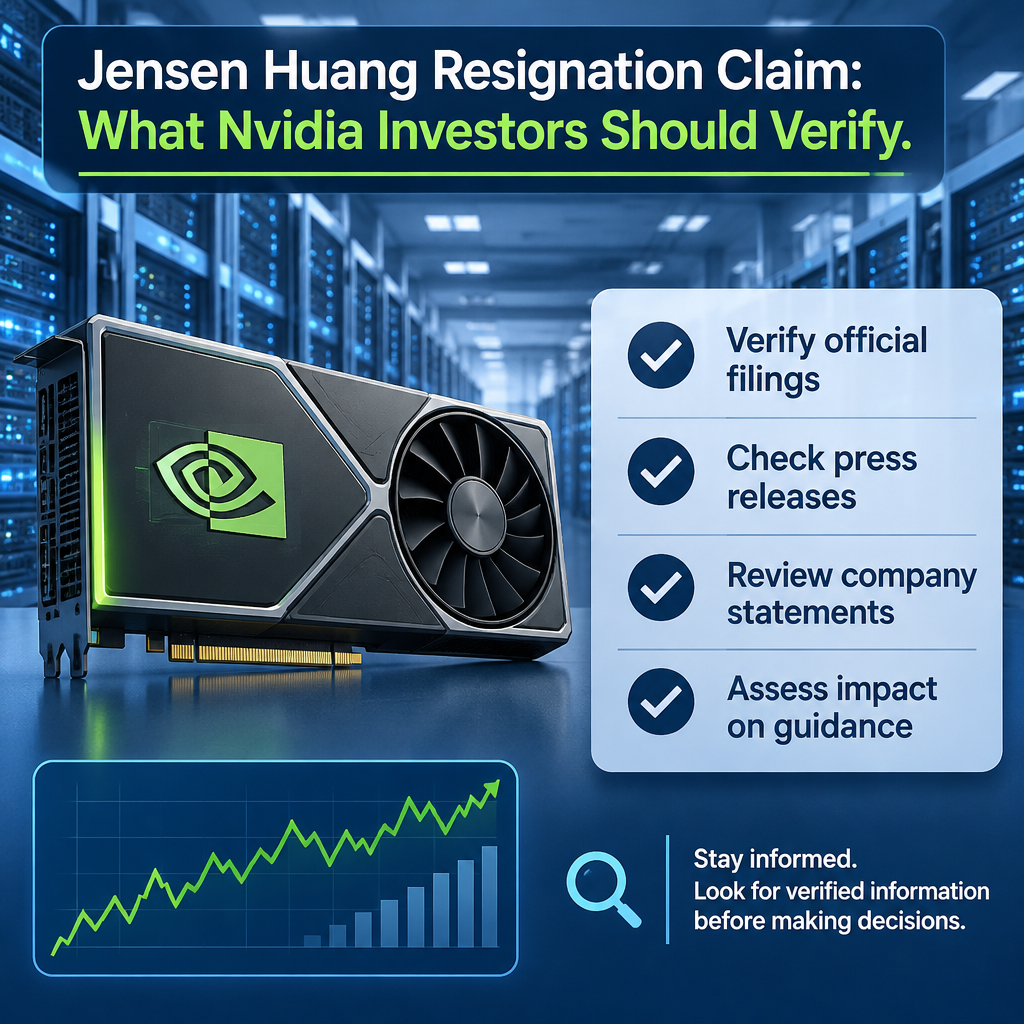
A few checks can separate a real corporate disclosure from a dramatic but poorly documented claim. I would do them in order, beginning with primary records and only then interpreting market reaction. This is not a prediction about Nvidia’s shares; it is a way to establish what has actually been reported.
- Find the filing. Search Nvidia’s SEC record for the relevant date and look for a Form 8-K, especially an Item 5.02 disclosure about an executive departure or appointment. Check the filing date, accession number, and full text. If the report gives no filing identifier, the SEC index is a practical place to look rather than relying on screenshots or copied snippets.
- Read the company’s own words. Compare the filing with Nvidia’s official newsroom and leadership information. Note whether the company says Huang resigned, whether the board accepted a resignation, and when any change takes effect. Those phrases may describe different steps in a transition. Do not turn a proposed or future arrangement into an immediate one.
- Confirm the interim role. The report says Colette Kress would be interim CEO while remaining CFO. Verify both parts in the company disclosure. An interim appointment can be temporary, but the exact authority, effective date, and reporting arrangements matter. Do not infer that the CFO role has been vacated if the statement says it continues.
- Separate the personal allegation. A leadership filing may not substantiate an alleged affair or espionage connection. Look for credible reporting that names its sources, relevant public records, or an attributable statement from a competent authority. If none exists, leave the claim unconfirmed. Do not identify a private individual or add details that the evidence does not establish.
- Pin down the market dates. Check a reputable quote source for the exact trading sessions, then compare percentage changes with the same starting point. Confirm whether a share-price series is adjusted for stock splits. A price change, a market-cap estimate, and a claimed dollar loss are related but not interchangeable measures.
- Look for independent confirmation. Two stories repeating the same unattributed claim are not necessarily two sources. Compare original records with reporting from outlets that independently contacted the company or named relevant sources. If all versions trace back to one statement without documentation, the evidence has not grown just because the story was copied widely.
- Update the conclusion when evidence changes. A filing can confirm a departure while leaving the reason undisclosed. A later correction can also change a date or market figure. Keep the conclusion proportional: say what the document establishes, what independent reporting adds, and what remains unknown.
This process is deliberately plain. It is meant to prevent a common error: treating a claim about a serious personal matter as if it were part of a verified company announcement. Frankly, five minutes with the actual filing can be more useful than an hour spent arguing over a cropped post.
Nvidia vs. AMD: what the comparison can tell us
Nvidia’s biggest rival in data-center accelerators is AMD, though the companies do not have identical product portfolios or software ecosystems. Comparing them helps explain the business stakes of a leadership claim, but it does not verify that claim. The report provides no comparable AMD share-price, market-cap, or leadership-change figures, so a numerical stock comparison would be made up.
| Comparison point | Nvidia | AMD |
|---|
| Reported leadership event | The report says Huang resigned and Kress became interim CEO; confirm in a filing. | No comparable AMD leadership event is described in the report. |
| AI computing platform | Nvidia GPUs and CUDA are central to its developer and data-center approach. CUDA documentation. | AMD offers Instinct accelerators and ROCm software; see AMD’s ROCm page. |
| Historical role described | The report traces Nvidia from gaming GPUs toward general-purpose computing and AI. | No AMD history or product performance figures are supplied here. |
| Financial comparison | The reported Nvidia price and market-value figures lack a year and exact dates. | No matching AMD figures are given, so relative returns cannot be calculated. |
| What customers should assess | Availability, performance, software support, power use, cost, and roadmap clarity. | The same practical measures apply; benchmark the workload rather than the slogan. |
The product comparison is more useful than a made-up market-cap contest. Nvidia’s software tools and installed base can make a switch expensive for customers, while AMD’s competing software and accelerator offerings give some buyers another route. The right choice depends on the workload, code support, performance in real systems, supply, and total cost—not a brand’s headline share price.
For investors, the leadership question adds governance and execution risk to those product factors. For customers, continuity of support and delivery can matter more than a temporary change in executive titles. For both groups, a confirmed filing would be a starting point, not a complete forecast of business performance.
Common mistakes to avoid
The first mistake is obvious but common: repeating a serious allegation as fact because it appears beside a business announcement. The second is treating every market move as a verdict on one executive. Neither shortcut survives careful checking.
- Confusing an allegation with confirmation. Words such as “spy” carry grave implications. Use them only with clear attribution, and distinguish a claim from a finding by a court or a public statement by an appropriate authority. If the reporting does not show how the claim was established, say that it remains unverified.
- Treating a filing reference as proof without locating the filing. A report may accurately describe a filing, but readers should still check the original record. Verify the issuer, date, document type, and relevant passage. A copied paragraph without a link or filing number is not the same thing as access to the document.
- Assuming a share-price drop proves causation. Shares move for more than one reason, often at the same time. Compare the company’s move with broader market and sector movement, check the dates, and avoid claiming that one headline caused every dollar of a decline unless evidence supports that conclusion.
- Mixing price and market capitalization. Share price alone does not show the full value of a company. Share count changes, stock splits, and the chosen date affect comparisons. A percentage decline can be accurately calculated from a chart while a quoted dollar loss still relies on a different starting point.
- Treating an interim CEO as a permanent successor. “Interim” means temporary or provisional in the appointment described; it does not name the eventual leader. Don’t infer that a succession search is complete, or that the CFO has left finance duties, unless the company says so.
- Assuming product leadership vanishes with one executive. Nvidia’s engineering, sales, software, manufacturing relationships, and customer contracts involve many teams. A founder can shape strategy profoundly, yet products do not appear or disappear at the moment a title changes. Watch the actual roadmap and disclosures.
Most tech commentary rewards certainty, even when certainty is the least defensible position. Here’s what nobody tells you: careful wording is not weakness. It lets readers distinguish the company event, the market reaction, and the personal allegation instead of blending three claims into one sensational story.
Frequently Asked Questions
Did Jensen Huang resign as Nvidia’s CEO?
The report says that he did and says Nvidia’s board accepted his resignation. That statement should be checked against a dated company announcement or SEC filing before it is presented as confirmed. The report does not give a filing accession number or year, so those details should not be guessed. Nvidia’s SEC filing index is the place to look for the primary record.
Has the alleged affair or espionage connection been confirmed?
The report makes that allegation, but the information described here does not establish it. A corporate leadership notice would not, by itself, prove a personal relationship or a national-security claim. Use careful attribution, do not add identifying details, and wait for reliable evidence from named sources or appropriate public records. Serious accusations deserve more than repetition.
What would Colette Kress becoming interim CEO mean?
If confirmed as described, Kress would temporarily take on the chief executive role while continuing as CFO. The exact authority, timing, and duration would depend on Nvidia’s announcement and board decisions. “Interim” does not establish who will become permanent CEO, nor does it necessarily end her finance responsibilities. Read the filing rather than guessing at the internal arrangement.
Why did Nvidia shares fall, and does the drop prove the report is true?
The report attributes a steep decline to the news, but a share-price move cannot verify a resignation or establish its cause. Investors may react to company disclosures, sector-wide selling, forecasts, or outside economic news. Check the dates and figures against a reliable market source, then look for company records to verify the event itself. The chart and the filing answer different questions.
A reported leadership change can be important without every accompanying claim being true. Separate the evidence, keep the dates straight, and resist turning a large number or a shocking allegation into a shortcut for proof.
When I assess a story like this, I start with the document that should exist if the corporate event occurred, then compare it with what the company actually says. That approach may feel less exciting than instant certainty, but it protects readers from repeating claims that can harm real people and distort business decisions.
Nvidia’s role in computing is worth examining on its own merits: its GPUs, CUDA ecosystem, data-center business, competitors, customers, and the dependence of AI development on concentrated computing capacity. Those issues will remain important regardless of who occupies the CEO’s office. The useful question is not only who leads a powerful technology company, but whether its tools are developed and used responsibly, with benefits that reach people beyond the boardroom.
Before treating the resignation or personal allegations as settled, check the filing, verify the timeline, and attribute every claim carefully. That is less dramatic than a viral post. It is also how reliable reporting is done.