UPS is doing something rare in logistics. It is making less money on less volume and looking better for it. The company raised its forecast after trimming...
Less Amazon, More Profit: How UPS Raised Its Forecast by Cutting Low-Yield Deliveries
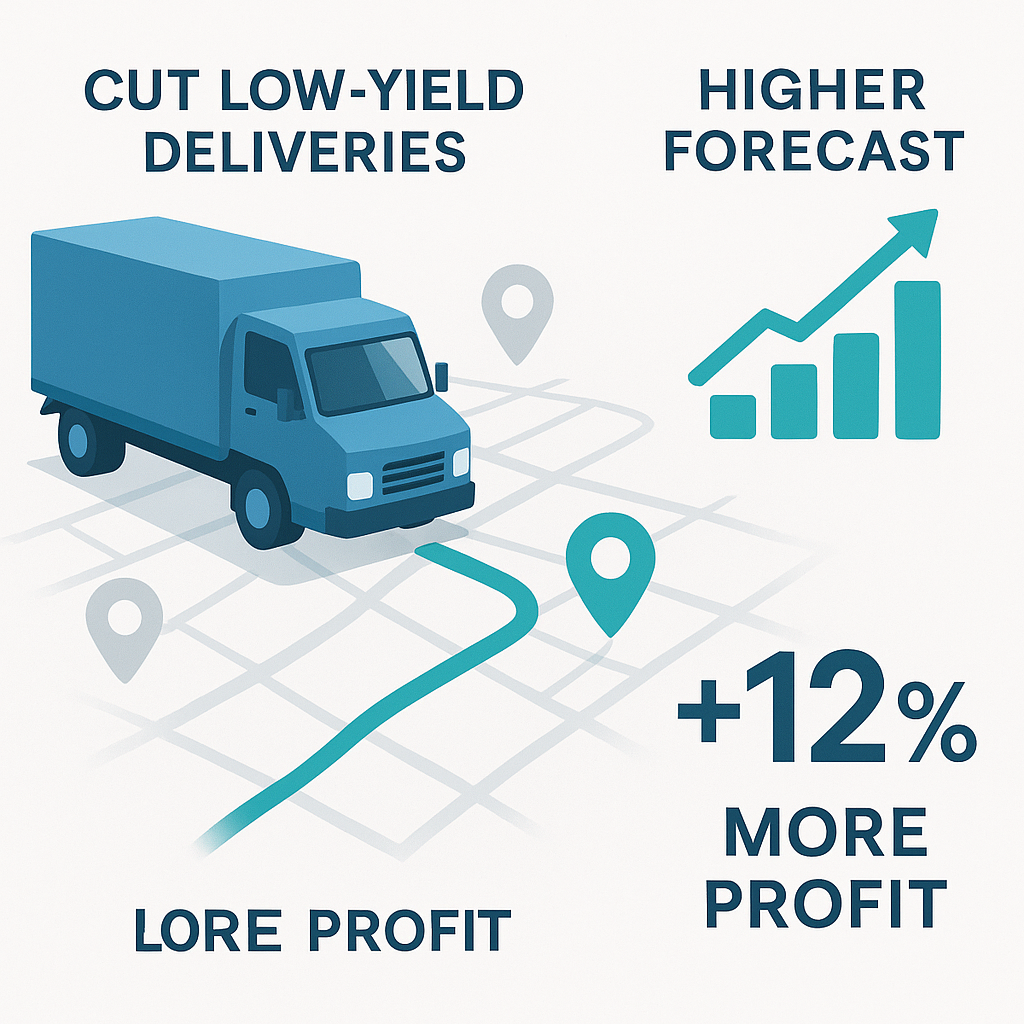
UPS is doing something rare in logistics. It is making less money on less volume and looking better for it. The company raised its forecast after trimming millions of low-yield Amazon deliveries, and that tells you something plain: not all package volume is worth the trouble. I’ve watched enough earnings calls to know the trick, and this one is simple. Revenue growth sounds nice, but margin discipline pays the bills.
Key Takeaways- UPS is prioritizing profit over parcel count.
- Cutting low-yield Amazon deliveries can improve margins even if volume falls.
- The move reflects a broader shift in logistics toward selective shipping, not blind growth.
- Investors care less about “more packages” and more about what each package earns.
- Good logistics is stewardship, not a race to move junk faster.
What is UPS doing, exactly?
UPS is reducing exposure to Amazon’s lower-margin package volume while focusing on shipments that produce better returns. That means fewer deliveries, but not necessarily worse business. Frankly, that’s the whole point. A parcel network is not a charity, and moving boxes that barely cover fuel, labor, and sortation costs is a fast way to get busy and broke.
The company’s move fits a pattern I’ve seen across shipping, warehousing, and last-mile delivery: volume is not the same as value. Amazon is a giant customer, sure, but giant customers often squeeze suppliers on price. When I look at a carrier’s numbers, I do not ask how many packages it touched first. I ask whether those packages earned enough after the truck rolls, the sort centers run, and the drivers get paid.
UPS operates in a business built on network efficiency, delivery density, fuel costs, labor contracts, and service mix. Small changes in mix can swing earnings more than people expect. Here’s the kicker: lower-yield packages can clog up the system. They consume route capacity, warehouse handling, and driver time without paying much back. That is bad arithmetic.
This also says something about the market itself. In a world obsessed with scale, some companies eventually realize that growth without margin is just expensive noise. That is not corporate poetry. It is basic discipline, the sort of thing any decent steward would respect. Resources should serve people well, not merely pile up on a spreadsheet.
For readers tracking the logistics side of tech and commerce, this move is worth watching alongside broader shifts in retail operations and shipping automation. If you want a useful primer on how modern fulfillment gets managed, see The Wall Street Journal’s coverage of UPS’s Amazon strategy, and for the broader e-commerce backdrop, Reuters retail and consumer reporting is a steady source.
Why does this matter?
The first reason is margins. Lower-volume business can still be healthier business if the revenue per stop is higher, the routes are denser, and the operating costs stay sane. UPS is basically saying that not every package deserves a slot in the network. I agree. Most people obsess over revenue and ignore the ugly little line called operating profit.
The second reason is pricing power. When a carrier walks away from bad freight, it can improve its negotiating position. That matters because logistics customers love to demand speed, accuracy, and cheap rates all at once, which is adorable in the same way a toddler demanding dessert before dinner is adorable. Someone has to say no.
The third reason is operational sanity. Massive parcel networks are brutal machines. Sortation, linehaul, delivery windows, customer service, and exception handling all compound. A few million low-yield shipments can create a lot of friction. Reduce the friction, and the whole machine runs cleaner.
The fourth reason is strategic focus. UPS has been pushing into higher-value areas such as healthcare logistics, time-critical shipping, and premium business services. Those categories tend to pay better because the shipper cares about reliability, compliance, and handling rather than just cheap movement. That is a smarter bet than fighting every discount battle.
The fifth reason is cultural. Companies that chase every unit of volume often train themselves to tolerate mediocrity. Companies that prune weak business learn to respect their own capacity. That sounds old-fashioned because it is old-fashioned, and it still works.
Here are the core benefits in plain terms:
- Better margins: fewer low-return deliveries can lift profit per shipment.
- Cleaner network use: trucks, hubs, and drivers are reserved for better-paying freight.
- Less pricing pressure: the carrier is not desperate to keep every client.
- More strategic flexibility: UPS can concentrate on segments with stronger economics.
- Improved investor confidence: markets usually reward disciplined operations.
If you want context on how logistics discipline affects markets and shipping firms, Bloomberg’s logistics coverage often frames these tradeoffs well. And if you care about labor, routing, and fleet pressure, CNBC’s logistics reporting keeps the corporate spin in check.
How should you think about this strategy?
Think of UPS like a tech company pruning bad code. It is removing the stuff that slows the system down. That’s the cleanest analogy I can give, and yes, it fits. A network becomes more valuable when it spends less energy on low-return work.
- Look at yield, not just volume. The important question is how much each package contributes after direct and indirect costs. Package count is vanity. Yield is reality.
- Check the customer mix. Amazon is a great customer only if the economics are fair. If a client uses scale to hammer rates too hard, the carrier eventually has to choose between growth and profitability. I’ve seen enough vendor relationships to know which side wins when the numbers get ugly.
- Track network density. Delivery density matters because scattered stops burn fuel and labor. Dense routes are easier to optimize, easier to staff, and easier to profit from.
- Watch premium services. Healthcare, next-day, time-definite, and business-critical shipments usually carry better margins. These are the lanes where reliability matters more than bargain pricing.
- Measure pricing discipline. If a carrier keeps every low-margin customer, it is often too scared to say no. Good pricing discipline signals that management understands cost structure.
- Don’t confuse “less” with “worse.” This is where a lot of analysts get lazy. Smaller volume can produce stronger earnings if the mix is better. The truth is, some of the best operations are boring on purpose.
When I read earnings reports, I care about the boring parts. Fuel surcharge mechanics. Labor productivity. Route efficiency. Sortation throughput. Those are the gears. The glossy slide deck is just paint.
For readers who want a broader look at how companies optimize operations and routing, this guide on technology operations and logistics is useful, though you should still read it with one eyebrow raised.

Comparison table: UPS vs. a volume-first competitor
UPS is not the only carrier under pressure, but its current strategy is more selective than a pure volume-chasing approach. Here’s a simple comparison with a hypothetical volume-first competitor model, the kind that takes every parcel and smiles through the pain.
| Factor | UPS selective strategy | Volume-first competitor |
|---|
| Primary goal | Higher profit per shipment | Maximum parcel count |
| Customer mix | More premium, higher-yield accounts | Broad, lower-margin accounts |
| Network load | Better controlled | Often strained |
| Pricing discipline | Stricter | Softer, more discount-driven |
| Margin outlook | Stronger if mix improves | Weaker if costs outrun revenue |
| Operational focus | Efficiency and selective growth | Raw expansion |
| Investor appeal | Better for profit-focused markets | Better only if growth converts to profit |
| Risk | Losing some volume | Getting trapped in low-return business |
This is the part a lot of people miss. A company can look smaller and be healthier. That is not a flaw. It is adult behavior.
If you want a source closer to the company’s own numbers, UPS Investor Relations is the place to check quarterly results and guidance. No fluff there, just the ledger.
Common mistakes to avoid
The biggest mistake is assuming fewer Amazon deliveries automatically mean trouble. Maybe, sometimes. But not every cut is a retreat. Some cuts are a correction. That distinction matters, and it is where a lot of lazy commentary goes off the rails.
Another mistake is treating logistics like a pure scale game. It is not. Scale helps only when the cost structure can absorb it. Otherwise you get bloated operations, thin margins, and a management team that keeps calling the same problem a temporary one. Frankly, that word is often a lie in a necktie.
A third mistake is ignoring mix. People love to quote parcel volume because it sounds concrete. It is concrete, sure, but not always useful. If the new packages are more profitable, the business can improve while the headline number falls. That makes spreadsheet watchers uncomfortable, which is exactly why it matters.
A fourth mistake is assuming Amazon is the enemy. It is not that simple. Big shippers negotiate hard because they can. Carriers negotiate hard because they must. The real issue is whether the relationship still makes sense economically. Business is not about loyalty theater.
A fifth mistake is forgetting the human side. Drivers, sorters, dispatchers, and warehouse staff absorb the consequences of bad mix. When networks get overloaded by cheap volume, workers carry more strain and less stability. A sane operation should respect labor as a real asset, not a disposable cost line. That lines up with a basic Catholic instinct: work should serve human dignity, not crush it.
A few practical warnings:
- Do not judge strategy by one quarter alone.
- Do not confuse revenue growth with healthy earnings.
- Do not assume any large customer is automatically good.
- Do not ignore fuel, labor, and route efficiency.
- Do not mistake busy for profitable.
If you want a balanced take on shipping trends and business freight, The Wall Street Journal’s transportation coverage is worth checking, and Reuters transportation reporting usually stays close to the facts.
Frequently Asked Questions
Why would UPS cut Amazon deliveries?
Because some deliveries do not pay enough to justify the cost of handling them. If the margin is weak, the volume is not worth much.
Does fewer Amazon parcels mean UPS is shrinking?
Not necessarily. It may mean UPS is shifting toward better-paying shipments and improving its mix.
Is this bad for customers?
It can be for shippers who relied on cheap capacity. For the market overall, better pricing and healthier operations can make service more stable over time.
What should investors watch next?
Watch operating margin, package yield, network efficiency, and the performance of premium business segments. Volume alone tells only part of the story.
Final thought
UPS is doing something that sounds dull and looks smart. It is choosing discipline over noise, and that is rare enough to be worth noticing.
Most of the time, the market rewards companies that chase more. More units. More routes. More headlines. But the better business move is often the less glamorous one: protect the network, keep the margins clean, and stop hauling freight that barely earns its keep. I’ve seen too many firms confuse motion with progress. This is not progress by hype. It is progress by subtraction.
There is also a deeper point here, and it is one that modern business forgets at its peril. Tools, fleets, warehouses, and algorithms are meant to serve people. They are not idols. If a logistics network gets too big to govern well, too cheap to sustain well, or too stretched to treat workers fairly, something is off. Good management should be accountable to the common good, even if it never uses those words out loud.
So yes, less Amazon can mean more profit. Funny how that works when the spreadsheet finally catches up with reality.