Meta’s new Glimmer AI model is a clue. It points to Mark Zuckerberg’s idea of <strong>personal intelligence</strong>, where AI stops acting like a distant...
Meta’s Glimmer AI Model and Zuckerberg’s Personal Intelligence Vision: What It Really Means
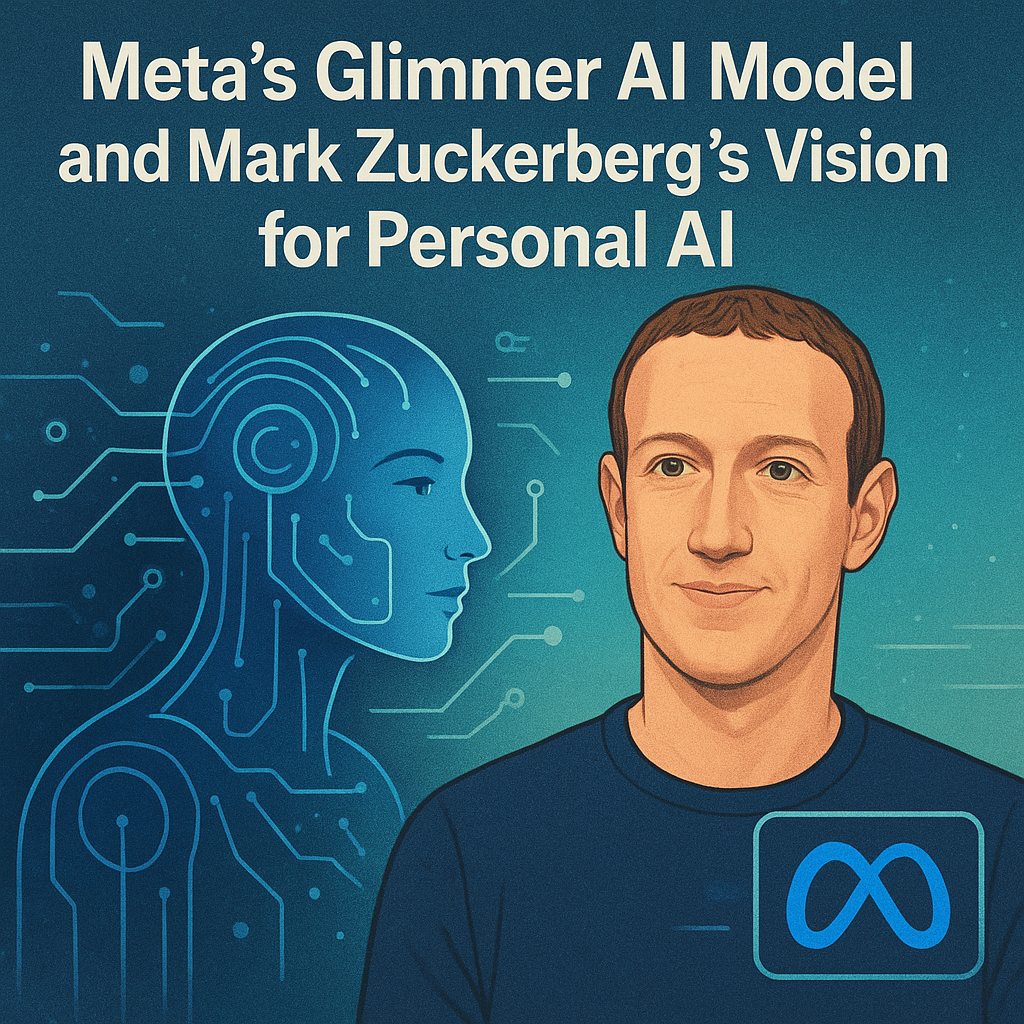
Meta’s new Glimmer AI model is a clue. It points to Mark Zuckerberg’s idea of personal intelligence, where AI stops acting like a distant cloud service and starts behaving more like an always-available assistant tuned to one person’s habits, goals, and context. That sounds neat. It also raises the usual mess: privacy, dependence, and whether the machine serves the user—or the other way around.
Key Takeaways:
- Glimmer appears to be part of Meta’s push toward personalized AI rather than one-size-fits-all chatbots.
- Zuckerberg’s vision centers on personal intelligence: AI that knows your preferences, work style, and daily context.
- The upside is obvious—faster help, better recommendations, fewer repetitive tasks.
- The risk is just as obvious—more data collection, more frictionless surveillance, and more temptation to outsource judgment.
- Most AI hype is glossy nonsense. What matters is utility, transparency, and whether the system respects human dignity.
- If Meta gets this right, it could reshape how people use phones, glasses, apps, and social platforms.
- If it gets it wrong, it becomes another polished machine for extracting attention.
What is Meta’s Glimmer AI model?
Meta’s Glimmer AI model is best understood as a signal, not just a product. It suggests Meta is working on AI that can adapt to an individual user’s routines, signals, and behavior across apps and devices. That is the heart of Zuckerberg’s personal intelligence pitch. The idea is simple enough: instead of asking a generic assistant a general question, you get an assistant that understands your calendar, your messages, your creative habits, your social graph, and maybe even the gear you wear.
I’ve reviewed enough tech launches to know the usual trick. Companies say “personalized,” and what they often mean is “we collected your data and called it convenience.” Frankly, that distinction matters. A true personal intelligence system would save time, reduce cognitive clutter, and surface relevant information without making the user feel like a lab rat. A sloppy one would just be a more polished ad machine.
Meta’s interest here is not mysterious. The company owns platforms where people already spend absurd amounts of time: Facebook, Instagram, WhatsApp, and now Threads. It also has a hardware angle through Quest headsets and smart glasses. That matters because personal intelligence only works if it lives where people already are. An AI assistant hidden in a separate app is a novelty. One woven into messaging, photos, voice commands, and wearable devices becomes infrastructure.
Here’s the kicker: this is not really about chatbots. It is about memory, context, and prediction. If Glimmer can remember that you prefer brief summaries, know when you are traveling, understand who you message most often, and adapt to your tone, then Meta has something powerful. If it cannot, then the model is just another benchmark trophy.
For broader context on how AI systems are being evaluated and deployed, see this overview of Meta AI research, plus reporting from The Verge and TechCrunch on consumer AI product strategy. If you want a practical frame for AI assistants, our own guide on AI assistants for daily work and the explainer on personal AI are useful starting points.
Core Benefits and why people should care
The promise is not magic. It is leverage. A well-designed personal AI can cut out a lot of friction, and not in some abstract future sense. Right now.
- Less repetition. If an assistant remembers your recurring tasks, preferred formats, and common contacts, you stop typing the same instructions over and over. That is real value.
- Better context. The model can use recent activity, calendar events, location cues, and communication patterns to give answers that are actually relevant.
- Faster decisions. People do not need more information all the time. They need the right information at the right moment, trimmed down to the useful bits.
- Smoother device integration. Meta’s hardware play matters here. Wearables, phones, and mixed reality devices can make AI feel more immediate.
- Reduced admin work. Drafting messages, summarizing threads, organizing photos, and setting reminders are boring tasks that machines should handle.
- Better accessibility. Voice-first and context-aware tools can help people who struggle with traditional interfaces.
But let’s not pretend every “benefit” is equal. Most users do not need a model to write poetry or generate fake art. They need a tool that remembers where they left the car keys, flags the next meeting, and cleans up a messy inbox without mangling the meaning. That is the real test.
There is also a moral angle here, and it is not optional. Human ingenuity should serve the common good, not just maximize screen time or ad clicks. That sounds old-fashioned because it is, and it is still right. A tool that helps people work honestly, communicate clearly, and spend more time on actual relationships is a fine use of software. A tool that keeps people docile and permanently stimulated is not.
For related reading, our article on best smart glasses shows why wearable AI matters, while privacy settings for connected devices explains how to reduce needless data exposure.

Step-by-step: how to think about Glimmer and personal intelligence
If you want to judge this honestly, do not get distracted by demo polish. Evaluate the system like a grumpy adult with bills to pay. I do.
- Check the use case first.
Does the AI reduce work, or just create a new interface for old tasks? A useful model should cut steps, not add ceremony.
- Look at memory behavior.
A personal intelligence model lives or dies on memory. Can it remember useful preferences without becoming creepy? Can you delete that memory easily?
- Inspect data boundaries.
Ask what stays on-device, what goes to the cloud, and what is used for training or ads. If the answer is vague, assume the worst.
- Test the tone.
A good assistant should be concise, accurate, and adaptable. Nobody asked for a digital cheerleader.
- Measure cross-app usefulness.
Does it work across chat, email, photos, search, and wearable devices? Or does it only shine in one sandbox?
- Watch for lock-in.
Personal AI gets sticky fast. Once it knows your habits, leaving becomes annoying. That is convenient, and also a trap.
- Audit outcomes, not promises.
Does the model save time every week? Does it improve decisions? Can you point to concrete wins? Marketing slides are cheap.
When I evaluate AI features, I ask one blunt question: does this respect the user’s agency? If the answer is yes, the product may have legs. If the answer is no, it is just a clever way to extract more attention.
Here is a simple rule: tools should remain tools. They are gifts of human skill meant for service, not idols to be fussed over. That applies to AI just as it applies to any other machine. Once the software starts shaping habits more than habits shape the software, you have a problem.
For a practical companion piece, read our AI privacy controls tutorial and our best AI productivity tools roundup.
Comparison table: Glimmer-style personal AI vs. generic assistant
| Feature | Meta Glimmer / Personal AI | Generic AI Assistant |
|---|
| Context awareness | Learns user habits, routines, and social context | Limited or session-based context |
| Memory | Persistent, if permitted | Often minimal or app-specific |
| Device integration | Stronger across Meta apps and wearables | Depends on ecosystem |
| Personalization | High | Moderate |
| Privacy risk | Higher, because more behavioral data is involved | Lower in some cases, but still present |
| Best for | Daily assistance, messaging, reminders, media, wearable use | General Q&A, drafting, simple tasks |
| Main weakness | Can feel invasive or overly sticky | Can feel shallow and repetitive |
The table makes the tradeoff plain. More personalization usually means more data, and more data means more responsibility. Shocking, I know.
Common mistakes to avoid
Most people misread these systems because they want a miracle. That is a good way to get burned.
- Assuming personalization equals intelligence.
A model can know a lot about you and still be mediocre at reasoning.
- Treating convenience as harmless.
If the AI makes things easier, users often stop noticing what they gave up to get there.
- Ignoring privacy settings.
Defaults are rarely designed in your favor. Check them. Then check them again.
- Believing demos are real life.
Product videos are staged. Actual use is messier, slower, and full of edge cases.
- Forgetting dependence.
If the model starts managing too much of your routine, a failure can be inconvenient—or worse, disorienting.
- Confusing novelty with value.
A chatbot that cracks jokes is not automatically useful. Most of that stuff is window dressing.
- Overlooking human judgment.
AI can sort, draft, and predict, but it should not replace conscience, discernment, or responsibility.
The truth is, good technology should make room for better human action, not crowd it out. That sounds almost quaint in an industry addicted to scale, but there it is.
Frequently Asked Questions
What is Meta’s Glimmer AI model?
It appears to be part of Meta’s effort to build personal intelligence: AI that adapts to individual users, their routines, and their context across devices and apps.
How is personal intelligence different from a regular chatbot?
A regular chatbot responds to prompts. Personal intelligence aims to remember preferences, infer context, and help across more of your digital life.
Is Meta’s approach better for consumers?
Potentially, yes, if it saves time and respects privacy. But if data collection grows faster than user control, the bargain gets ugly fast.
What should users watch for?
Watch memory settings, data-sharing policies, default permissions, and how deeply the AI gets embedded into your daily routines.
Final thought
Meta is not just chasing another model release. It is trying to redefine what AI means to a person, not a platform. That is the real story behind Glimmer. If Zuckerberg’s vision works, AI becomes less like a novelty app and more like a quiet layer beneath daily life—helpful, familiar, and hard to remove.
That sounds efficient. It also sounds dangerous if the balance is wrong.
I’ve seen enough technology cycles to know the pattern: first comes the promise of ease, then comes the concentration of power, and only afterward do people ask who benefited. The better path is simpler. Build tools that respect the user, protect the weak against hidden extraction, and serve actual human flourishing. In Catholic terms, technology should remain ordered toward the person, not the other way around.
So yes, Glimmer matters. Not because the name is cute. Because it may reveal whether Meta wants to make AI useful for people—or merely more intimate as a means of control. That difference is everything.