M&Ms are not a climate plan. Solar panels are not either, by themselves. The real work is making operations boring, visible, and accountable, which is...
M&Ms, Solar Panels, and Plain Language: Inside Slalom’s Climate Strategy
M&Ms are not a climate plan. Solar panels are not either, by themselves. The real work is making operations boring, visible, and accountable, which is exactly why Slalom’s climate strategy matters: it mixes practical energy choices, plain language, and steady measurement instead of grand speeches.
Key Takeaways- Climate work sticks when it is concrete, not theatrical.
- Solar, efficiency, and procurement matter more than slogans.
- Plain language helps employees act without confusion.
- Good climate strategy respects stewardship, people, and long-term responsibility.
- The best programs are measured, audited, and annoyingly specific.
What is Slalom’s climate strategy?
Slalom’s climate strategy is a business approach that treats emissions reduction as an operational discipline, not a branding exercise. It centers on reducing energy waste, buying cleaner power, improving office and travel policies, and communicating in plain language so people actually understand what to do. That sounds dull. Good. Dull is often what works.
When I analyze climate programs that last, the successful ones do not rely on heroics, press releases, or flashy one-off projects. They depend on repeatable controls: better building energy choices, cleaner electricity, lower-carbon travel, and supplier pressure that keeps waste from sneaking back in. Slalom’s angle is interesting because it pairs practical action with ordinary speech. No jargon fog. No fake urgency. Just decisions that can be checked.
That matters because many corporate climate efforts fail in the same way software projects fail: too many goals, too little clarity, and no one wants to own the mess. Slalom’s strategy, as described in coverage like Bloomberg’s profile of Meagan Breidert, leans into internal accountability and simple explanations rather than glossy theater. Here’s the kicker: if employees cannot explain the plan in one minute, the plan is probably bloated.
Climate strategy in a consulting firm also has a wider effect. Consultants shape client choices, vendor behavior, and travel habits across many organizations. That means the firm’s own operations become a kind of proof-of-work. If Slalom can show cleaner offices, smarter purchasing, and credible measurement, it has something more useful than a slogan. It has a working model.
I’ve reviewed enough tech and operations programs to know this pattern: the best ones look almost unremarkable from the outside. Solar panels on rooftops. Efficient hardware. Better meeting habits. Procurement rules that do not reward waste. That is not glamorous, but stewardship rarely is. The moral logic is simple enough for anybody to grasp: if people are gifts, time and resources should be treated that way too.
The climate part also has to survive contact with real operations. That means accounting for office power use, cloud and IT loads, commuting, business travel, and the long tail of purchased goods. Frankly, people love talking about carbon while ignoring the annoying spreadsheets that make carbon visible. Slalom’s strategy is useful precisely because it appears to respect the spreadsheet.
This is not about perfection. It is about fidelity to the facts. When a company says it wants to cut emissions, the proof lives in meters, invoices, travel data, and procurement decisions. If the numbers are not changing, the story is decorative. Who needs that?
Core benefits and why it matters
The benefits are concrete.
A climate strategy built on plain language and measurable actions does more than reduce emissions, because it changes how an organization thinks about ownership, waste, and tradeoffs, and that affects everything from office design to vendor selection to employee habits.
- Lower operating costs: Energy efficiency, smarter HVAC controls, and reduced waste often cut bills before they cut emissions. People forget this part because saving money is less exciting than announcing a pledge.
- Clearer employee behavior: When rules are simple, adoption improves. Tell people what to do in plain English and they usually do it. Wrap it in ten layers of corporate mush and everybody shrugs.
- Better decision quality: Emissions data forces leaders to compare options honestly. That is handy when buying power, choosing hardware, or changing travel policies.
- More credible client conversations: A firm advising others on sustainability needs a working example. Otherwise, the advice smells like perfume sprayed on a tire fire.
- Stronger resilience: Energy efficiency and distributed power planning reduce exposure to volatility, outages, and regulatory shocks.
- Ethical consistency: A Catholic view of stewardship asks whether resource use serves the common good. That does not mean austerity for its own sake. It means using skill, money, and equipment responsibly, not carelessly.
The biggest benefit is trust. Clients, staff, and partners can spot empty climate talk from a mile away. They may not know the emissions factor for grid power, but they know when a company is serious. Serious means specific. Specific means measurable. Measurable means someone is actually paying attention.
There is also an overlooked cultural benefit. A plain-language climate strategy teaches an organization to value clarity over performance. That spills into product work, operations, and customer support. Confusion breeds waste. Clarity trims it.
If you want a tech comparison, think of it like choosing a device with a clean operating system and good battery life instead of one stuffed with junk apps and fake features. The second option may look more impressive in the store. The first one gets used every day. That is the difference.
For context on how climate leadership is being framed in corporate and policy circles, the U.S. Department of Energy’s office on efficiency and renewable power remains a useful baseline: U.S. DOE EERE. It is not glamorous. It is useful. That counts.
Step-by-step guide to making it work
Start with the basics.
A climate strategy only works when it gets translated into habits, budgets, and checklists, because noble intentions without implementation are just wall art with a conscience.
- Measure the current footprint
I always start here, because guesswork is how companies lie to themselves without meaning to. Measure office power use, travel, cloud workloads where relevant, purchased goods, and facilities data. If you cannot see the numbers, you cannot cut them.
- Fix the easiest waste first
Replace inefficient lighting, tune HVAC schedules, reduce idle equipment use, and cut obvious energy leaks. This is not sexy. So what? Boring improvements often deliver the fastest returns.
- Buy cleaner electricity
Use renewable procurement where it makes sense, whether through utility programs, power purchase agreements, or verified renewable energy certificates. The trick is avoiding sloppy claims. Greenwashing is still greenwashing even if the slide deck has nice gradients.
- Simplify employee guidance
Write short rules for travel, office energy use, device purchasing, and meeting behavior. Say what matters. Say it twice if needed. People are not mind readers.
- Work with vendors
Ask suppliers for emissions data, packaging changes, repairability, and return programs. Procurement is a lever, and a large one. Most firms treat purchasing as paperwork, which is how waste sneaks in through the side door.
- Track progress publicly and internally
Use monthly or quarterly reporting with real numbers. Not vibes. Not half-baked estimates buried in footnotes. Numbers.
- Connect sustainability to service
Tie the program to customer impact, employee well-being, and long-term reliability. That keeps the effort from drifting into checkbox territory.
- Review and revise
Climate programs fail when they freeze. Revisit assumptions each year. If a tactic is not moving the metric, cut it loose.
When I look at programs that actually stick, I see three habits. First, they are operational, not ornamental. Second, they are explained in plain language. Third, they are reviewed often enough to catch nonsense before it calcifies. Simple, but not easy.
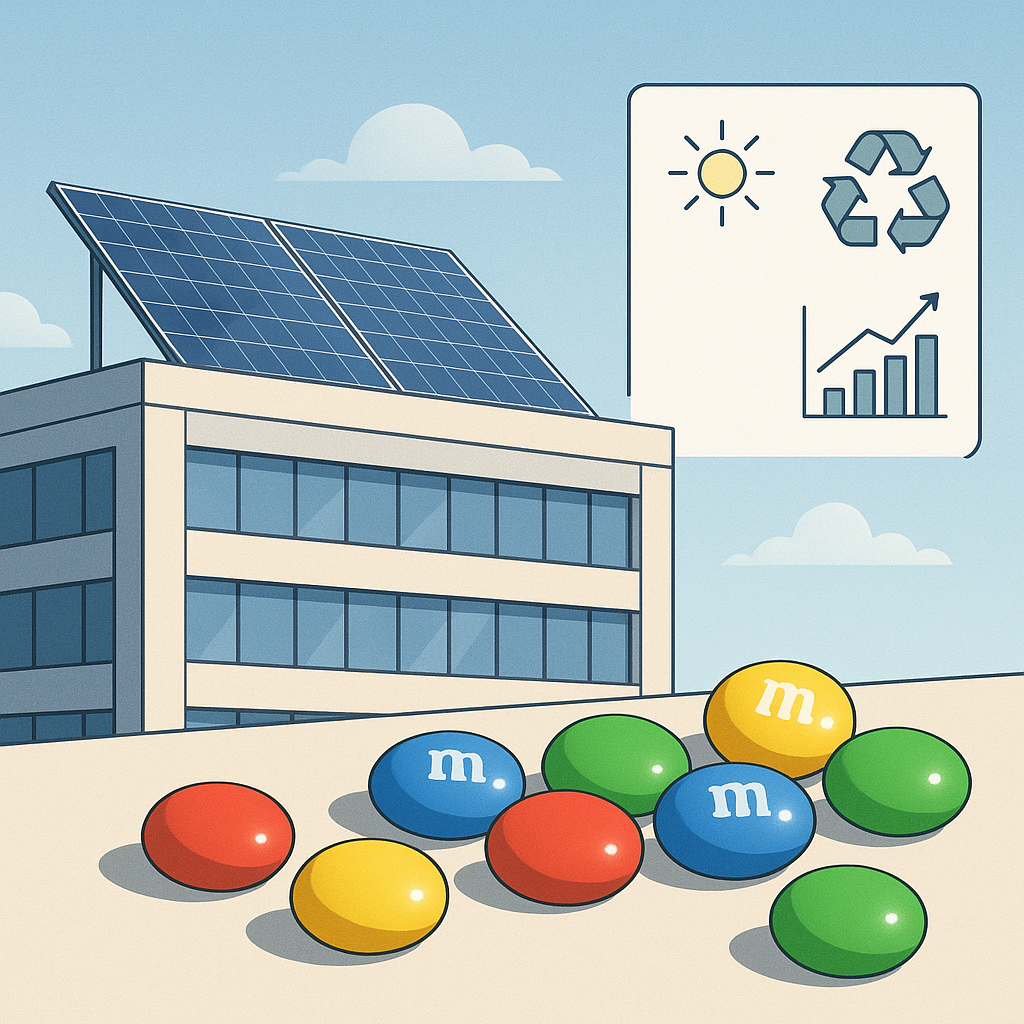
Here’s the kicker: M&Ms on a table do not lower emissions. Solar panels on a roof help only if they are part of a broader plan that includes efficiency, procurement, and travel discipline. The candy is a metaphor for the temptation to confuse visibility with value. That temptation is everywhere.
If you want a broader climate standard for buildings and operations, the EPA energy guidance is worth a look. Again, boring. Again, useful.

Comparison table: real climate strategy vs. token climate theater
Here is the blunt comparison. The difference is obvious once you stop listening to press-release language.
| Factor | Practical climate strategy | Token climate theater |
|---|
| Primary goal | Reduce emissions and waste | Look responsible in public |
| Language | Plain and direct | Loaded with buzzwords |
| Measurement | Regular, audited, specific | Vague, selective, or hidden |
| Employee action | Clear rules and habits | Confusing asks and posters |
| Energy choices | Efficiency first, then cleaner power | One flashy project, little follow-through |
| Vendor management | Procurement standards and data requests | No real pressure on suppliers |
| Client credibility | High, because practice matches claims | Low, because claims outrun facts |
| Long-term value | Better resilience and cost control | Short-lived attention |
The comparison is not subtle. Serious climate work looks a lot like good operations management, because that is what it is. People who dislike this truth usually prefer the costume version, where a company says the right words and hopes nobody checks the meter.
You can see similar reporting discipline in public climate reporting standards from groups like the CDP, which keeps attention on disclosure, measurement, and comparability. The point is not perfection. The point is honest accounting.
Common mistakes to avoid
Do not make this fancy.
Most climate programs go sideways for predictable reasons, and the worst advice is usually wrapped in confident language that sounds impressive but does almost nothing.
- Mistake 1: Treating solar as the whole answer
Solar helps, but it is not a magic shield. If your building wastes power all day, rooftop panels are just a partial fix.
- Mistake 2: Overcomplicating the message
If employees need a decoder ring, the message failed. Plain language is not a stylistic bonus. It is a delivery mechanism.
- Mistake 3: Focusing on optics before operations
Fancy dashboards, branded campaigns, and polished statements are fine only after the boring work is done. Otherwise, it is lipstick on a tractor.
- Mistake 4: Ignoring travel and procurement
Many firms obsess over office utilities while the biggest emissions sit in flights, contractors, equipment, and supply chains. That is a classic blind spot.
- Mistake 5: Using offsets as a shortcut
Offsets may have a place, but they do not excuse weak internal action. Anyone selling shortcuts as virtue is probably selling something else too.
- Mistake 6: Forgetting the human side
A program that saves energy but confuses or burdens staff will get resented. Good stewardship respects people, not just metrics.
- Mistake 7: Never revisiting the plan
Markets shift. Buildings age. Travel patterns change. A static plan is a dead plan.
The truth is, most bad climate advice sounds dramatic because drama hides weak math. Better advice sounds ordinary because it is tied to data, habits, and follow-through. That is the hard pill.
I’ve seen this in tech product work too: teams chase features they can demo instead of features people use. Climate strategy has the same flaw when leadership chases announcements instead of reduction. Both are forms of self-deception. Neither helps.
For context on energy efficiency and consumer behavior, the International Energy Agency has plain evidence that efficiency remains one of the fastest ways to cut demand. Not glamorous. Still true.
Frequently asked questions
People ask the same things.
Why does plain language matter in climate strategy?
Plain language matters because people act on what they understand, and a climate plan that reads like legal fog will not change daily behavior, supplier choices, or budget decisions in any reliable way.
Is solar power enough for a corporate climate plan?
No. Solar helps reduce grid reliance, but it works best with efficiency, smart procurement, and travel reduction, because a single measure cannot fix structural waste by itself.
How do you know if a climate strategy is real?
Look for measurable targets, regular reporting, specific actions, and evidence that operations are changing, because real strategy leaves fingerprints in utility bills, travel data, and purchasing records.
What is the biggest mistake companies make?
They confuse public messaging with implementation, and that usually means they spend more time on statements than on the boring work that actually lowers emissions.
Final thought
Good climate strategy is not a trophy.
It is a habit of responsible action, the kind that treats energy, money, and labor as gifts to be used well rather than squandered, and that matters whether you are running a firm, a family, or a server room. The world does not need more polished excuses. It needs more sober stewardship.
That is why the mix of M&Ms, solar panels, and plain language is not silly at all. It is almost brutally honest. Candy may draw attention. Solar may cut carbon. Plain speech may keep people honest. Put together, they point to the same thing: real change is usually less dramatic than the marketing people want, and far more useful.
If a company can explain its climate work without jargon, measure it without flinching, and carry it out without making a show of itself, then it has done something rare. It has aligned competence with conscience. That is worth more than a clever slogan, and it ages better too.