Pulse Space just landed a $40 million Space Force contract to build a space laser power system. That sounds flashy, and it is, but the real story is less...
Pulse Space’s $40M Space Force Contract: What a Space Laser Power System Really Means
Pulse Space just landed a $40 million Space Force contract to build a space laser power system. That sounds flashy, and it is, but the real story is less sci-fi and more engineering discipline: power generation, thermal control, beam stability, orbital constraints, and the ugly fact that space hardware has to work the first time. No second chances.
Key Takeaways:- Pulse Space is now tied to a high-stakes defense program focused on laser power in space.
- The work likely centers on power delivery, conversion efficiency, thermal management, and reliability in orbit.
- Space laser systems are not magic; they are brutally constrained by physics, mass, heat, and pointing accuracy.
- The contract matters because it suggests confidence in directed-energy architecture, not just a one-off experiment.
- The bigger question is whether this can move from demo hardware to a dependable operational system that serves the common good, not just a budget line.
What is a space laser power system? It is the electrical and thermal backbone that keeps a laser system alive in orbit, and that means more than simply feeding current into a beam emitter. You need stable generation, storage, power conditioning, heat rejection, and enough fault tolerance to survive radiation, vibration, launch loads, and long stretches without maintenance. Most people hear “laser” and imagine the beam; engineers look at the batteries, solar arrays, converters, radiators, and control loops.
I’ve reviewed enough hardware to say this plainly: the glamorous part is usually the least important part. The beam is the headline, but the system lives or dies on boring components. Frankly, that is how serious engineering works. A space platform must respect limits, because space does not care about marketing slides or patriotic slogans. It only cares about watts, mass, and heat.
There is also a broader point here. Human ingenuity is a gift, but it is not a license for sloppy ambition. If a system like this is built well, it can support deterrence, resilience, and protection of critical assets. If it is built carelessly, it becomes an expensive proof-of-concept with no moral weight beyond sunk cost. Technology should serve people, not merely feed a procurement machine.
Pulse Space’s award is significant because the Space Force does not hand out $40 million for decorative experiments. That money usually signals a serious need: power architecture that can support future orbital systems, likely including scalable directed-energy use, more compact subsystems, or a path to fieldable infrastructure. Here’s the kicker: in defense tech, the challenge is not inventing a clever demo. It is making the thing survive space, budget pressure, and bureaucratic scrutiny all at once.
For a good background on adjacent space and hardware trends, see NASA’s official research resources, U.S. Space Force updates, and a practical hardware analysis from Analog Devices’ technical articles. Those sources are useful because they talk about real constraints rather than dreamy brochure copy.
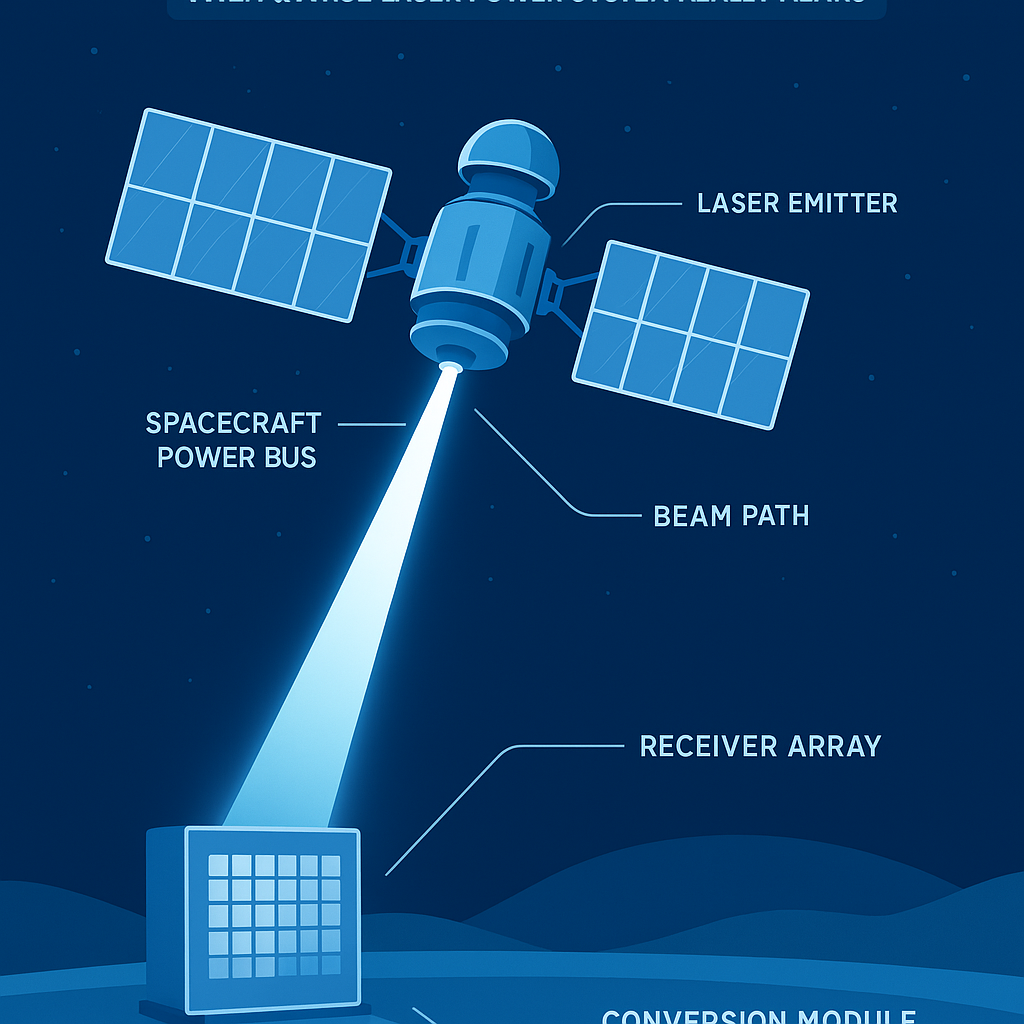
What is a space laser power system?
A space laser power system is the collection of hardware and software that generates, conditions, stores, and delivers electrical energy to a laser payload in orbit. That sounds simple until you account for everything orbit throws at it—vacuum, radiation, thermal swings, launch vibration, and the fact that maintenance is basically impossible. So the design has to be overbuilt in the smart ways and light in the right places.
At a minimum, the system usually includes solar arrays, batteries, power distribution units, power electronics, thermal radiators, and control firmware. If the mission calls for high-energy output, it may also need energy buffering so the laser can fire in controlled bursts instead of draining the whole platform. Most people focus on the emitter, but the emitter is only one piece of a much larger machine.
When I look at programs like this, I ask three questions: how much power, how much mass, and how much heat? Those are the ugly truths. Every watt in space has a cost. Every kilogram costs launch margin. Every degree of heat has to go somewhere, and space is not a magic trash can for thermal waste. The result is a design problem that rewards patience, not buzzwords.
The term also implies a strategic intent. A power system built for lasers in orbit is not a consumer device, obviously, but it shares a familiar tech logic with EV battery packs, server power supplies, and high-efficiency converters: you must deliver stable energy under load while minimizing losses. The difference is that failure in a consumer gadget annoys you. Failure in space can wipe out a mission.
For readers who want a broader technical frame, a useful primer on energy management in advanced systems appears in NREL’s research on power systems. It is not about lasers specifically, but the physics of efficient power flow still applies.
Core benefits and why it matters
- Strategic resilience: Space-based power systems can support missions that need reliable operation in contested environments. That matters if you care about communications, sensing, or protection of orbital assets.
- Technical spillover: Work on power conversion, thermal control, and high-reliability electronics often benefits other sectors, including satellite platforms, remote sensing gear, and even rugged industrial electronics.
- Scalability: If the architecture works, it may support future systems that need bursts of energy without hauling absurd amounts of hardware into orbit.
- Reduced dependency on ground support: Space platforms that manage power intelligently can operate with fewer interventions, which is the whole point when you cannot send a technician with a screwdriver.
- Industrial credibility: A $40 million award is not a trophy. It is a vote of confidence that the company can build something hard, on schedule, and to spec.
But let’s be real. There is always a lot of talk around defense technology that sounds more certain than it is. Most programs do not fail because the physics is impossible. They fail because the engineering tradeoffs are brutal and the integration work is miserable. That is where budgets go to get chewed up.
The benefit that gets overlooked is discipline. Space systems force design teams to stop pretending that extra complexity is free. It is not. A cleaner architecture, fewer conversion stages, better thermal margins, and robust fault handling can matter more than a bigger spec sheet. That principle is worth remembering in consumer electronics too. A product with fewer, better-chosen features is often more useful than a bloated one.
There is also an ethical dimension. If technology is treated as an end in itself, it becomes a vanity project. If it is built as stewardship—using skill and resources for defense, stability, and the protection of legitimate goods—it has a better claim on moral seriousness. That old Catholic instinct matters here: excellence is not just about what can be done, but why it should be done.
For a related angle on advanced hardware tradeoffs, see IEEE’s technical publications and NASA’s Small Spacecraft resources. They are dry, yes, but useful. The dry stuff is usually where the truth lives.

Step-by-step: how a system like this gets built
- Define mission requirements
Start with power output, duty cycle, orbital altitude, thermal limits, radiation exposure, and mass budget. I’ve seen teams fail before they even begin because they treat requirements like suggestions. They are not suggestions. - Choose the power source
Solar arrays are the usual baseline for orbital power, but the exact cell chemistry, panel area, and deployment mechanism all matter. If the laser needs bursts above the steady-state generation level, then energy storage becomes the next issue. - Design storage and buffering
Batteries or capacitors may store energy for firing cycles. The trick is avoiding a bulky, fragile pack that chews up spacecraft mass and thermal headroom. The best design is the one that works without drama. - Build power conditioning electronics
This includes converters, regulators, and distribution circuits. Their job is to keep the payload fed with stable voltage and current. Cheap consumer electronics love sloppy margins. Space hardware does not. - Solve thermal management early
High-power systems create heat. Heat in orbit is a serious headache because there is no air to carry it away. Radiators, heat pipes, and careful duty cycling are essential. Ignore this, and the system cooks itself alive. - Integrate control software
Firmware must sequence power safely, monitor faults, and shut down gracefully when something smells wrong. The control layer is not glamour material, but it is what keeps one bad reading from cascading into a dead mission. - Test in harsh conditions
Vibration, vacuum, thermal cycling, and radiation testing are mandatory. I am skeptical of any program that talks loudly about “breakthroughs” before it has passed brutal qualification tests. - Plan for launch and operations
Even a good design can fail if the deployment sequence is sloppy or the operations team misreads telemetry. A spacecraft is a system, not a parts bin.
The useful lesson here is broader than defense. Whether you are building a satellite, a smartphone, or a power bank, good engineering means understanding failure modes before you ship. The truth is, most bad products are not bad because of one giant defect. They are bad because ten small compromises add up.
If you want a practical consumer analogy, compare this to choosing a laptop battery or a rugged phone. The useful question is not “how much power is there on paper?” It is “how consistently does it deliver under load, heat, and wear?” That is the same mindset behind careful reviews of devices like smartwatches and tablets in best smartwatch reviews, USB-C charger guides, and rugged laptop gear coverage.
Comparison table: space laser power system vs. conventional satellite power bus
| Feature | Space Laser Power System | Conventional Satellite Power Bus |
|---|
| Primary goal | Deliver high, stable energy to a laser payload | Support standard spacecraft subsystems |
| Power demand | Very high, often burst-oriented | Moderate and steady |
| Thermal burden | Severe, because lasers and converters make intense heat | Lower, but still important |
| Pointing sensitivity | Extremely high if beam operation is involved | Typically lower |
| Mass pressure | Very high due to storage and cooling needs | High, but usually less extreme |
| Fault tolerance | Must be extremely robust | Robust, but less punishing |
| Operational complexity | High | Medium |
| Strategic use case | Directed-energy, defense-related capabilities | Communications, sensing, navigation |
| Engineering risk | Elevated | Lower, though still significant |
The table shows why this contract matters. A normal satellite bus is already hard. This is harder. Much harder.
I’ve looked at enough product categories to know that complexity is often sold as innovation. Sometimes it is. Sometimes it is just complication in a nicer coat. With space power systems, the distinction is clear: if extra complexity buys reliability and mission capability, it is justified. If it only buys a slide deck, it is junk.
The comparison also echoes consumer tech. A phone with a brighter screen, faster processor, and bigger battery is not automatically better if it overheats, drains quickly, or crashes under load. The same logic holds here. Capability without stability is a liability.
For more on satellite subsystems and how power architecture shapes mission success, useful references include ESA’s engineering pages and NASA communications and navigation systems. Again, boring sources. Also the useful ones.
Common mistakes to avoid
- Confusing the beam with the system
Most people obsess over the laser itself. That is the wrong focus. Power generation, conditioning, and heat rejection decide whether the system works at all. - Assuming high watts solve everything
More power is not a free pass. Bigger systems weigh more, run hotter, and complicate deployment. In space, brute force gets punished. - Ignoring thermal limits
I keep coming back to heat because heat is where many projects die. Not because it is sexy. Because it is real. - Believing prototype success means field success
Lab demos are easy to overhype. Space qualification is the actual test. A bench result is not a mission result. - Treating regulation and ethics as afterthoughts
Technology does not exist in a moral vacuum. If a system can affect security or escalate conflict, it deserves sober oversight. That is not weakness. That is maturity. - Copying consumer-tech assumptions
A smartphone battery strategy does not translate cleanly to orbital hardware. Space is harsher, maintenance is absent, and margins are thinner.
Frankly, the worst advice in this sector comes from people who want easy certainties. There are none. Systems engineering is a tradeoff festival, and the ticket is expensive.
One subtle but important point: any technology this powerful should be governed by purpose. Skill without restraint becomes a mess. Used rightly, though, engineering can protect infrastructure, support deterrence, and preserve order. That is a more serious view than “build cool stuff because we can,” and it is a better one.
If you want broader background on high-reliability electronics and qualification standards, see ECSS standards resources. Standards are boring. They are also what keep expensive hardware from becoming space debris.
Frequently asked questions
What is Pulse Space building for the Space Force contract?
Pulse Space is working on a space laser power system, which likely means hardware for generating, conditioning, storing, and delivering high levels of electrical energy to a laser payload in orbit.
Why is a $40 million contract important?
Because it signals serious confidence from the Space Force. This is not small-change experimentation. It suggests the company is expected to deliver meaningful technical progress on a difficult defense platform.
Why are space laser power systems so hard to build?
Because space punishes every weakness. The system has to deal with radiation, heat, launch vibration, mass limits, and the need for near-perfect reliability. No repair truck is coming.
Is this technology practical or mostly experimental?
At this stage, it is likely still closer to advanced development than broad deployment. That said, serious engineering programs often move from prototype to practical use once they prove they can survive real operating conditions.
Final thought
The Pulse Space contract is a reminder that serious technology is rarely glamorous up close. It is measured in margins, not slogans. The beam may make headlines, but the power system is where the real work lives, and that work is a test of discipline, competence, and restraint. That is true in space, and it is true in every good machine.
I do not think people should cheer every defense contract reflexively. That would be shallow. But I also do not think the correct response is cynicism. Good engineering can serve the common good when it is aimed at protection, stability, and lawful use. The hard part is keeping the goal clear while the machinery gets more elaborate. That is where character matters as much as circuitry.
If Pulse Space can turn this award into a dependable orbital power architecture, the result will matter far beyond one program office. It could shape how we think about high-power systems in space, how we manage scarce resources, and how we judge the line between technical ambition and responsible stewardship. That line matters. It always has.