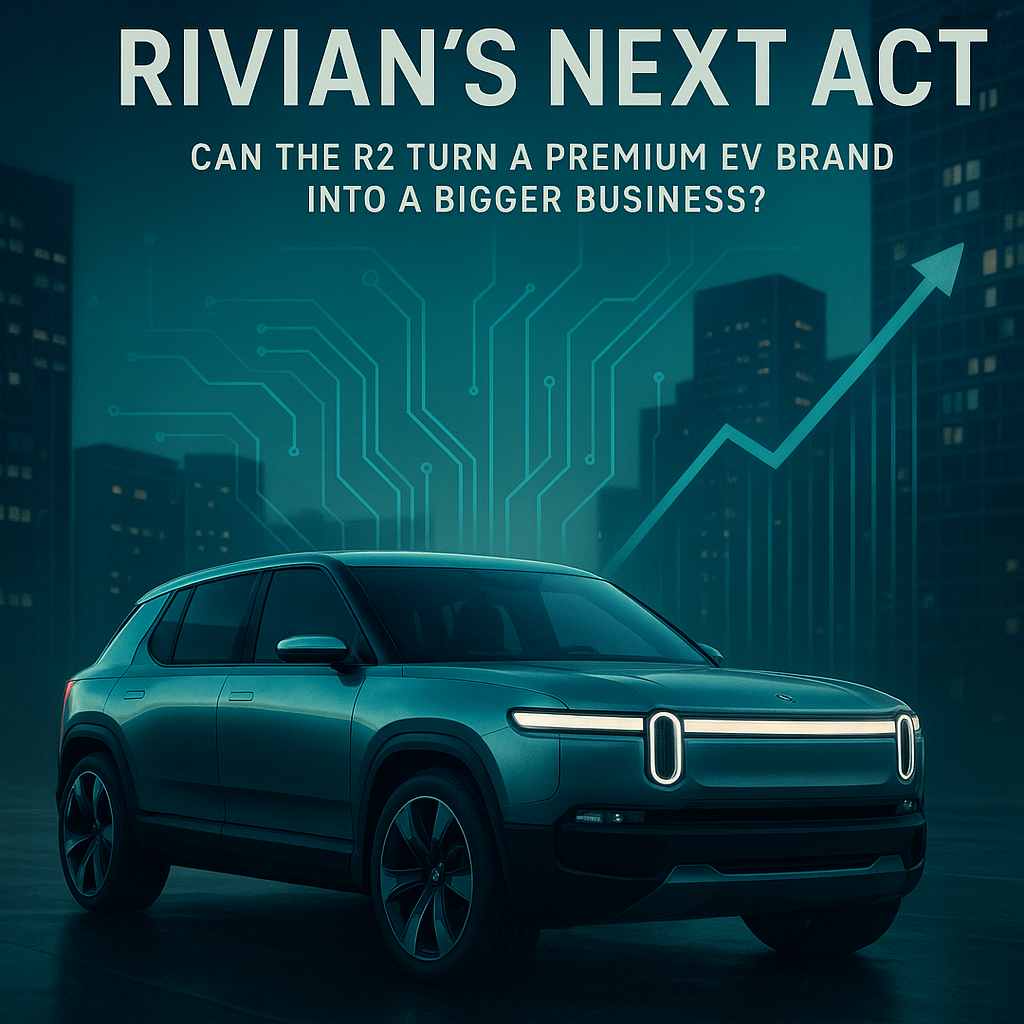
Rivian’s Next Act: Can the R2 Turn a Premium EV Brand Into a Bigger Business?
Rivian’s next act is not simply another electric truck. It is a test of whether the company can turn its premium R1 vehicles, software expertise, and Volkswagen partnership into a more affordable, higher-volume business without losing control of costs or quality. The R2 is central to that plan, but execution—not a polished reveal—will decide whether it works.
What Is Rivian’s Next Act?
Rivian’s next act is the company’s effort to grow beyond its first-generation premium electric vehicles. Its R1T pickup and R1S SUV established a recognizable identity: outdoors-focused design, distinctive lighting, strong performance, and a cabin that feels less like a rolling gadget showroom than some rivals. That identity has value. It also has a limit. Expensive vehicles serve a smaller pool of buyers, and a company with ambitious manufacturing plans needs more than a niche audience.
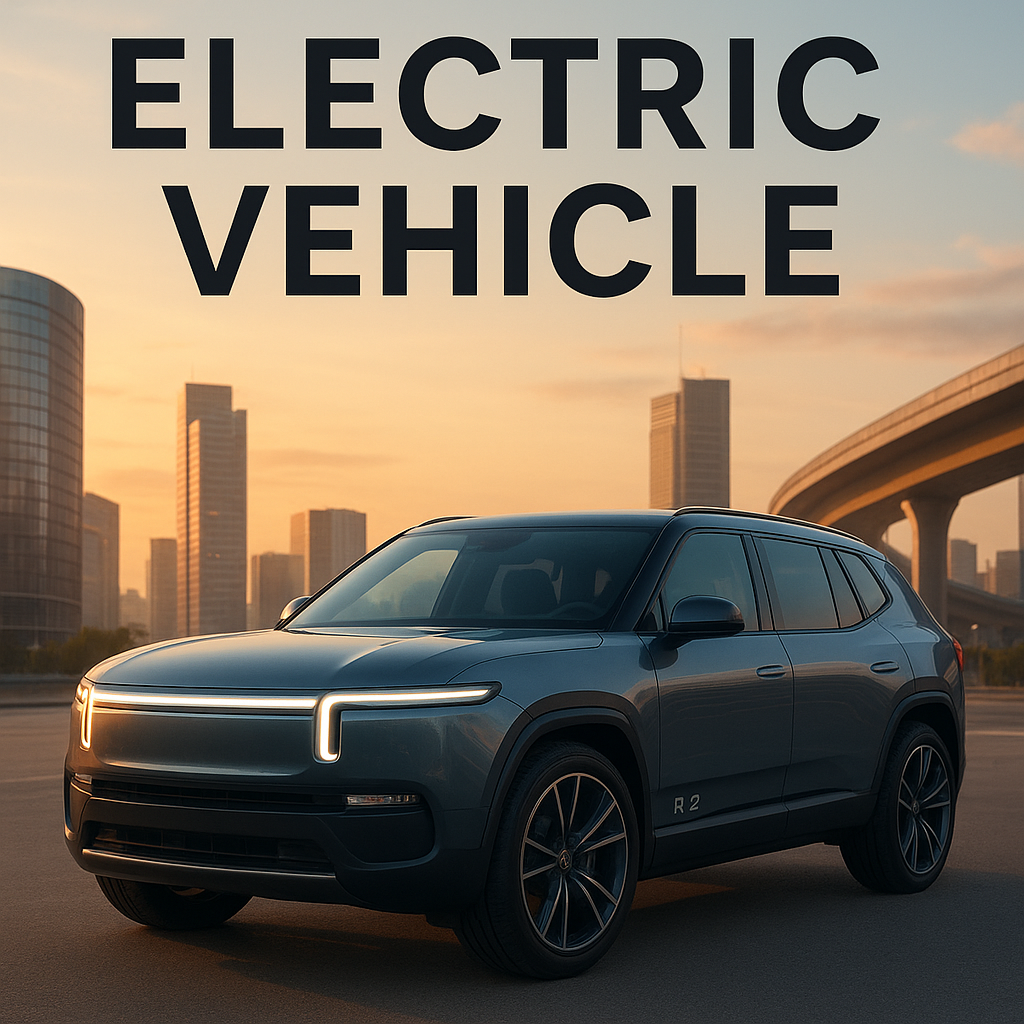
The R2 is the clearest expression of Rivian’s attempt to broaden its reach. Rivian describes it as a smaller, more accessible SUV than the R1S, while retaining the company’s focus on utility, design, and electric performance. The official Rivian R2 page gives the company’s current product framing; buyers should check it for the latest specifications and availability, since vehicle programs and launch details can change. The important strategic point is not a single feature. It is whether Rivian can build a vehicle at a price and scale that bring in new customers without sanding away the traits that made the brand interesting.
There is a second part to the story. Rivian has developed in-house vehicle software and electrical architecture, and Volkswagen Group announced a joint venture with Rivian focused on software-defined vehicle technology. The Volkswagen Group announcement describes the collaboration. In principle, shared development could spread engineering costs and put Rivian’s work to use beyond Rivian-branded vehicles. In practice, any such arrangement must prove itself through working systems, dependable updates, and clear commercial results.
When I assess a car company’s next act, I look past the stage lights. Can it build the product repeatedly, deliver it on time, support it after the sale, and make enough money to keep improving it? That is the dull checklist. It is also the one that matters.
Why Rivian’s Next Phase Matters
Rivian’s first products showed that electric vehicles can feel purpose-built rather than merely electrified versions of familiar cars. That distinction helped the company earn attention. It does not automatically create a profitable business. The next phase matters because it connects product appeal to factory economics, customer service, software support, and the ability to fund future work.
Here are the main reasons to watch closely:
- A wider pool of buyers. A smaller vehicle intended to cost less than Rivian’s larger R1 models could reach households that want an electric SUV but do not want a full-size premium purchase. “More accessible” is not the same as inexpensive, though. The final price, trim structure, financing, and available incentives will determine who can actually buy one.
- Manufacturing discipline. Vehicle assembly is unforgiving. A compelling design still has to move through factories with consistent quality, predictable parts supply, and low waste. Rivian’s ability to simplify production can matter as much as a headline-grabbing acceleration figure.
- A clearer path to volume. More vehicles on the road can support stronger brand recognition and a larger service base. But volume is useful only when each vehicle is built and supported at a sustainable cost. Shipping more cars while losing too much on each one is not a victory lap.
- Software as a product, not a slogan. Drivers experience software through navigation, charging information, driver assistance, phone integration, and controls. Updates can improve an ownership experience, but bugs and confusing menus can sour it just as quickly. Software quality needs to be judged by daily use, not the size of a feature list.
- Partnership leverage. Working with Volkswagen may give Rivian a wider commercial role for its software work and a way to share development effort. The upside is plausible; the execution details matter. Joint ventures bring coordination, governance, and delivery challenges that a press release cannot settle.
- A more durable electric-vehicle market. Buyers need vehicles that suit ordinary routines, not just weekend adventures or technology demonstrations. Better products can serve people well, reduce local tailpipe pollution, and make useful mobility available to more households. That is a worthwhile aim, provided cost and resource use are treated honestly.
Frankly, Rivian’s strength and risk are closely related. The company has a point of view, but a distinctive design language can be expensive to produce, and brand enthusiasm cannot fix service delays or a weak financial model. I would rather see a well-built vehicle with a sensible ownership experience than another round of grand claims about redefining the car.
How to Evaluate Rivian’s Next Act: A Practical Guide
You do not need an investor terminal to judge whether Rivian is making progress. You need to follow a short list of measurable questions, separate announced plans from delivered products, and resist the urge to treat every reveal as proof of success.
- Start with the product customers can actually buy. Separate current vehicles from announced or planned ones. A concept, preorder page, or early specification is not the same thing as a vehicle sitting at a local retailer. Check Rivian’s official product pages and current announcements for availability, configuration, and delivery information. Dates can shift; treat old reporting as context, not a guarantee.
- Compare the full price, not the headline number. Look at the specific trim, destination charges, optional equipment, financing, insurance, home charging, and eligibility for any current incentives. A vehicle advertised at a starting price may not match the configuration you want. The cheapest trim may also arrive later or omit features that matter to you.
- Match range claims to your driving. Published range depends on configuration and test procedures. Cold weather, highway speed, towing, roof accessories, hills, and cabin heating can all affect real-world consumption. I pay more attention to charging access and trip patterns than to a single best-case range number. If you regularly tow or drive long distances, test those needs against the exact vehicle configuration.
- Check the charging routine before buying. Identify dependable chargers along the routes you use, then check connector compatibility, payment methods, charging speed, and alternatives if a station is down. A home charger is convenient, but renters and apartment residents may have a different calculation. The best electric vehicle is the one you can charge without turning every errand into a planning exercise.
- Inspect software and controls in person. Try the navigation, climate controls, camera views, driver-assistance settings, and phone connection. Ask how updates are delivered and how owners get help when an update or component causes trouble. A central screen can look tidy in photographs while making everyday tasks needlessly fiddly.
- Judge practical space, not marketing adjectives. Sit in both rows. Bring the child seat, suitcase, dog crate, or equipment you actually use. Check visibility, door openings, storage, and how easily the cargo area can be loaded. An SUV can look spacious from the curb yet disappoint when the family’s gear arrives.
- Read the warranty and service plan. Confirm coverage terms, roadside support, repair options, and the nearest service locations. Ask how collision repairs are handled and whether parts availability could affect turnaround time. Ownership quality is not only the moment of delivery; it is also the company’s response when something breaks.
- Watch the production evidence. Look for recurring indicators rather than one celebratory announcement: product availability, delivery performance, quality reports, factory efficiency, and the company’s financial updates. Rivian’s investor materials are a useful primary source for company-reported information. Read them as company disclosures, not independent verdicts.
- Compare alternatives on your actual requirements. The Tesla Model Y, other electric SUVs, and efficient hybrids may each suit different households. Set priorities before comparing: cargo space, charging access, ride comfort, range, price, repair support, or a particular feature. I find that a written shortlist beats a late-night spiral through specification sheets.
- Recheck the details before you commit. Price, available trims, delivery estimates, software features, and incentives change. Verify the final contract and the manufacturer’s current documentation. A reservation is not the same thing as a delivered vehicle, and it should not be treated as one.
Here’s the kicker: the best indicator is a boring one—whether the company consistently does what it said it would do. A dependable vehicle and a support network that answers the phone beat a spectacular launch event every time.
Rivian R2 vs. Tesla Model Y: What the Comparison Really Shows
The Tesla Model Y is a useful competitor because it occupies the electric-SUV conversation many shoppers already know. It is not a perfect match. Rivian’s R2 is positioned around a more adventure-oriented identity, while the Model Y is a mainstream electric crossover with its own software, charging, and ownership ecosystem. Their exact specifications depend on model year and trim, so use manufacturer information and official efficiency listings for the configuration you are considering. The U.S. government’s FuelEconomy.gov vehicle search is one place to check published efficiency and range information for listed models.
| Factor | Rivian R2 | Tesla Model Y |
|---|
| Intended role | Smaller Rivian SUV aimed at widening the brand’s audience | Mainstream electric crossover in Tesla’s established lineup |
| Brand emphasis | Utility, outdoor use, and Rivian’s distinctive styling | Broad everyday use, software features, and Tesla’s charging ecosystem |
| Size and packaging | Positioned below Rivian’s larger R1S; verify final measurements and seating details | Crossover packaging; seating and cargo configuration vary by version and market |
| Specifications | Announced specifications and final production details should be checked with Rivian | Specifications vary by trim, model year, and market; check Tesla’s current page |
| Charging | Confirm connector, route coverage, charging access, and current compatibility for the exact vehicle | Tesla’s charging network is a major consideration for many buyers; availability and access rules can change |
| Price | Compare the actual order configuration and current delivery terms | Compare the current trim, options, fees, financing, and incentives |
| Best comparison question | Does its utility and design justify the price and fit your charging routine? | Does its package, charging access, and ownership experience suit your priorities? |
The table does not declare a winner, because that would be pretending every household wants the same car. If you value Rivian’s styling and practical outdoor orientation, the R2 may deserve a close look. If charging convenience, a familiar software setup, or a currently available configuration matters more, the Model Y may make more sense. The specific car you can buy matters more than the promise of a future trim.
For the latest Model Y configurations, consult Tesla’s official Model Y page. Use the pages as starting points, then arrange a test drive and check independent road tests for the exact version. Manufacturer figures describe standardized testing; they cannot tell you whether the seat feels right after two hours or whether the rear hatch suits your luggage.
Common Mistakes to Avoid
There is plenty of confident advice about electric vehicles. Some of it is useful. Some of it has the shelf life of a social-media post. These are the mistakes most likely to distort a judgment about Rivian’s next phase.
- Treating an announced vehicle as a finished one. A reveal communicates intent. It does not confirm that final pricing, production quality, delivery dates, and service arrangements will match early expectations. Wait for customer vehicles and independent assessments before making a costly decision on the strength of a presentation.
- Assuming a lower price automatically means mass-market success. A vehicle can be cheaper than a premium predecessor and still be too expensive for many households. Affordability depends on the complete cost of ownership, including financing, insurance, charging, repairs, and depreciation. Compare real quotes rather than repeating a target price as if it were a signed promise.
- Confusing technology with usefulness. A large display, clever lighting, or a new software architecture can be interesting. None is inherently valuable if basic controls are frustrating or the system is unreliable. I judge technology by whether it reduces friction without creating new problems.
- Reading range as a guarantee. EPA figures offer a standardized comparison, not a personal forecast. Highway speed, temperature, payload, tires, and route elevation affect results. Plan for the conditions you encounter, not the friend who says their car always beats the sticker.
- Assuming a partnership guarantees a successful product. A major automaker can contribute experience and scale, while a technology partner can contribute software expertise. That does not remove the need to coordinate teams, settle responsibilities, and ship dependable systems. Watch what the partnership delivers, not just who signed the agreement.
- Ignoring service and repair access. A car is not a phone. You cannot casually replace it when support becomes inconvenient. Before buying, understand where service is available, how collision repairs work, and what happens if a part takes time to arrive.
- Comparing only the most attractive specifications. Peak power and best-case range do not tell you about ride comfort, visibility, seat support, cargo flexibility, or software usability. A proper comparison includes the daily annoyances that a brochure leaves out.
- Assuming more production always means better financial health. Higher output can improve factory utilization, but only if demand, costs, and quality stay under control. Growth has to be supported by sound economics; otherwise, the company simply makes its problems at a faster rate.
- Forgetting that cars have environmental costs too. Electric vehicles remove tailpipe emissions while driving, but they still require materials, manufacturing energy, tires, and electricity. Responsible progress means improving the whole system where possible, not declaring every electric product impact-free. Technology is most worthwhile when human ingenuity serves practical needs and stewardship rather than consumption for its own sake.
Let’s be real: skepticism is not hostility to electric vehicles. It is a sensible response to expensive promises. Ask for evidence, compare alternatives, and give the people who build and service these vehicles the same attention you give the people who market them.
Frequently Asked Questions
What is Rivian’s next act?
It is Rivian’s effort to grow from a premium electric-vehicle maker into a larger business. The R2 is central to that plan because it is positioned below the R1T and R1S, while Rivian’s software work and Volkswagen collaboration offer another possible source of value. The company still has to prove that it can deliver products consistently, manage costs, and support owners well.
Is the Rivian R2 a competitor to the Tesla Model Y?
They are reasonable vehicles to compare if you are shopping for an electric SUV, but they do not have identical positioning. Rivian emphasizes its own design and utility-focused identity, while Tesla has a well-known crossover and charging ecosystem. Compare the exact versions available to you, their final prices, charging access, service options, and real-world suitability. Verify current specifications with the manufacturers.
What should buyers check before reserving or ordering an R2?
Check current availability, final pricing, the exact trim and equipment, estimated delivery timing, charging compatibility, warranty terms, and nearby service support. Also consider home charging, insurance, and the routes you commonly drive. Treat projected dates and early specifications as provisional until the manufacturer confirms the details for your order.
Why does Rivian’s Volkswagen partnership matter?
The announced joint venture is focused on software-defined vehicle technology. If the collaboration produces dependable systems and useful commercial results, it could help both companies share development work and apply software expertise more widely. The announcement alone does not establish how well the partnership will execute; delivered technology and customer experience are the real measures.
Final Thought
Rivian has earned attention by making electric vehicles that look and feel different from the usual template. That is an accomplishment, not a lifetime exemption from scrutiny. Its next phase will be judged by less glamorous measures: whether the R2 reaches customers as promised, whether production becomes more efficient, whether software behaves reliably, and whether owners can get repairs without needless friction.
The Volkswagen partnership may extend Rivian’s role beyond its own vehicle lineup. That could be meaningful, but the value will appear only when shared technology works in real vehicles and creates a durable business result. Until then, it belongs in the category of potential, not proof. The same rule applies to promised prices, future trims, and ambitious production targets.
For shoppers, the sensible move is not to preorder out of fear of missing out or dismiss the brand because another company has more vehicles on the road. Make a list of needs, verify current facts, test the actual product, and compare the full ownership experience. For Rivian, the work is simpler to describe and harder to do: build well, control costs, treat customers fairly, and keep the product useful after the launch-week buzz fades.
That is how a promising electric-vehicle maker becomes a durable one. A good car can serve its owner; a well-run company can keep serving the people who depend on it. Rivian’s next act will matter if it can do both.
FAQPage Schema
{"@context":"https://schema.org","@type":"FAQPage","mainEntity":[{"@type":"Question","name":"What is Rivian’s next act?","acceptedAnswer":{"@type":"Answer","text":"It is Rivian’s effort to grow from a premium electric-vehicle maker into a larger business. The R2 is central to that plan, while Rivian’s software work and Volkswagen collaboration offer another possible source of value. The company still has to prove that it can deliver products consistently, manage costs, and support owners well."}},{"@type":"Question","name":"Is the Rivian R2 a competitor to the Tesla Model Y?","acceptedAnswer":{"@type":"Answer","text":"They are reasonable vehicles to compare when shopping for an electric SUV, but they do not have identical positioning. Compare exact versions, final prices, charging access, service options, and real-world suitability, and verify current specifications with the manufacturers."}},{"@type":"Question","name":"What should buyers check before reserving or ordering an R2?","acceptedAnswer":{"@type":"Answer","text":"Check current availability, final pricing, trim and equipment, delivery timing, charging compatibility, warranty terms, nearby service support, home charging, insurance, and your common routes. Treat projected dates and early specifications as provisional until confirmed for your order."}},{"@type":"Question","name":"Why does Rivian’s Volkswagen partnership matter?","acceptedAnswer":{"@type":"Answer","text":"The announced joint venture is focused on software-defined vehicle technology. If it produces dependable systems and useful commercial results, it could help both companies share development work. Delivered technology and customer experience will show how well the partnership executes."}}]}