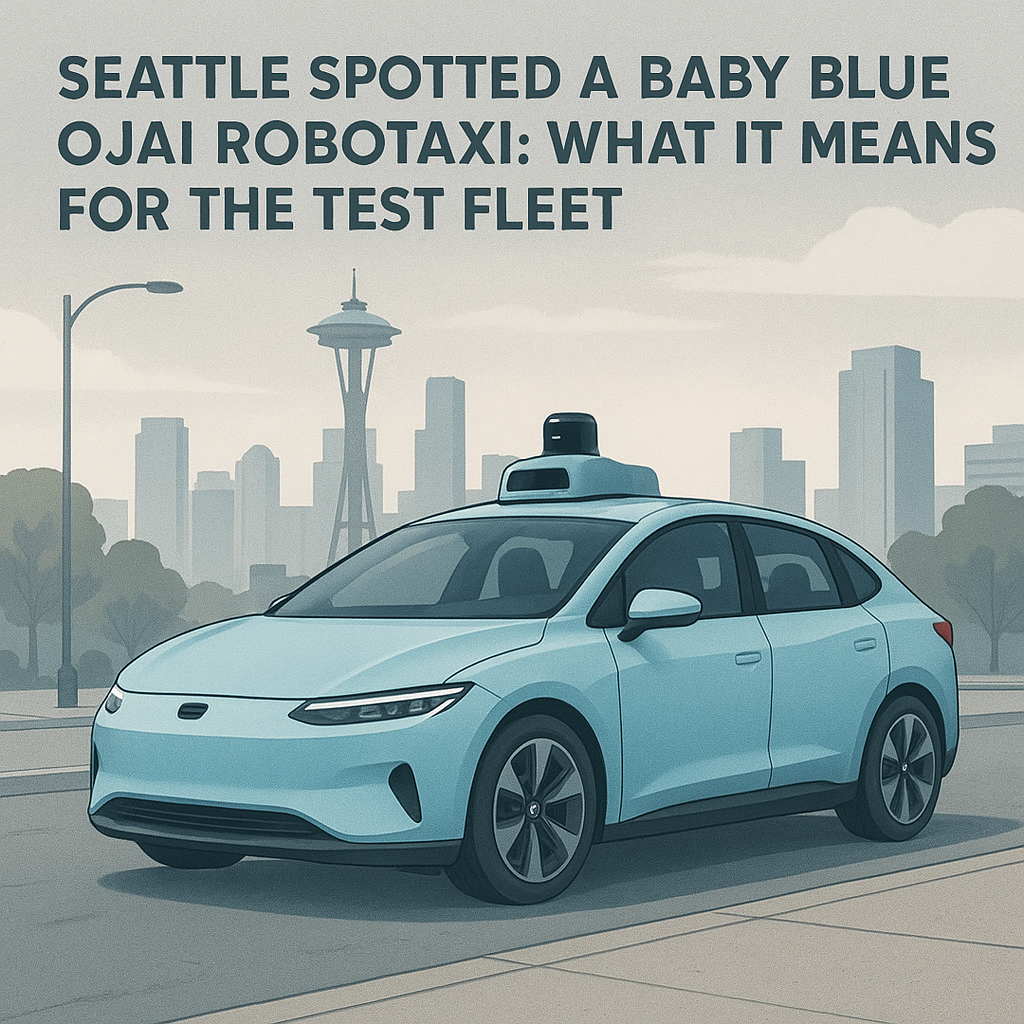
Seattle has another clue about the robotaxi race. A boxy baby blue vehicle nicknamed <strong>Ojai</strong> was spotted in the city, and that matters because...
Seattle has another clue about the robotaxi race. A boxy baby blue vehicle nicknamed Ojai was spotted in the city, and that matters because test fleets are where the promises meet potholes, rain, and real people.
Key Takeaways- Ojai appears to be part of an expanding robotaxi test fleet in Seattle.
- Urban testing is harder than glossy demos; rain, glare, traffic, and pedestrians expose weak systems fast.
- The important tech pieces are sensor suite, compute, mapping, redundancy, and fleet operations.
- Most public chatter focuses on the vehicle. The real story is software, safety, and operations.
- If the system can’t handle Seattle, it probably isn’t ready for broad deployment.
What is the Ojai robotaxi test fleet vehicle?
Ojai is the kind of prototype that makes headlines because it looks strange, not because it has solved autonomy. The baby blue, boxy shape suggests a purpose-built AV platform, likely designed around sensors, cameras, radar, onboard compute, and ride-hailing service integration rather than a consumer car with a few extra gadgets bolted on.
Let's be real: most robotaxi coverage reads like a press release wearing sunglasses. The car is only half the story. The actual product is the stack behind it—perception, prediction, planning, control, teleoperation backup, remote diagnostics, and fleet management. When I evaluate these vehicles, I care less about the paint color and more about whether the system can make sane decisions in ugly real-world conditions.
Seattle is a meaningful place to test. The city has narrow streets, frequent rain, variable light, cyclists, pedestrians, delivery vans, and the kind of traffic behavior that politely ignores neat assumptions. That makes it useful for stress-testing the full autonomy stack. A vehicle like Ojai is not just a car; it is a mobile lab for proving whether the software can cope with mess.
If you want background on how autonomous systems are being built and certified, see our analysis of self-driving car safety, the hardware side in robotics hardware, and the deployment angle in urban autonomy rollouts.
Here’s the kicker. A robotaxi fleet vehicle that looks simple often contains a nasty amount of engineering complexity. It may rely on fused input from LiDAR, cameras, radar, GNSS, and inertial sensors, plus custom machine-learning models trained on millions of miles of driving data. The public sees a cute baby blue box. Engineers see a data center on wheels, wrapped in steel and liability.
A subtle truth runs through all of this. Human ingenuity is good, but it needs fences. Technology should serve people, not make people into beta testers for sloppy ambition. A robotaxi that saves time, reduces crashes, and expands mobility for the elderly or disabled is a real good. One that cuts corners on safety is just expensive hubris with wheels.
Core benefits and why this matters
The spotted Ojai vehicle matters for reasons beyond gossip. A test fleet is where companies find out whether their system works in the wild, and the wild never reads the spec sheet. Frankly, that is the entire point.
- Safety validation: Real streets expose edge cases that simulation misses. A truck blocking a lane, a child stepping off a curb, wet reflective pavement, or a cyclist drifting unexpectedly can ruin clean lab assumptions.
- Operational learning: Robotaxi service is not just autonomy. It includes dispatch, charging, cleaning, maintenance, remote support, and rider handling. Test fleets reveal whether operations can scale without collapsing into chaos.
- Weather performance: Seattle rain is not a trivia detail. Water droplets, fog, low contrast, and glare stress cameras and sensor fusion. If a fleet performs here, it has earned some respect.
- Human trust: People judge AVs by behavior. Smooth braking, clear responses at intersections, and predictable lane keeping matter more than flashy demos. Confidence is built one uneventful ride at a time.
- Regulatory evidence: City and state regulators want proof, not slogans. Logged miles, incident reports, disengagement rates, and safety cases carry more weight than ad campaigns.
- Mobility access: Properly designed robotaxi service can help people who cannot drive—older adults, low-vision riders, and those in mobility deserts. That is not a marketing flourish; it is a practical benefit.
I’ve reviewed enough transportation tech to know that people overrate peak demos and underrate boring reliability. Boring wins. A robotaxi that behaves like a careful driver on a damp Tuesday is far more important than a viral clip of perfect downtown cruising.
There is another point most coverage skips. Fleet testing helps reveal how software interacts with society, not just asphalt. Does the car block bike lanes? Does it make courteous but confusing moves? Does it understand informal traffic patterns? Those questions matter because road use is a shared trust, not a private science project.
For a broader look at autonomy and machine learning tradeoffs, pair this with our guide to machine learning in transport and our coverage of fleet management tools. If you want the policy side, our piece on tech regulation and safety is worth your time.
Step-by-step: how to evaluate a robotaxi test fleet sighting
If you spot a vehicle like Ojai, do not get hypnotized by the shiny paint. Evaluate the system with discipline. Most people get distracted by branding and forget to ask whether the vehicle can actually operate safely.
- Identify the platform
Look for external sensor mounts, rooftop pods, unusual body shapes, and manufacturer markings. Purpose-built AVs usually advertise themselves through hardware, not badges. - Check the sensor package
A serious robotaxi prototype often uses multiple camera arrays, radar, and sometimes LiDAR. The question is not whether sensors exist, but whether they are arranged for full coverage and redundancy. - Observe driving behavior
Watch for lane discipline, braking smoothness, turns at intersections, and reactions to pedestrians or cyclists. Good autonomy is quiet. Bad autonomy is twitchy. - Look for fleet signals
Charging stops, depot runs, vehicle numbering, maintenance markings, or repeated sightings in the same corridor can hint at structured fleet operations rather than one-off publicity. - Consider the environment
A test in Seattle is more useful than a sunshine-only route. Rain, dusk, dense traffic, and street clutter reveal whether the system’s perception stack is robust or brittle. - Separate hardware from service readiness
A capable vehicle can still fail as a service if routing, rider support, or remote oversight is weak. I’ve seen more “advanced” projects stumble on ordinary operations than on core driving. - Ask the stewardship question
Is the technology being used to reduce harm and serve the public, or mainly to chase headlines and valuations? That distinction sounds old-fashioned, but it matters. - Track the safety case
Read official filings, incident reports, and company statements against observable behavior. Don’t take polished videos as evidence. Videos lie by omission.
If you want a practical primer on interpreting vehicle tech claims, our how to read tech specs guide helps, and our AV sensor kit review compares the usual hardware stacks. You can also compare deployment styles in driver-assist vs robotaxi.
Comparison table: Ojai-style robotaxi test fleet vs. a conventional ride-hailing car
The contrast is simple. One is built to observe, decide, and operate with automation in mind; the other is a human-driven car used for transport. That difference changes everything from sensors to service design.
| Feature | Ojai-style robotaxi test fleet vehicle | Conventional ride-hailing car |
|---|
| Primary purpose | Validate autonomy and fleet operations | Move passengers with a human driver |
| Sensors | Camera, radar, often LiDAR, GNSS, inertial units | Standard car sensors, driver vision only |
| Software | Perception, prediction, planning, remote monitoring | Navigation app and driver assistance |
| Safety model | Redundancy, fallback modes, teleoperation support | Human driver judgment and reflexes |
| Weather handling | Must be proven in rain, glare, and low light | Human adaptation varies by driver |
| Data collection | Heavy logging for model improvement | Limited trip and app data |
| Maintenance | Depot-based fleet upkeep | Consumer vehicle maintenance model |
| Passenger experience | Consistent, if the system is mature | Variable by driver behavior |
Most people compare robotaxis to taxis and stop there. That is lazy. A better comparison is with the operational discipline of airline ground systems or warehouse robotics, because the value comes from repeatability, monitoring, and control.
For more on fleet systems, see electric vehicle depots and our analysis of telemetry platforms. If you want a broader transport angle, city mobility tech is a decent companion read.
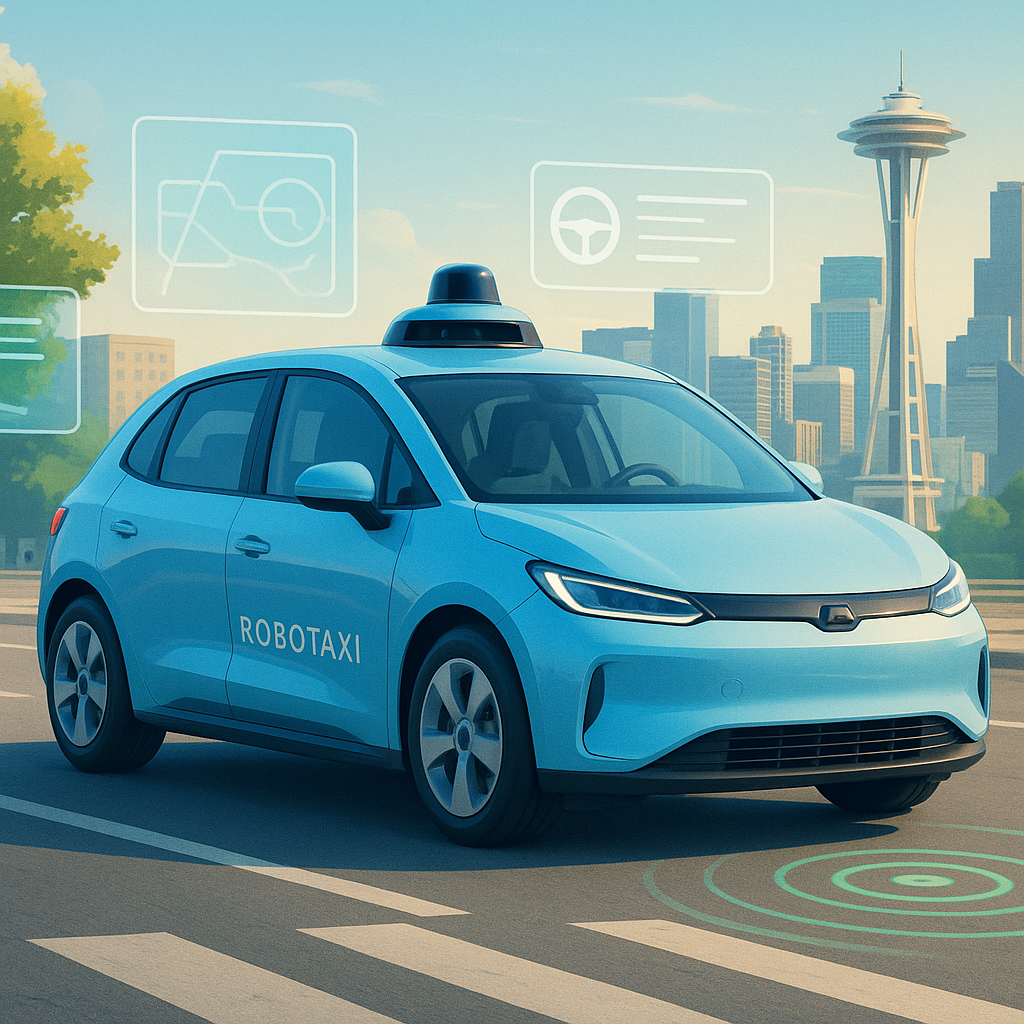
Common mistakes to avoid when judging robotaxi news
People make the same mistakes every time a test vehicle appears. The pattern is exhausting.
- Confusing a prototype with a product: A spotted vehicle is not proof of commercial readiness. Prototype miles and passenger service are different universes.
- Believing marketing videos: Clean clips are curated. They omit disengagements, edge cases, and the ugly hours when engineers earn their coffee.
- Ignoring weather and region: A system that works in dry sun may fail in rain, fog, or dense urban clutter. Seattle is not some side note.
- Overrating the body shell: The boxy shape gets attention, but the shell is not the brain. The software stack and safety case matter more.
- Assuming automation is cheaper on day one: Early fleet deployment is expensive. Sensors, compute, safety staffing, mapping, and maintenance add up quickly.
- Treating regulation as decoration: Permits, reporting, and oversight are not bureaucratic ornaments. They are part of the operating system of public trust.
- Forgetting the rider: A robotaxi can be technically clever and still miserable to use if pickup logic, support, or trip clarity is poor.
Here’s what nobody tells you. A lot of autonomy hype comes from people who have never cleaned a fleet vehicle, handled a support call, or watched a system fail in drizzle at 6:30 p.m. Reality is less glamorous and far more useful.
When I assess this sector, I ask a stubborn question: does the machine reduce friction without creating new hidden costs? That is the real test. Efficiency that shifts the burden onto riders, workers, or the public is not progress. It is bookkeeping dressed as innovation.
For more context, read robotaxi economics, AV incidents and reporting, and vehicle safety checklist.
Frequently asked questions
What does the Ojai robotaxi sighting mean?
It likely means the company behind the vehicle is expanding real-world testing in Seattle, using the city to stress-test autonomy, fleet operations, and safety systems under difficult conditions.
Why is Seattle a big deal for robotaxi testing?
Because the weather and street conditions are rougher than in many test markets. Rain, glare, narrow roads, and traffic complexity force the system to prove itself instead of coasting on ideal conditions.
Is a robotaxi test fleet the same as a public service?
No. A test fleet usually collects data and validates safety and operations. Public service requires broader reliability, legal approval, customer support, and a stronger safety case.
What matters most in a robotaxi system?
The software stack, sensor fusion, redundancy, and fleet operations matter more than the vehicle’s shape or branding. The shell is just the shell.
Final thought
A baby blue prototype turns heads, sure. But novelty is cheap, and competence is expensive. The real measure of a robotaxi fleet is not how futuristic it looks when parked on a Seattle street; it is whether the system can carry people safely, predictably, and without making the public eat the risk while a company chases scale.
That is why I take sightings like Ojai seriously, but not sentimentally. They are clues, not proof. They show movement, not victory. If the fleet learns from the city, respects human dignity, and treats safety as more than a slogan, it can earn its place. If not, it is just a clever machine wandering through a very old moral question: can our tools serve the common good without forgetting the people who must live with them?