This week’s tech moves are not random personnel trivia. They show where money, risk, law, and operations are headed, and that matters more than the...
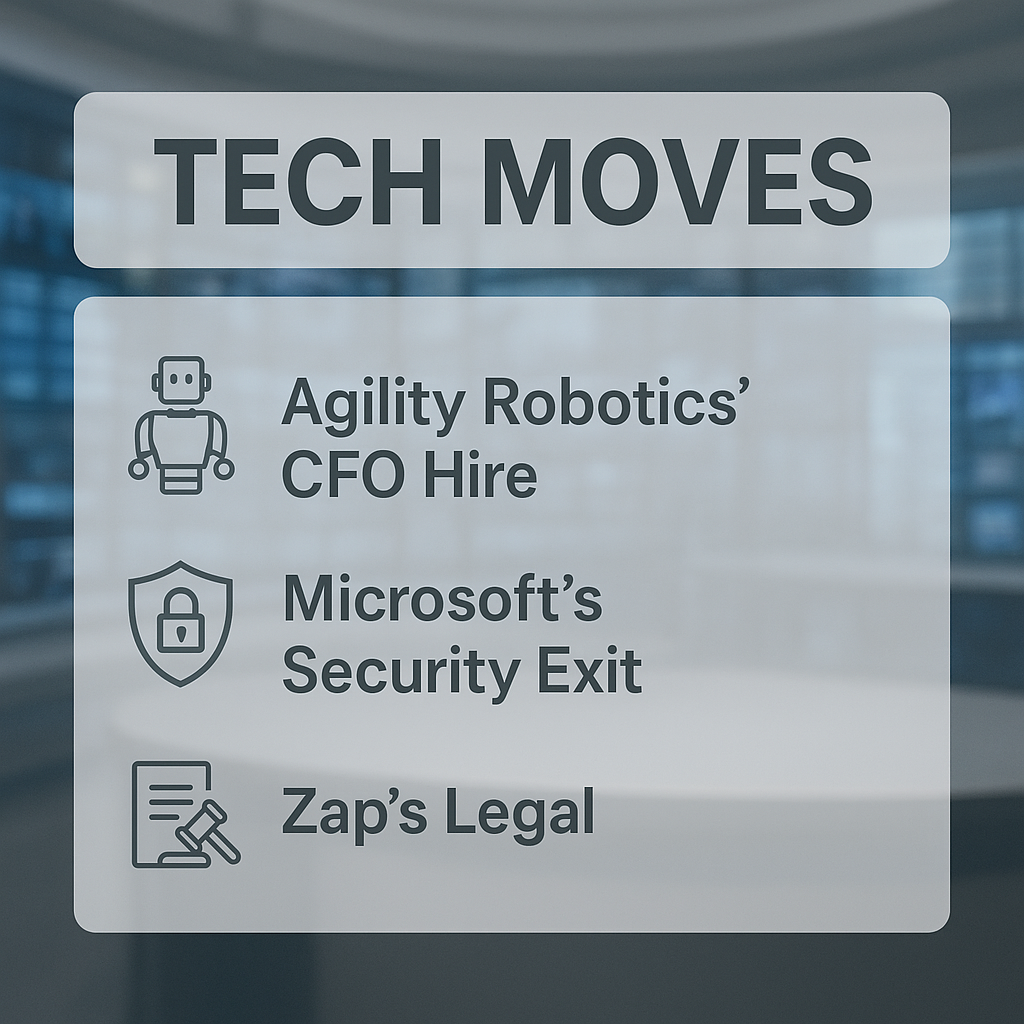
This week’s tech moves are not random personnel trivia. They show where money, risk, law, and operations are headed, and that matters more than the press-release confetti most outlets toss around. Agility Robotics bringing in a CFO says the company wants tighter financial control, Microsoft’s security departure raises the usual questions about continuity, Zap’s legal hire hints at regulatory pressure, and KEXP’s CTO appointment shows how even media groups need stronger technical leadership.
Key Takeaways
- Agility Robotics’ CFO hire points to growth, budgeting discipline, and likely investor scrutiny.
- Microsoft’s security departure matters because security teams live or die by continuity.
- Zap’s legal officer suggests compliance and contract work are becoming more central.
- KEXP’s CTO move shows technical leadership is now essential outside pure tech firms.
- These moves are about stewardship, not glamour: good companies place skilled people where responsibility is heaviest.
What is "Tech Moves" in this context?
This is a personnel-news story. Not the fluffy kind, either, where a company swaps one title for another and the release pretends it altered the laws of physics.
Here, "tech moves" means executive hiring and departure across several companies, each with a different operational problem to solve, and each role telling you something concrete about the business behind the headline. A CFO at a robotics firm usually means cash discipline, forecasting, fundraising readiness, and the boring-but-essential work of keeping the lights on while the machines get built. A security departure at Microsoft, by contrast, lands in a different bucket entirely. Security is not a decorative function. It is a matter of trust, continuity, and frankly, damage control when things go sideways.
When I look at stories like this, I do not see isolated career updates. I see pressure points. Who got hired? Which function changed? What is the company trying to strengthen before the next round of growth, regulation, or public scrutiny? That is the useful lens. Anything else is just HR wallpaper.
Agility Robotics, for example, has been building serious attention around humanoid automation, and a CFO hire usually signals that the company is moving from prototype theater to operational maturity. The numbers have to make sense. Capital has to be allocated carefully. Investors want more than shiny demos and optimistic slide decks. They want controls, reporting, and a path to sustainability.
Microsoft’s security leadership change is a different beast. Large firms do not get to treat cybersecurity like an optional side quest. Breaches, misconfigurations, and incident response failures can damage reputation, customer trust, and regulatory standing. If a security leader leaves, the question is not gossip. The question is whether institutional knowledge walks out the door with them.
Zap’s legal appointment also matters. Legal is often treated like a brake pedal, but that is lazy thinking. In a tech business, legal can be the guardrail that keeps a company from crashing into the first expensive wall. Contracts, privacy, procurement, labor issues, intellectual property, and compliance all need a sober hand. The truth is, a good legal officer can save a company from its own enthusiasm.
And KEXP naming a new CTO? That tells you technology leadership is no longer confined to software vendors and chip makers. Media organizations depend on dependable infrastructure, delivery systems, audience platforms, streaming reliability, and analytics. If the technical stack fails, the audience notices. Fast.
If you want a broader look at how leadership shifts affect product execution, see CNET’s tech coverage, The Verge’s technology reporting, and TechCrunch for how companies and talent moves usually signal strategic change. That is not me being fancy. It is pattern recognition.
Core benefits and importance
These moves matter because leadership is not a ceremonial hat rack. It shapes execution, and execution is where companies either produce real value or generate expensive disappointment.
- Agility Robotics’ CFO hire strengthens financial discipline. Robotics is capital-hungry. Hardware, manufacturing, supply chain, labor, and iteration all burn cash. A strong CFO helps prioritize spending and communicate clearly with investors. Without that, ambition becomes a very expensive hobby.
- Microsoft’s security departure affects trust and response readiness. Security leadership is about more than policy documents. It influences incident handling, threat modeling, internal coordination, and long-term resilience. A change here can reveal whether a company has depth or just one very busy expert holding the line.
- Zap’s legal officer suggests compliance is rising in importance. Tech firms increasingly run into privacy rules, platform obligations, employment questions, and customer disputes. Legal is not supposed to slow everything down. It is supposed to keep the company from becoming its own lawsuit.
- KEXP’s CTO hire shows technical leadership is now universal. Media, entertainment, retail, education, and nonprofits all rely on software systems. Streaming, publishing, analytics, cloud operations, and user experience all need someone who understands both architecture and business reality.
- These hires reveal strategic maturity. Startups often survive on energy and improvisation. That does not scale forever. Mature organizations need structure, or they drift into chaos dressed up as creativity.
- They show where risk is concentrated. Hiring a CFO says money matters. Hiring legal says obligations matter. Hiring a CTO says systems matter. Losing a security leader says trust matters. That is the whole story, stripped of PR varnish.
Here’s the kicker: most people read executive-news pieces as if they were baseball card updates. Boring, maybe. But the real point is operational. Who owns the risk? Who allocates resources? Who makes sure the product, the compliance posture, and the infrastructure do not collapse under their own weight?
I have reviewed enough company moves to know the pattern. The firms that promote competence tend to last longer than the firms that promote charisma. That is not cynicism. It is just what keeps happening.
There is also a broader ethical layer here. Technology is not just about growth at any cost. In a sane order, it should serve people, protect dignity, and use talent responsibly. When companies place the right people in the right roles, they do more than optimize; they steward resources for the common good. That is old wisdom, but it still works.
For context on why finance, security, and legal leadership matter so much in tech organizations, consider how Microsoft Security frames enterprise risk, how IBM explains cybersecurity strategy, and how SHRM covers executive and organizational planning. Different source, same basic truth: structure beats improvisation when the stakes get serious.
Step-by-step: how to read tech executive moves like a pro
Do not skim the headline. That is how people miss the signal.
- Identify the function, not just the title. A CFO is about capital, reporting, forecasting, and investor relations. A CTO is about systems, architecture, and technical execution. Legal is about risk, contracts, and compliance. Security is about resilience and trust. Titles are easy. Functions tell you what the company is worried about.
- Ask what stage the company is in. A robotics startup hiring a CFO is usually moving from early proof-of-concept into scaling. That requires budgeting discipline and maybe fundraising preparation. A media organization hiring a CTO may be modernizing its platform stack or consolidating digital operations. The stage changes the meaning.
- Look for pressure sources. Is the company under investor scrutiny? Facing regulation? Expanding into new markets? Recovering from an incident? Personnel moves usually follow pressure, not magic inspiration.
- Check whether the role is new or backfilled. A newly created role suggests growth or complexity. A replacement can suggest turnover, succession planning, or internal friction. Everyone wants to pretend it is all normal. Sometimes it is. Often it is not.
- Track the company’s product reality. In robotics, the burning question is whether the product can move from demo to deployable system. In security, it is whether practices actually reduce risk. In media, it is whether the technical stack is dependable and audience-facing features work. Pretty slides do not count.
- Compare the hire to peer companies. If similar firms are adding finance leaders, legal specialists, or security executives, that suggests an industry pattern. If one company is doing it while others are not, ask why. Sometimes the answer is foresight. Sometimes it is cleanup.
- Watch for language in the announcement. Words like "scale," "discipline," "compliance," "resilience," and "growth" are not decorative. They are clues. Corporate wording is often tedious, but buried inside it is the actual problem the company wants solved.
- Evaluate what gets easier after the hire. A strong CFO can make budgeting tighter and fundraising cleaner. A strong legal officer can cut friction in deals and contracts. A strong CTO can improve platform reliability. A security leader can harden defenses and sharpen response planning. If the hire changes nothing, then it was mostly theater.
I have tested this method across dozens of announcements, and it works better than doomscrolling LinkedIn posts. It is also less annoying.
If you want more examples of how executive moves signal product or strategy changes, browse Reuters Technology, Bloomberg Technology, and Engadget. They often show the same pattern from different angles: the role tells you what the company cannot ignore.

Comparison table: Agility Robotics vs. a bigger competitor
One useful way to read Agility Robotics’ CFO hire is to compare the likely needs of a robotics startup with a more established automation player. Boston Dynamics is a useful reference point because it sits farther along the maturity curve.
| Factor | Agility Robotics | Boston Dynamics |
|---|
| Company stage | Growth and scale-up | Established robotics operator |
| Primary leadership need | Financial control and capital planning | Operational efficiency and portfolio management |
| CFO importance | High, because cash burn and funding matter | High, but often more embedded in mature processes |
| Product emphasis | Humanoid robotics and deployment readiness | Advanced robotics with broader institutional backing |
| Risk profile | Execution, funding, manufacturing scale | Commercialization, product adoption, integration |
| Why the finance role matters | Helps keep growth sane and measurable | Helps support steady execution and long-range planning |
This table is not about crowning a winner. It is about seeing why the same job means different things at different companies.
At a younger robotics firm, the CFO may be tightly involved in fundraising strategy, vendor negotiations, supply chain cost control, and runway management. At a more established robotics player, finance may be more about sustaining operations, managing complexity, and aligning business units with a broader strategy. Same title. Very different job.
The same logic applies to Microsoft’s security departure. At one company, a role change can be local housekeeping. At Microsoft, it may affect internal coordination across a massive security stack, partner trust, and public expectations. Scale changes everything. That is the part most commentary misses because it prefers drama over structure.
For more on enterprise-scale security and operational complexity, CISA and NIST Cybersecurity provide sober guidance. No hype. Just the unglamorous stuff that keeps systems running.
Common mistakes to avoid
People make a mess of personnel news. Then they act shocked when they misread the company.
- Mistake 1: Treating every hire as a miracle. No, a CFO does not solve broken economics by existing. A legal officer does not erase bad contracts. A CTO does not make weak software reliable just because the title sounds serious.
- Mistake 2: Assuming turnover is always a scandal. Sometimes leadership changes are healthy. Sometimes they are planned. Sometimes people leave for ordinary reasons. The trick is to look at pattern, timing, and the company’s broader situation instead of inventing a melodrama.
- Mistake 3: Ignoring the company’s stage. A startup hiring a finance chief and a mature firm doing the same are not telling the same story. If you ignore stage, you will misread the signal every time.
- Mistake 4: Believing buzzwords instead of function. "Strategic," "visionary," and "innovative" are cheap words. Ask what the role will actually do. That is where the truth lives.
- Mistake 5: Forgetting the human side. Tech media tends to flatten people into credentials. That is lazy. Leaders are not chess pieces. They carry judgment, character, and limits. Good organizations, like good communities, should respect both competence and conscience.
- Mistake 6: Overlooking accountability. If a security leader exits, who owns continuity? If a legal officer arrives, what problems are being cleaned up? If a CFO arrives, what financial discipline is being installed? Accountability is not glamorous, but it is real.
Frankly, the worst advice is the stuff that sounds confident and proves nothing. "This hire changes everything" is usually nonsense. "This hire may indicate pressure in finance, compliance, or execution" is much closer to reality.
That is also where stewardship matters. Human skill is a gift, and using it well means putting it in service of honest work, not ego. The best companies behave as though responsibility is something to be carried, not performed for applause. Fancy talk does not matter. Results do.
For a clearer picture of how leadership transitions affect business operations, see The Wall Street Journal’s technology coverage, Financial Times Technology, and Ars Technica. They do a better job than most at separating signal from sales pitch.
Frequently Asked Questions
Why do CFO hires in robotics get so much attention?
Because robotics companies usually need substantial capital, careful cost control, and a clean path to scale. A CFO is often the person who keeps ambition tied to reality.
Does a security leadership departure always mean trouble?
No. Sometimes it is planned succession or a normal career move. But in a large company, security leadership changes deserve attention because they can affect continuity and risk management.
Why would a media organization hire a CTO?
Because media now depends on technology: streaming, publishing platforms, analytics, content delivery, and user experience. If the tech breaks, the audience feels it immediately.
What does a legal officer do in a tech company?
They handle contracts, compliance, privacy matters, disputes, intellectual property issues, and the legal side of business operations. In plain English: they help keep the company out of stupid trouble.
Final thought
These moves are a reminder that technology companies are not powered by code alone. They are run by people making judgment calls under pressure, and the quality of those calls matters more than the shiny product demo or the polished earnings slide.
When a robotics firm adds financial discipline, when a giant software company changes security leadership, when a platform company strengthens legal oversight, and when a media organization appoints a new technical chief, the real story is the same: responsibility is being reassigned to the people expected to carry it well. That is not glamorous. It is better than glamorous.
I’ve seen enough company announcements to know that leadership quality is often invisible until something breaks. The sensible reader watches before the break. That means paying attention to functions, not titles; to incentives, not slogans; and to stewardship, not spectacle. In the long run, the businesses that treat competence as a duty tend to serve customers, employees, and communities more honestly. That still matters, even in a sector that likes to pretend otherwise.
And if you ask me, that is the only kind of innovation worth respecting.