Tesla Is Ending Cybertruck Production: What the Cybercab Shift Means
Tesla plans to stop producing the Cybertruck next year and redirect the factory space to two-seat Cybercab robotaxis, CEO Elon Musk said on X. The move marks a sharp retreat from a pickup once forecast to sell 250,000 units annually—and a more concrete bet on Tesla’s AI and robotics ambitions.
What Is Tesla’s Cybertruck Production Shift?
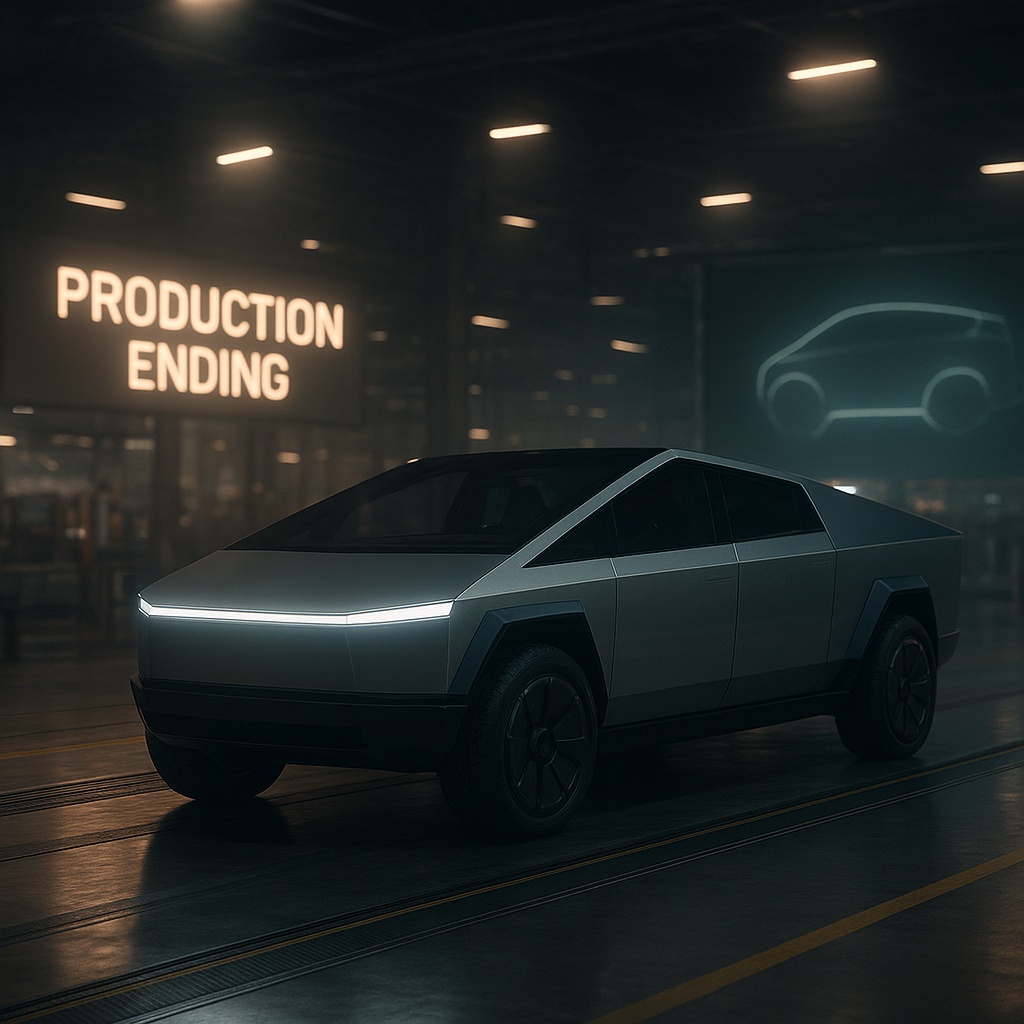
The Cybertruck production shift is Tesla’s reported plan to stop building its stainless-steel electric pickup next year and use the factory space for Cybercabs, the company’s two-seat robotaxis. It is more than a product discontinuation. It is a decision about which products Tesla believes deserve limited factory capacity as it tries to recast itself as an AI and robotics company.
The Cybertruck was announced in 2019 as a radical electric pickup, with a hard-edged design that Musk associated with cyberpunk science fiction and Blade Runner. Tesla’s early pitch was just as bold: a starting price below $40,000 and a range of up to 500 miles. Neither figure survived the trip to production. The truck was delayed for about two years, partly because of the COVID-19 pandemic, and reached customers in late 2023 with a base price of around $60,000 and a top-end range more than 100 miles below the original claim.
That gap matters. A concept can attract attention with striking lines and ambitious numbers, but buyers eventually judge a vehicle by its price, range, utility, quality, and ability to fit daily life. I would separate the Cybertruck’s visual novelty from its commercial performance: it was certainly distinctive, but the provided sales figures—tens of thousands in total over three years—are nowhere near the annual volume Musk once predicted. Tesla’s Cybertruck page offers the company’s current product presentation; it should not be mistaken for evidence that the original targets were met.
The factory decision also follows earlier changes. Tesla decided this year to end production of the Model S sedan and Model X SUV and devote their factory space to Optimus, its humanoid robot program. That makes the Cybertruck the third product line identified in this shift toward robotics and AI. The pattern is plain: Tesla is willing to give up vehicle production capacity to make room for products it believes could define its next phase.
But a factory change does not settle the business case. It says where Tesla wants to place its bets, not whether those bets will pay off. The Cybercab has spent two months on Austin streets, and Tesla has said it plans to expand operations to other cities, starting with Dallas later this month. That rollout is still evidence of an operating program—not proof of a mature, profitable service. The difference is important, especially when a production line is being reassigned.
Core Benefits and Importance of the Shift
There are sensible reasons for Tesla to reconsider Cybertruck production. A factory is a finite resource: floor space, equipment, workers, and management attention cannot be allocated to every product indefinitely. If the pickup is selling well below the company’s earlier ambition, and Tesla has another use for the space, a production change may be more rational than defending a forecast simply because it was once made.
The shift may also reduce the opportunity cost of keeping a low-volume vehicle in production. A product’s value is not only its sticker price or sales count; it also depends on how much factory capacity it uses and what that capacity could produce instead. The source information does not report the Cybertruck’s production cost, profit margin, or the Cybercab line’s expected output, so no responsible analysis can claim the factory move will improve Tesla’s finances. Still, it is fair to say that Tesla is choosing a different use for the space.
There is a strategic logic, too. Tesla has said it wants to focus more heavily on AI and robotics. Cybercabs sit directly in that story: a two-seat vehicle built for robotaxi operations rather than conventional private ownership. The company already operates robotaxi versions of Model Y SUVs in Austin, Houston, Dallas, and three cities in Florida, while its Cybercab activity has been underway in Austin. Tesla’s Robotaxi page is useful for understanding how the company presents that program, though the real test remains the service customers can actually use.
Here’s the kicker: a compelling strategy still needs execution. Tesla says there have been no major incidents to date during the Cybercab operation in Austin, but that statement should not be stretched into a broad safety conclusion. The length and scale of the reported operation are limited. Wider city coverage, dependable service, and a clear record over time would tell consumers and regulators much more than a launch announcement can.
The product shift also makes Tesla’s priorities easier to read. The company is not merely adding a robotaxi; it is moving capacity away from vehicles that have been part of its identity for years. Replacing the Model S and Model X with Optimus production space, then making room for Cybercabs instead of Cybertrucks, signals a serious bet on nontraditional products. The question is whether those products can serve people reliably, not whether they sound futuristic.
There is a human measure worth keeping in view. Technology and manufacturing are forms of human ingenuity, but they are best judged by whether they serve people well. Responsible stewardship means using money, materials, and workers’ skills with care—and protecting human dignity as automation expands. A robotaxi that offers safe, dependable transportation could be useful. A robotaxi program that is mainly a promise would not justify the same confidence.
How to Evaluate Tesla’s Cybertruck-to-Cybercab Shift
The useful way to assess this move is to separate what Tesla has announced from what remains unreported. I would use the following checks rather than treating a confident executive statement as a finished business case.
- Pin down the production claim. Musk said on X that Tesla would stop making the Cybertruck next year and use the factory space for more Cybercabs. That establishes the stated plan. It does not, by itself, establish the exact final production date, how quickly the factory will be changed, or whether all Cybertruck production will cease at once. Unless Tesla reports those details, they remain unknown.
- Compare the original promise with the delivered product. The initial targets were a price under $40,000 and range up to 500 miles. The pickup arrived in late 2023 at a base price around $60,000, with the highest-end range more than 100 miles below the original figure. The delay was about two years and partly linked to the pandemic. Those are the reported points of comparison; avoid filling gaps with invented precision.
- Treat sales as a signal, not a full financial statement. Tesla’s reported total is tens of thousands over the last three years, compared with Musk’s prediction of around 250,000 per year. That contrast shows a large miss against the public ambition. It does not tell us the truck’s gross margin, order cancellations, inventory, service costs, or how much output the factory can shift to another product. I would not infer those numbers from unit sales alone.
- Watch whether Cybercab service expands as stated. Tesla has operated Cybercabs in Austin for two months and says it plans to start in Dallas later this month. The company also runs Model Y robotaxi versions in Austin, Houston, Dallas, and three Florida cities. Expansion is a concrete milestone, but the important questions are whether the service remains available, how dependable it is, and what level of human oversight it requires. Those details are not reported here.
- Look for evidence of actual production and use. A factory repurposing plan is not the same as a completed line conversion. Likewise, a robotaxi operating in a city is not proof of large-scale demand or profitability. Watch for reported production numbers, operating coverage, customer use, and safety information. Tesla’s official AI information describes the company’s stated focus, while its Optimus page sets out another part of that ambition. Neither page substitutes for measured results.
- Keep the alternatives visible. Tesla has already chosen to devote Model S and Model X factory space to Optimus. The Cybertruck-to-Cybercab plan extends that shift. For customers, workers, and investors, the relevant issue is not whether the new direction sounds bold. It is whether these new uses of factory space create a product or service people value, with a sustainable operating model and acceptable risks.
That checklist is not glamorous. It is useful. Most technology coverage spends more time on the promised future than on the milestones that would demonstrate progress. Here, I would judge Tesla on reported output and actual service performance, not on the spectacle of a stainless-steel truck or the appeal of a robotaxi concept.
Cybertruck vs. Cybercab: Factory Priority Comparison
Cybercab is not a direct pickup-truck competitor. It is the strategic alternative Tesla has chosen for the factory space, so the comparison is about production priorities rather than a head-to-head vehicle test. The facts below reflect the reported information; figures that were not reported are marked accordingly.
| Measure | Cybertruck | Cybercab |
|---|
| Intended role | Electric pickup for customers | Two-seat robotaxi for Tesla operations |
| Public introduction or timing | Announced in 2019; customer handovers began in late 2023 | Operating in Austin for about two months at the time of the report |
| Factory plan | Production to stop next year, according to Musk | More Cybercabs to be built using the factory space |
| Original targets or stated goals | Under $40,000 starting price and up to 500 miles of range were promised in 2019 | No unit output, price, or service revenue figure was reported |
| Reported commercial or operating signal | Tens of thousands sold in total over three years, versus a 250,000-per-year prediction | Tesla said it planned to expand to Dallas later that month; no major incidents were reported by the company to date |
| Key unknowns | Final production date, margin, and future support details were not reported | Production volume, operating economics, service scale, and wider safety record were not reported |
The table shows the difference between a product with a visible sales shortfall and a replacement program whose broader economics are not yet known. That is not a fair contest if one side is judged on sales and the other on intention. It is, however, a fair description of Tesla’s current factory choice: Cybertruck capacity is being assigned to a robotaxi program the company believes better fits its future.
The Cybertruck had a clear consumer proposition: an electric pickup with unusual styling and a claimed set of price and range targets. Its eventual price and range diverged from those early figures, and sales did not match Musk’s stated annual goal. Cybercab’s proposition is different. It is a two-seat vehicle associated with transportation as a service, and its success depends not only on vehicle design but also on safe operation, availability, customer trust, and whether the service can work outside its early footprint.
There is no reported apples-to-apples cost comparison. We do not know from the available facts how many Cybercabs the factory could produce, what changes the line needs, how much the conversion costs, or what revenue a deployed vehicle might generate. Those are not minor footnotes; they are the measurements needed to know whether this is a sound allocation of capital. Tesla’s investor relations site is the appropriate place to look for company disclosures as they become available.
For now, the safest reading is narrow. Tesla is moving factory capacity toward its robotaxi plans and away from Cybertruck production because that is the direction Musk announced. Whether the choice is commercially superior will depend on facts that have not been reported yet. A disciplined reader should leave the question open.
Common Mistakes to Avoid
Mistake 1: Calling the move proof that robotaxis have already won. Tesla’s decision shows a priority, not a finished result. Cybercabs have been on Austin streets for two months, and the company has said it plans a Dallas expansion. That is meaningful progress in the limited sense that vehicles are operating and a next step has been named. It is not a complete record of safety, demand, reliability, or financial performance. Frankly, confusing an announced plan with proven scale is how technology coverage turns into advertising.
Mistake 2: Treating Musk’s 250,000-per-year estimate as a sales target Tesla nearly reached. The reported comparison is stark: Tesla has sold tens of thousands in total over three years, while Musk once predicted about 250,000 in a single year. The annual forecast was not a modest variation on actual sales. It was a much larger ambition. At the same time, do not invent a precise shortfall by turning the broad total into a made-up annual average. The available numbers are not more exact than they are.
Mistake 3: Reducing the Cybertruck’s difficulties to its polarizing design. The styling was divisive, and the source account says it did not sit well with many buyers. But the product also missed its original price and range promises, arrived about two years late, and entered the market at a higher-than-promised base price. A buyer’s decision can involve all of those factors. Pinning the result on one visual choice is an easy story, not a complete explanation.
Mistake 4: Assuming Cybertruck production ends immediately. Musk said Tesla would stop making the truck next year. That is a future plan, not a report that production has already ceased. The exact final date, transition schedule, and treatment of existing owners were not reported in the information here. Keep the tense straight. It matters to buyers, employees, suppliers, and anyone trying to understand what happens next.
Mistake 5: Treating the company’s statement about incidents as an independent safety verdict. Tesla has said there have been no major incidents to date in Austin. That statement is worth reporting with attribution. It does not tell us how many trips occurred, what counts as a major incident, what supervision was present, or how the service performed in every circumstance. Use the company’s wording accurately and resist turning it into a broader claim than the evidence allows.
Mistake 6: Assuming factory space is interchangeable at no cost. A shift from one vehicle to another—or from vehicles to robots—may require changes to equipment, staffing, supply chains, and production processes. The available facts do not report conversion costs or schedules. It is reasonable to ask about them; it is not reasonable to pretend the answer is already known.
Frequently Asked Questions
Is Tesla stopping Cybertruck production?
According to Elon Musk’s statement on X, Tesla plans to stop making the Cybertruck next year and use the factory space to build more two-seat Cybercabs. The statement describes a future plan. The information available here does not specify the exact last production date or a detailed transition schedule, so those points should not be treated as settled.
Why is Tesla ending Cybertruck production?
The stated reason is that Tesla wants to use the factory space for more Cybercabs as the company pursues AI and robotics ambitions. The move follows Tesla’s earlier decision to end Model S and Model X production and devote that factory space to Optimus humanoid robots. The reported Cybertruck sales total—tens of thousands over three years—also falls well short of Musk’s prediction of around 250,000 per year. Tesla has not provided the production economics needed to establish every reason behind the decision.
How many Cybertrucks has Tesla sold?
The reported figure is tens of thousands in total over the last three years. No more precise cumulative total is provided here. Musk had predicted Tesla would sell around 250,000 per year, which makes the contrast between the ambition and the reported sales clear without pretending we know an exact final tally.
Where are Tesla Cybercabs operating?
The company has been operating Cybercabs on Austin streets for about two months and said it planned to expand to Dallas later that month. Tesla also operates robotaxi versions of the Model Y in Austin, Houston, and Dallas, as well as three cities in Florida. The statement that there had been no major Cybercab incidents to date came from Tesla; it is not a substitute for a broader, independently assessed safety record.
Tesla’s next proof point is not another dramatic product reveal. It is the dull, necessary work of showing that a factory can be repurposed and that a robotaxi service can operate reliably beyond a small initial footprint. A bold plan can be worth pursuing; it still has to earn trust through visible performance. That is true for a pickup, a robot, and any automated service carrying people through public streets.
Factory space is not an abstract chessboard. It represents equipment, jobs, investment, and goods or services that affect ordinary lives. A company should be free to change course when evidence suggests a product is not meeting its aims, but it should also be judged by whether the replacement serves people, uses resources responsibly, and delivers what it promises. Tesla has made its choice clear. The harder work—showing that the choice is wise—comes next.