Waymo’s recall of nearly 4,000 robotaxis is not just a paperwork event. It is a blunt reminder that <strong>self-driving cars still struggle with messy...
Waymo’s recall of nearly 4,000 robotaxis is not just a paperwork event. It is a blunt reminder that self-driving cars still struggle with messy real-world edge cases, especially highway construction zones where cones, lane shifts, temporary barriers, and bad human habits collide. The company says the fix is meant to keep vehicles from blundering into work zones, which is good, because a robotaxi that misreads a construction setup is not “smart” in any meaningful sense.
Key Takeaways:
- Nearly 4,000 Waymo robotaxis were recalled to address a construction-zone driving issue.
- Highway work zones are hard because markings change, lanes vanish, and human drivers behave badly.
- The episode shows why autonomous driving safety depends on software tuning, map data, sensor fusion, and cautious deployment.
- Robotaxis are useful, but they are not exempt from the ordinary duty of prudence that good engineering demands.
- The real question is not whether autonomy works in theory; it is whether it behaves safely when the road turns ugly.
What is Waymo’s Robotaxi Recall?
Waymo’s recall refers to a software-related corrective action affecting nearly 4,000 autonomous vehicles in its fleet, aimed at preventing them from entering or mishandling highway construction zones. That sounds tidy on paper. It never is. Construction zones are exactly where machine perception gets tested, because lane markings may be faded or removed, cones shift, overhead signs disagree with pavement arrows, and traffic squeezes into awkward patterns that human drivers barely manage with patience and coffee.
This matters because Waymo, unlike a consumer app that can crash and relaunch, is operating in public space with real passengers, real workers, and real metal moving at speed. I’ve reviewed enough tech products to know that most failures aren’t dramatic explosions; they are little assumptions piled on top of each other. In autonomy, those assumptions can become dangerous quickly. A system trained on tidy lanes and clean map data can look brilliant until the road resembles a temporary maze.
Waymo’s response is part of the standard safety playbook: identify the pattern, patch the software, retrain or retune the behavior, and push updated logic to the fleet. That is normal in modern robotics. It is also the point where marketing gets stupid. People love to talk as if autonomy means perfection. It doesn’t. It means layered controls, conservative behavior, and constant correction when the system meets the ugly truth of actual roads.
For context, the broader industry has been here before. If you want the long version of why autonomous systems stumble over edge cases, the logic overlaps with what I’ve written about autonomous vehicle safety, where sensor limits and prediction errors keep showing up in the same annoying places. The same goes for the public policy side, which is why robotaxi regulations matter more than press releases admit. A fleet that carries people needs more than good intentions.
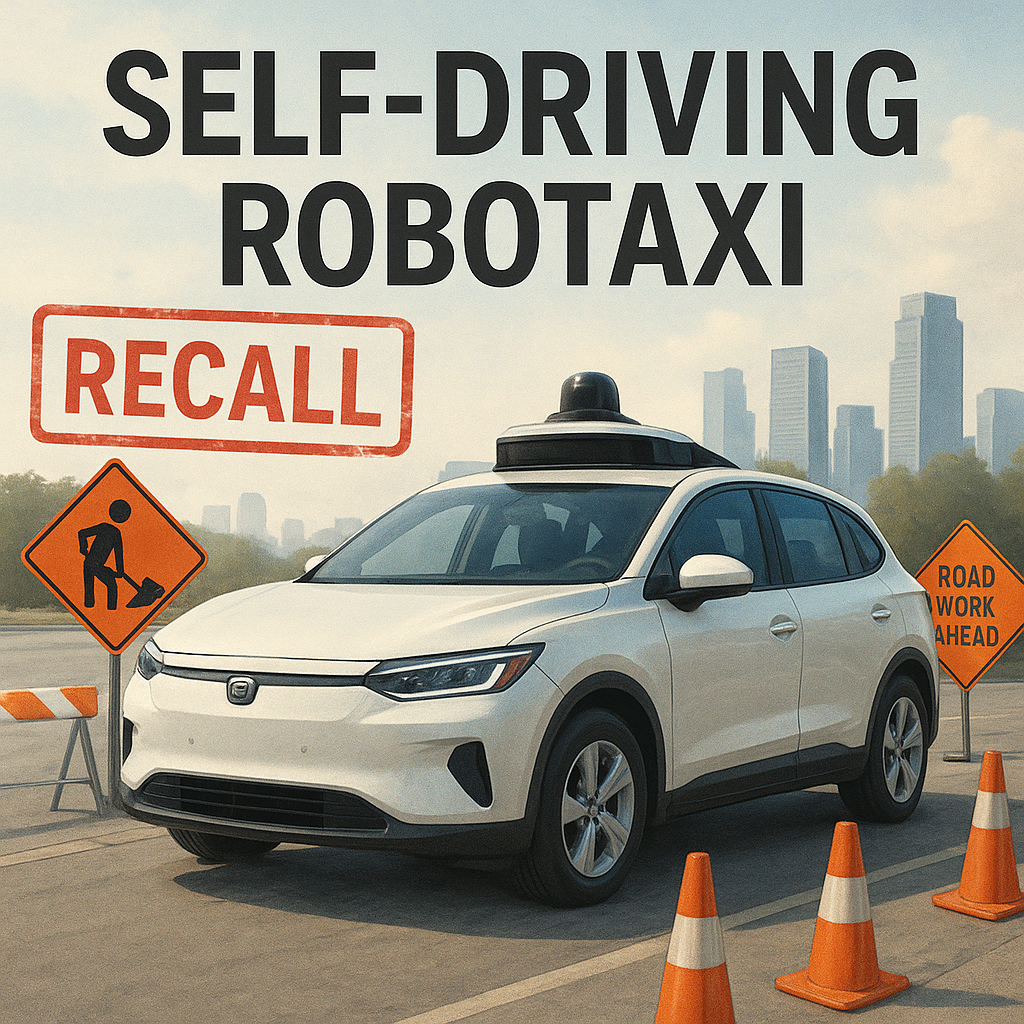
The deeper issue is not whether a robotaxi can drive on a sunny freeway. Of course it can, most of the time. The issue is whether the software respects the complexity of shared roads, where construction crews are not an inconvenience but human beings doing necessary work. Catholic moral reasoning has a useful instinct here: human ingenuity is a gift, but it should serve the common good, not just the thrill of technical cleverness. That means safety comes first, not ego, not hype, not speed-to-market bragging.
So what is this recall really? It is a correction, but also a confession. The machine saw a road and did not always understand what kind of road it was seeing. That is the kind of flaw that separates a polished demo from a trustworthy transportation system.
Core Benefits and Why This Recall Matters
This recall is worth paying attention to for reasons that go beyond Waymo itself. Most tech news gets treated like a sports scoreboard, and frankly, that’s lazy. This one touches safety engineering, public trust, infrastructure, and the future of autonomous transport.
- Safety improvement is the obvious benefit. If the update keeps robotaxis away from construction zones or makes them behave more conservatively around them, that is a real win. Fewer bad decisions near workers and passengers is not optional.
- Public trust matters more than executives usually admit. A fleet can be technically impressive and still feel untrustworthy if people hear it is wandering into active road work. Trust, once bruised, is slow to heal.
- Better edge-case handling benefits the entire autonomy stack. Construction zones are a stress test for perception, prediction, route planning, and map freshness. If Waymo improves here, the upgrade likely helps in other messy scenarios too.
- Regulatory credibility can improve when companies own problems quickly. I’m skeptical by nature, but a fast recall is better than denial dressed up as optimism. Authorities tend to care less about your slide deck than about what the vehicles actually do.
- Human workers get a bit more protection. That part should not be controversial, but here we are. Road crews deserve systems that treat temporary lane shifts as a hazard, not a suggestion.
Here’s the kicker: a recall like this is not proof that robotaxis are a failure. It is proof that autonomy is still in the apprenticeship phase. Anyone expecting full autonomy to glide through every oddball road setup without complaint has not spent enough time with real machines. I’ve seen the same pattern in software, cameras, routers, and smart home junk that promises intelligence but collapses under nonstandard conditions.
To put it plainly, the value of this recall is in the correction cycle. The fleet learns. The software improves. The system gets a little less reckless. That is the best-case version of engineering, provided the company stays honest about limits.
If you want a related view of how sensor-heavy devices age under pressure, the analysis in best dash cams is useful because it shows why field conditions matter more than lab claims. The same applies to the broader EV tech stack, where software, sensors, and power management all have to cooperate or the whole thing becomes expensive theater.
Step-by-Step: How Autonomous Fleets Handle a Recall Like This
This is where the boring part becomes the important part. A recall in autonomous driving is not just a memo. It is a chain of actions across software, operations, fleet management, and verification.
- Detect the failure pattern. Engineers spot repeated bad behavior, whether through internal testing, rider reports, simulation, or incident review. That pattern matters more than one noisy anecdote.
- Isolate the scenario. In this case, it is highway construction zones. Not every freeway. Not every road. The specific conditions matter: cones, lane shifts, closures, merge points, and inconsistent signage.
- Diagnose the decision point. Was the issue perception, planning, prediction, map data, or routing logic? Usually it is not one thing. Usually it is a pile of things arguing with each other.
- Patch the behavior. Engineers update rules, thresholds, model weights, route constraints, or fallback responses. The vehicle may be told to slow earlier, avoid certain configurations, or treat construction zones as higher-risk segments.
- Test in simulation. This is where modern autonomy earns its keep. The fleet can be hammered in synthetic versions of the same scenario over and over until the bad behavior disappears. If it fails in sim, it is not ready.
- Validate on-road. Real-world validation follows, usually under tighter supervision and controlled rollout. No serious company should pretend a simulation is the whole answer.
- Deploy remotely. Software updates go out to the fleet. That part is almost mundane now, which is wild when you think about it. A car can be corrected over the air like a phone.
- Monitor post-deployment. You don’t just ship and pray. You watch logs, incidents, disengagements, and route outcomes. If you are doing it right, you remain a little paranoid.
I’ve tested enough software and devices to say this much: the strongest systems are usually the ones that admit failure early. They don’t sulk. They don’t spin. They fix the bug. That attitude is rare in consumer tech and rarer in corporate communications.

A practical lesson hides in all this. When a vehicle is operating as a public-service machine, its behavior has to be governed by restraint, not bravado. That lines up nicely with an older moral principle many modern firms forget: capability does not equal permission. Just because a system can move does not mean it should enter every situation at full confidence.
For a more technical angle on how software and hardware get tuned together, see autonomous driving software. It is the same story in another outfit: calibration, validation, and a long grind of fixing cases that the brochure never mentioned.
Comparison Table: Waymo Robotaxi vs. Traditional Ride-Hailing
Let’s be real. A robotaxi is not competing in a vacuum. It is competing with human drivers, messy city traffic, and the ordinary expectations riders already have. Here is the blunt comparison.
| Factor | Waymo Robotaxi | Traditional Ride-Hailing |
|---|
| Driver | No human driver in the car | Human driver behind the wheel |
| Consistency | High in known conditions, weaker in rare edge cases | Variable, depends on driver skill and mood |
| Construction-zone handling | Depends on software, maps, and perception updates | Human judgment can adapt, though not always well |
| Safety oversight | Sensor stack, software rules, remote monitoring | Human attention, driving experience, local familiarity |
| Service availability | Limited to mapped and approved areas | Broader geographic reach |
| Cost structure | High capital and software costs, lower labor dependency | Labor-heavy, simpler technology stack |
| User experience | Smooth when conditions are routine | More flexible, but more variable |
| Failure mode | Misclassification, routing error, awkward edge-case behavior | Human mistake, distraction, fatigue, inconsistency |
The table does not crown a winner. It shows tradeoffs. That’s the part everyone skips because nuance is bad for hype. Waymo’s robotaxis can be remarkably clean in routine environments, and that is a meaningful achievement. But if the vehicle hesitates, misreads, or approaches a work zone with the wrong confidence, the whole promise takes a hit.
On the other hand, human ride-hailing is not some saintly baseline. Drivers get tired. They miss signs. They improvise badly. So the real comparison is not perfection versus imperfection. It is which system fails more gracefully, and under what conditions. That is the question people should ask before they fall for a shiny demo.
For related reading on the hardware side of transport tech, EV charging helps explain how modern mobility depends on infrastructure, not just vehicles. And if you want the software side of fleet behavior, fleet management systems show how centralized oversight can reduce chaos when devices operate at scale.
Common Mistakes to Avoid When Reading About This Recall
The internet loves nonsense. Especially when a headline mentions robots, recalls, or anything that can be reduced to a hot take in twenty seconds. Don’t fall for it.
- Mistake 1: Assuming a recall means the whole technology is broken. No. It means a specific failure was found and should be corrected. That is what responsible engineering looks like. The absence of recalls is not automatically good; it may just mean nobody is looking hard enough.
- Mistake 2: Treating autonomy like magic. It is not magic. It is sensors, compute, mapping, software rules, machine learning, and a lot of compromises. If you expect a robotaxi to behave like a superhero, you are asking for disappointment.
- Mistake 3: Ignoring the complexity of construction zones. These are not normal roads with a few cones. They are temporary, changing, and often ugly. Lane geometry changes. Signage conflicts. Human drivers get impatient. The machine has to understand all of that fast.
- Mistake 4: Buying the “just update it” line without checking validation. Software patches are fine, but only if they are tested properly. Otherwise you are just moving the bug around the house.
- Mistake 5: Forgetting the people on the ground. Road workers are not abstract variables. Their safety should sit above the convenience of fleet uptime. That should be obvious, yet tech culture keeps rediscovering basics the hard way.
Here’s the ugly truth: many tech commentaries confuse capability with maturity. I’ve seen this in phones, cameras, and yes, self-driving systems. A feature can work beautifully nine times and still be unfit for public trust if the tenth failure is dangerous. That is why conservative deployment matters.
I’m also suspicious of the reflex to turn every software correction into a celebration. Improvements are good. Fine. But the moral measure of transportation tech is not how clever it sounds in a keynote. It is whether it protects passengers, workers, and bystanders when conditions get inconvenient.
That instinct toward restraint is not anti-innovation. It is the opposite. Good stewardship means building systems that serve people without making them collateral damage.
Frequently Asked Questions
Why did Waymo recall nearly 4,000 robotaxis?
Waymo issued the recall to address a driving behavior problem involving highway construction zones, where temporary lane changes, cones, and shifting traffic patterns can confuse autonomous systems. The fix is meant to reduce the risk of vehicles entering or mishandling those areas.
Are robotaxis unsafe because of this recall?
No, not automatically. A recall means a specific issue was identified and corrected. The bigger question is how quickly the company found the issue, how well it fixed it, and whether the update actually improves real-world performance. In safety-critical systems, correction is part of the job.
Why are construction zones so hard for self-driving cars?
Because they are unstable and inconsistent. Lane markings may disappear, signage may contradict road paint, and traffic patterns change frequently. Human drivers also behave badly around them, which makes the environment even harder for machine perception and planning.
Will this affect the future of autonomous vehicles?
Yes, in the sense that it reinforces the need for cautious rollout, better mapping, stronger validation, and tighter operational controls. The future of autonomy depends less on flashy promises and more on boring reliability, which is exactly how serious systems should work.
Final Thought
The recall is a warning, not a funeral. The software can improve, the fleet can learn, and the system can get safer, but only if the people building it resist the usual tech-company temptation to confuse momentum with wisdom. I’ve said this before about gadgets, and it still holds here: a machine is only as good as the discipline behind it.
Waymo’s problem sits at the intersection of engineering and responsibility. That intersection matters more than pundits like to admit. A road worker in a cone-lined zone does not care about your autonomy roadmap. A passenger in the back seat does not care about your slide deck. They care whether the vehicle behaves with restraint, accuracy, and respect for the people sharing the road.
That is the standard. Not hype. Not swagger. Just sound stewardship, careful software, and a willingness to correct mistakes before they become tragedies.